
VW ID. Buzz Cargo 4Motion Review: The retro icon gets grown-up grunt
Watch the review — click here (opens YouTube in a new tab)
A week with VW’s top of the Buzz Cargo range — ID. Buzz Cargo 4Motion, reviewed by Ian Campbell
First Impressions
Third van review on the trot, and this month we’re stepping up market again. After the cheap-and-cheerful Farizon V7E and the premium-but-sluggish Mercedes eVito, I’ve spent a week with something properly special: the Volkswagen ID. Buzz Cargo Commerce Plus 4Motion. This is the flagship of the Buzz Cargo range, the all-wheel drive, 340PS version introduced last year as the top rung of the ladder, and it is a van that stands apart from everything else I’ve tested this year.
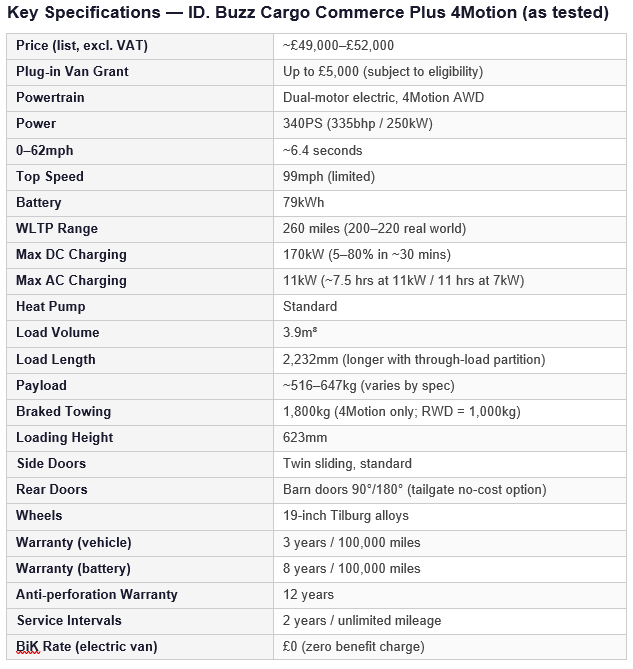
Let’s deal with the headline numbers first. 340PS (335bhp in real money). Dual-motor 4Motion all-wheel drive. 79kWh battery with an official 260-mile WLTP range. 170kW DC fast charging. 1,800kg of braked towing capacity, nearly double what rivals in this segment offer. A heat pump as standard. And a cabin that genuinely feels a step up when you climb into it at the start of the day. On paper this reads as a van that’s been built for a very particular kind of fleet operator — the one who wants their drivers in something properly good.
In practice, after a week behind the wheel, I came away genuinely impressed. The eye-catching retro exterior starts conversations in car parks, the driving experience is in a different class to the mainstream medium-van competition, the equipment list is generous, and the ride quality is properly refined. But; and there always is a but with the ID. Buzz Cargo, the sticker price is a proper swallow, and the practical load credentials are modest for the segment. Fleet verdict is nuanced. Let’s get into it.
Standout Design and Cabin Vibe
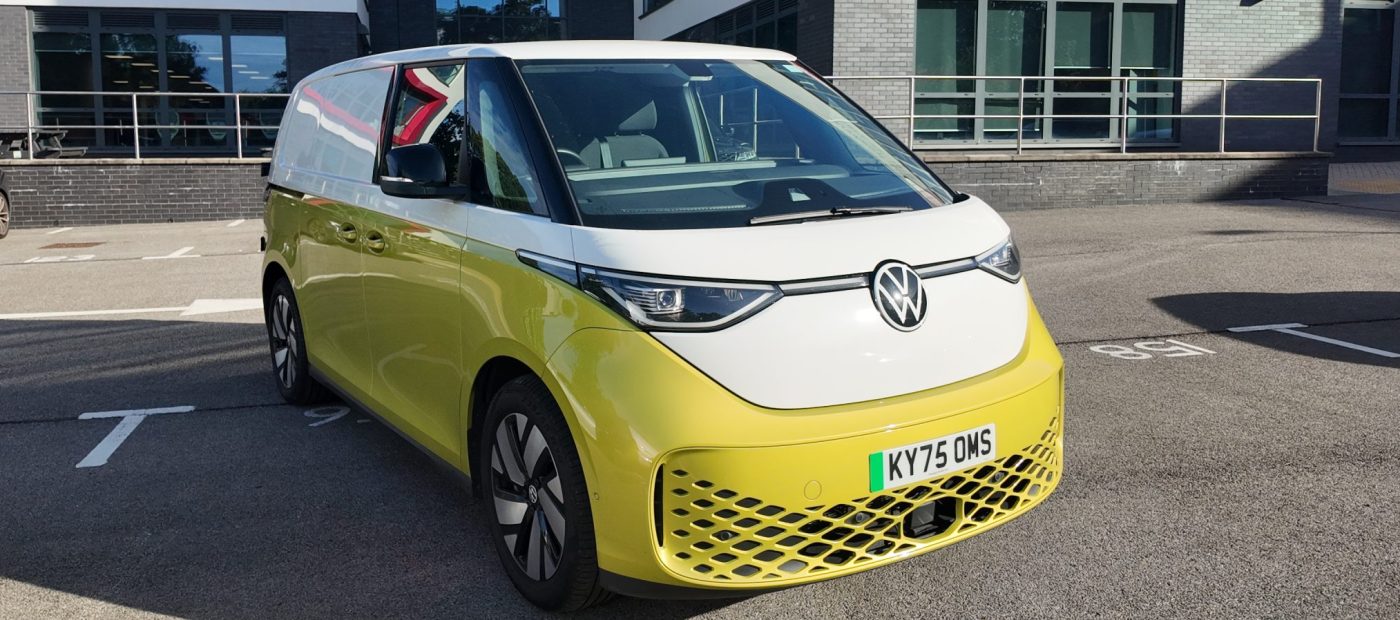
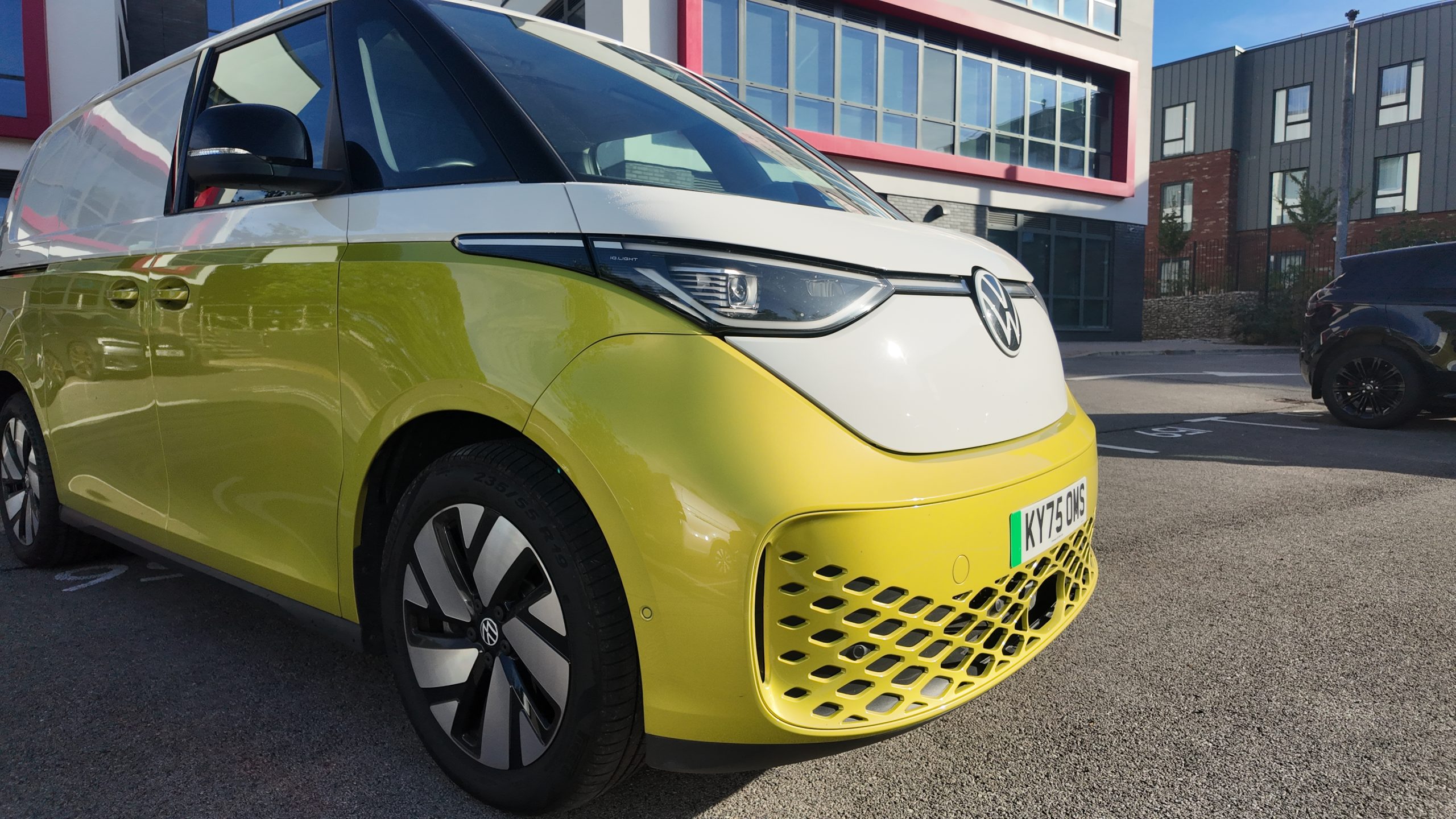
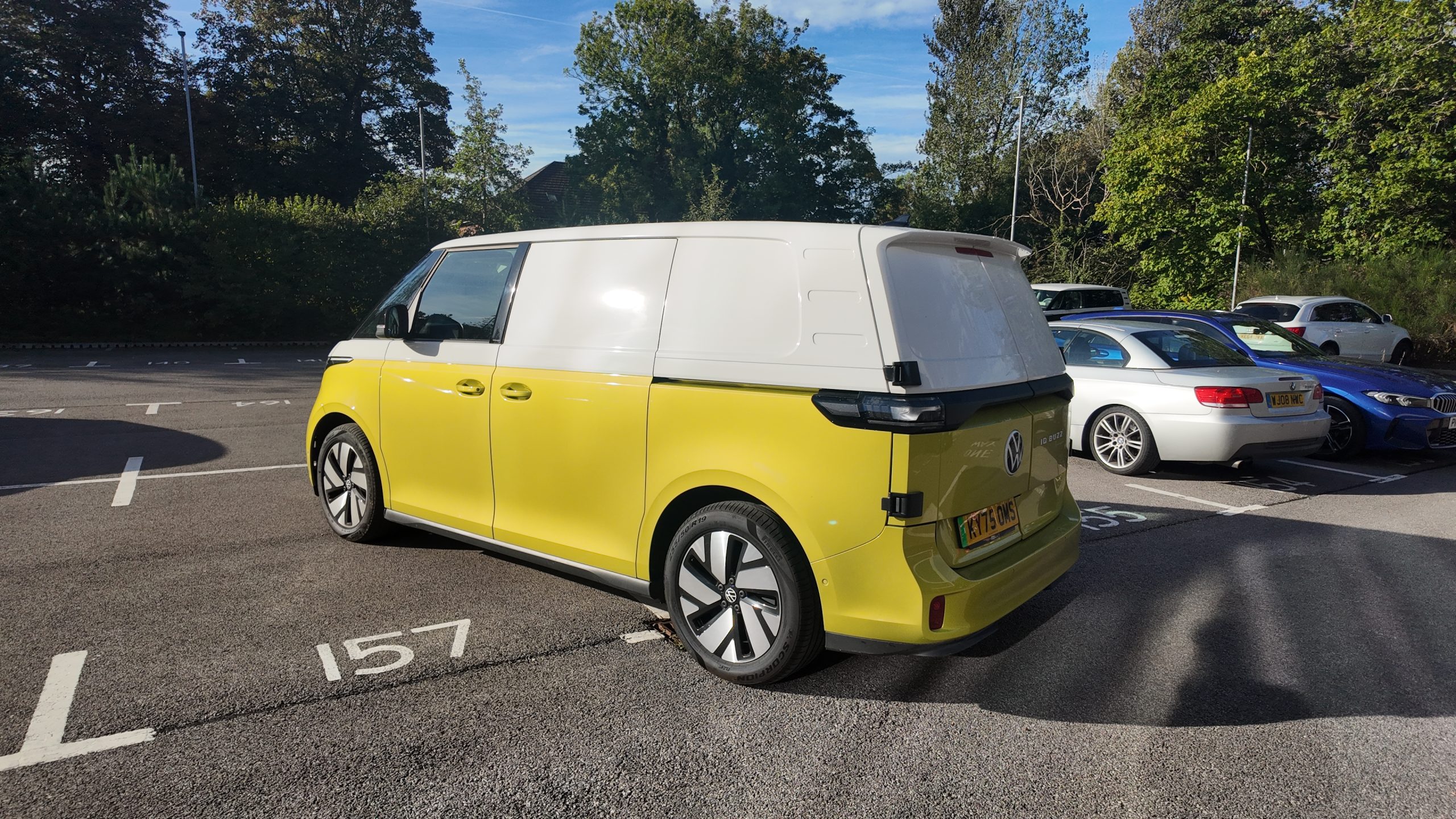
I’ll start where every ID. Buzz Cargo review has to start: the looks. This is a van that genuinely stands out on the road, and after a week of driving around Lancashire, I’d had three unprompted conversations with members of the public asking what it was. The retro-styled front end that nods to the original VW Transporter, the two-tone paint options, the generally friendly stance — nothing else in the medium van segment comes close for pure road presence. For a fleet operator who wants their vehicle to be a mobile advertisement; branded service businesses, premium trades, event teams, high-end hospitality, the ID. Buzz Cargo arrives at the customer’s drive with a message of ‘this is a proper business’ that no Transit Custom or Vivaro Electric will match.
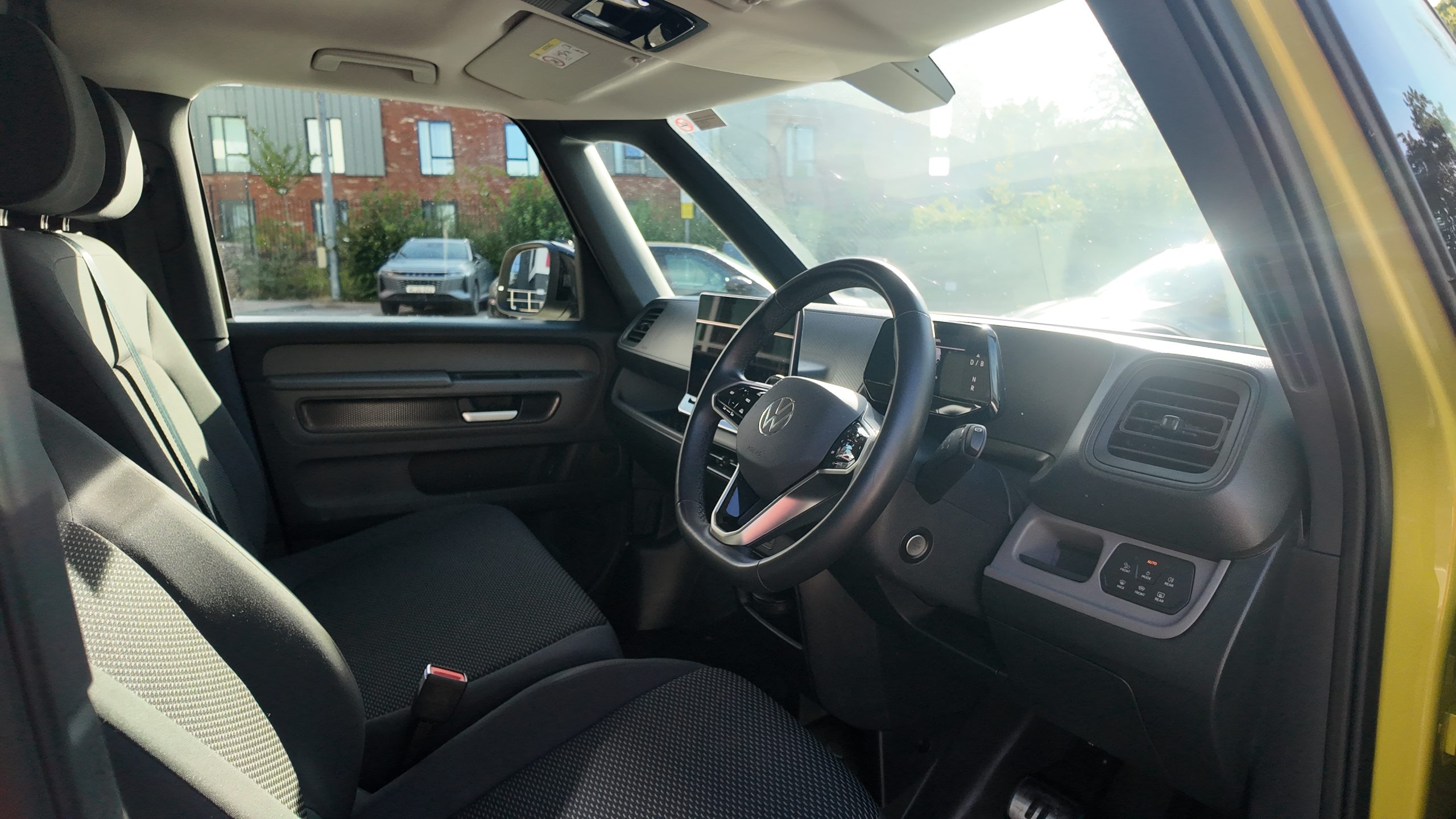
Climb inside and the cabin vibe matches the exterior. It genuinely feels like an upscale step up at the start of your day, not luxury in a Mercedes sense, but modern, airy, well-finished and comfortable. The commanding driving position is one of the best I’ve experienced in a van all year, head room is generous, the heated driver’s seat is properly comfortable and the heated steering wheel on cold mornings is one of those features that becomes essential within a couple of days of ownership.
Materials are good quality rather than opulent, lots of flat grey plastic rather than the colourful jazziness of the passenger ID. Buzz, but everything feels built to a proper standard. VW’s build quality shines through. Nothing creaks, nothing rattles, everything feels like it will still be there in five years. There’s a huge amount of thoughtful storage too; big open shelves across the top of the dashboard, deep door bins, a cavernous glovebox with a separate compartment above, and multiple cup holders including one for the middle passenger.
Driver Comfort and Low Fatigue
This is where the Buzz Cargo properly earns its keep for fleet operators who care about driver welfare. After a full day behind the wheel I was noticeably less fatigued than I would be after an equivalent day in a diesel medium van. Several things combine to deliver this:
The high driving position gives you a lorry-driver’s commanding view of the road ahead; you can see over hedges, over car roofs, well down the road. On a long motorway stint that reduces the cognitive load of driving measurably. The seat itself is well-shaped and well-adjusted, with heated cushioning that’s welcome on cold mornings. The heated windscreen means the van is ready to drive within a minute of starting up on frosty days, no scraping, no waiting. And the cabin is quite genuinely quiet. There’s minimal wind noise even at motorway speeds, almost no road noise over most surfaces, and of course the electric drivetrain itself is near-silent. VW’s build quality means nothing squeaks or rattles to disturb the serenity.
For a fleet where drivers spend eight hours a day in the vehicle, mobile engineers, service teams, long-distance couriers, that lower fatigue is a genuine welfare and productivity benefit. It’s hard to put a precise number on, but it matters.
Powertrain and Performance
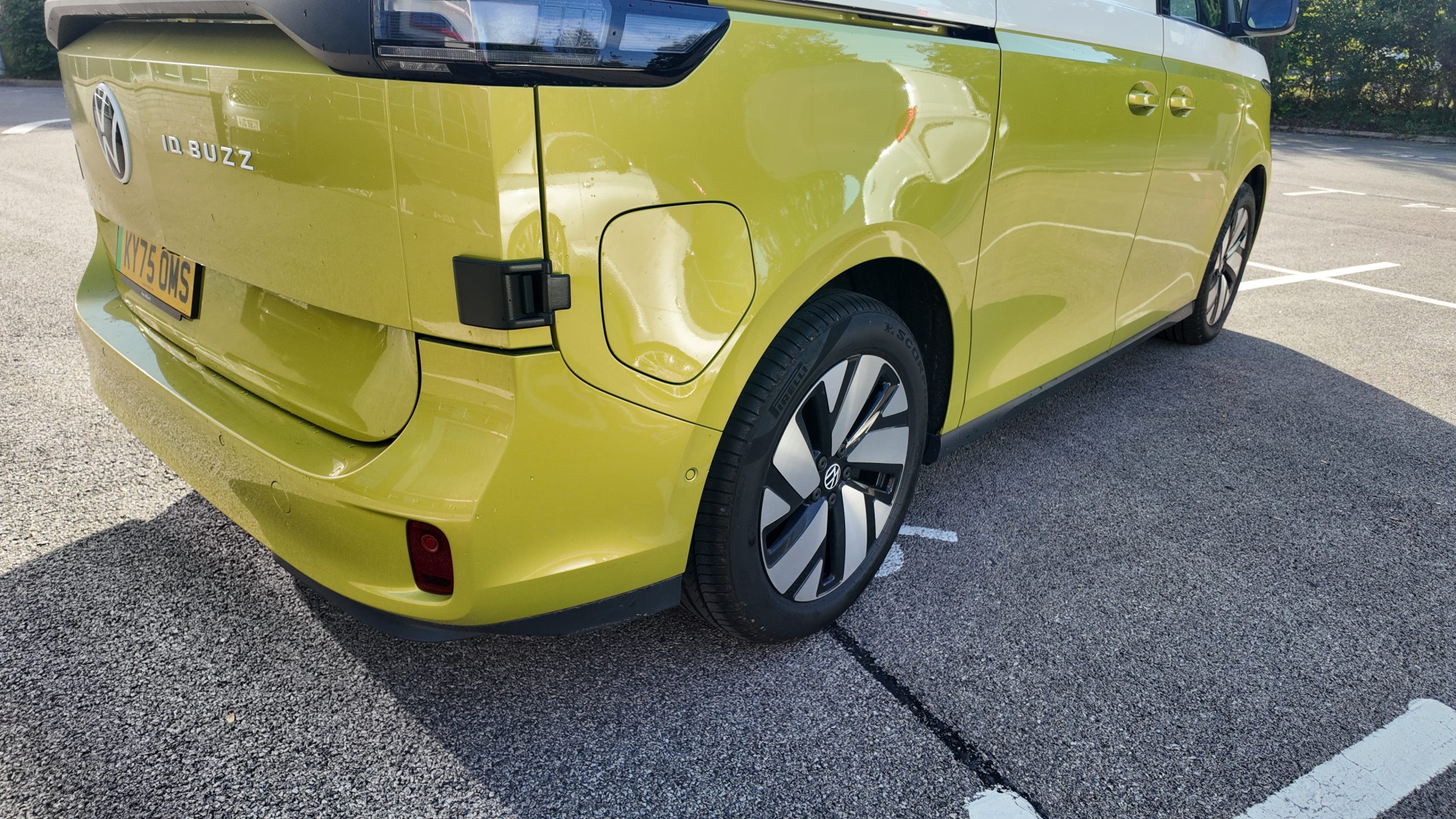
This is where the 4Motion variant separates itself from the rest of the range offering 340PS, 335bhp and driving all four wheels through a dual-motor setup. 0–62mph in a claimed 6.4 seconds, which is genuinely quick for any vehicle, let alone a van. Instant response from rest means pulling out of junctions is effortless, acceleration up to motorway speed is strong and continuous rather than tailing off as in most electric vans, and overtakes can be dispatched with confidence. This is the first electric van I’ve tested this year where I never once felt I was waiting for the thing to catch up to the gap I was planning to fill.
On the motorway it cruises beautifully. Smooth, quiet, utterly unflappable at legal speeds. The steering is light but accurate, giving the van a much more car-like feel than most competitors, I kept forgetting I was in a van. Town driving is similarly effortless; the light steering, tight 11.1m turning circle, instant torque off the mark and advanced Park Assist Plus system make navigating tight urban spaces properly straightforward. For a vehicle of this size, it’s a remarkably easy drive.
Ride quality is where you really notice the Volkswagen engineering. Even on the 19-inch Tilburg alloys of the Commerce Plus trim, which I’d normally expect to make the ride choppy over broken urban tarmac, the Buzz Cargo handled every bump I threw at it with proper refinement. The low centre of gravity (the battery sits in the floor) means almost no body roll in corners, the suspension is well-damped and controlled, and the whole vehicle feels planted and composed in a way most vans frankly don’t.
Infotainment and Equipment
The 12.9-inch Discover Pro central touchscreen on the Commerce Plus trim is amongst the sharpest infotainment systems in any van I’ve tested. The graphics are crisp, response times are quick, wireless Apple CarPlay connects reliably every single time, and the layout mostly makes sense once you’ve customised the home-screen shortcuts. USB-C ports are distributed generously throughout the cabin and proper thought has gone into where you’ll actually want to plug something in, including a smartphone tray with two USBs to the left of the steering wheel.
Equipment levels on the Commerce Plus 4Motion are properly generous for a van. Adaptive cruise control with stop-and-go functionality (brilliant in motorway traffic), Travel Assist for semi-autonomous highway driving, Side Assist for blind-spot monitoring, front and rear parking sensors as standard, a rear-view camera, keyless entry, an alarm, and the heat pump that keeps the van efficient in cold weather. The IQ.Light intelligent headlights fitted to my test van automatically adjust the beam pattern for city, country or motorway conditions and work beautifully.
Honest frustration time though: like several VW products, climate control is managed through touch-sensitive sliders below the main screen rather than physical knobs. They work, but they’re fiddly on the move, and you can’t find them by feel the way you can with a proper dial. For a working vehicle, physical climate controls would be the right call. Not a deal-breaker, but a persistent niggle.
Load Space and Payload
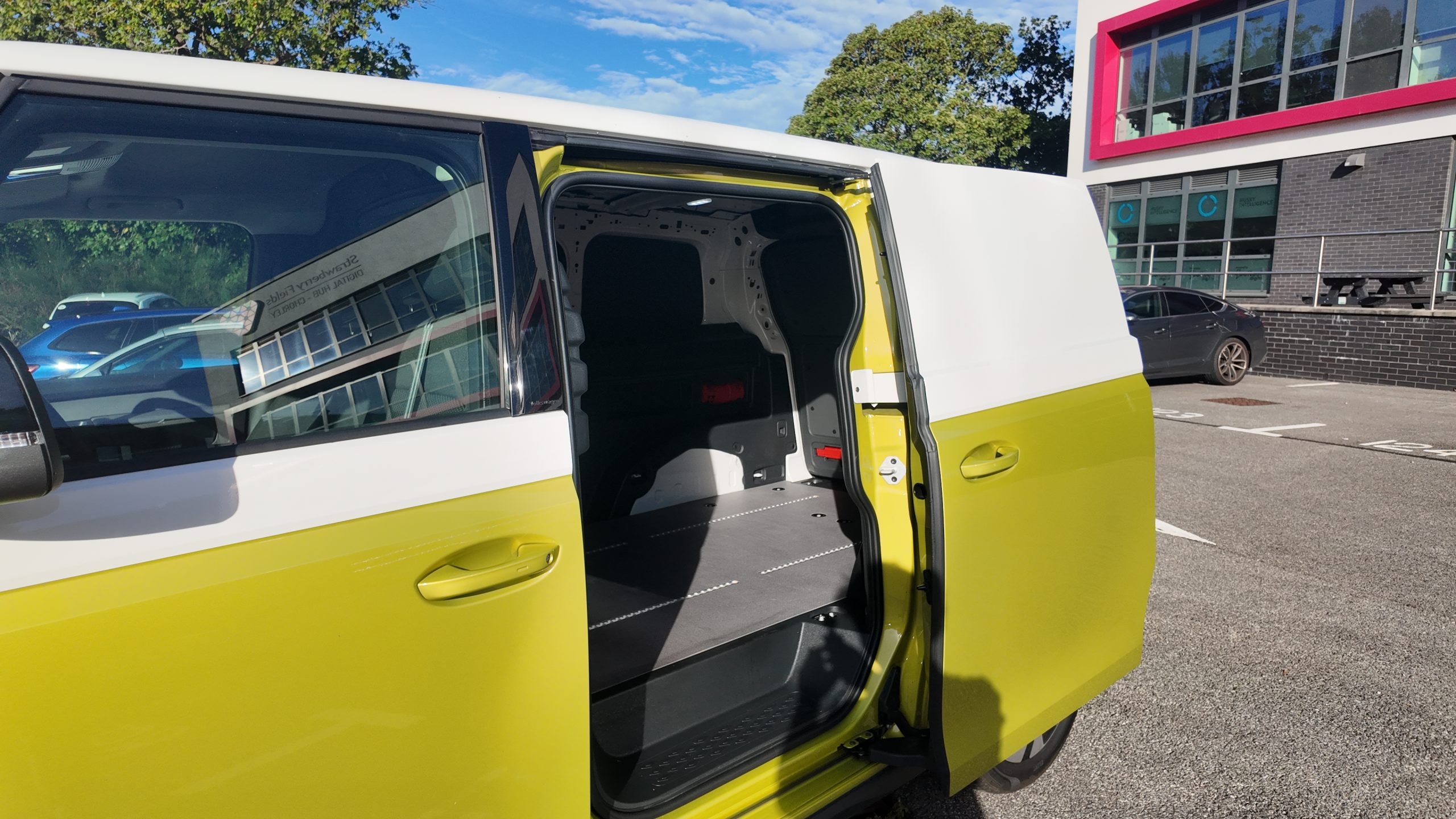
Access to the load bay is excellent. Twin sliding side doors come as standard, one on each side, and both open wide enough for proper kerbside loading from either side. The rear is handled by a pair of barn doors that swing through 90 degrees as standard and can be pushed to 180 degrees via little yellow release levers. No windows in the rear doors on this spec, which is exactly what commercial users want. A conventional powered tailgate is a no-cost swap if that suits your operation better.
Load bay specification on the Commerce Plus is properly thoughtful. The through-load partition means long items can slide under the bulkhead into the cabin footwell, extending the usable length of what you can carry. The universal floor incorporates C-rails for genuinely versatile load securing, hardboard side panels run all the way up to the roof for proper protection, there’s a wooden floor insert for durability, and the LED load-area lighting makes rummaging for the right tool at the end of a dark winter afternoon much easier. VW have genuinely thought about what a working driver needs in the load area.
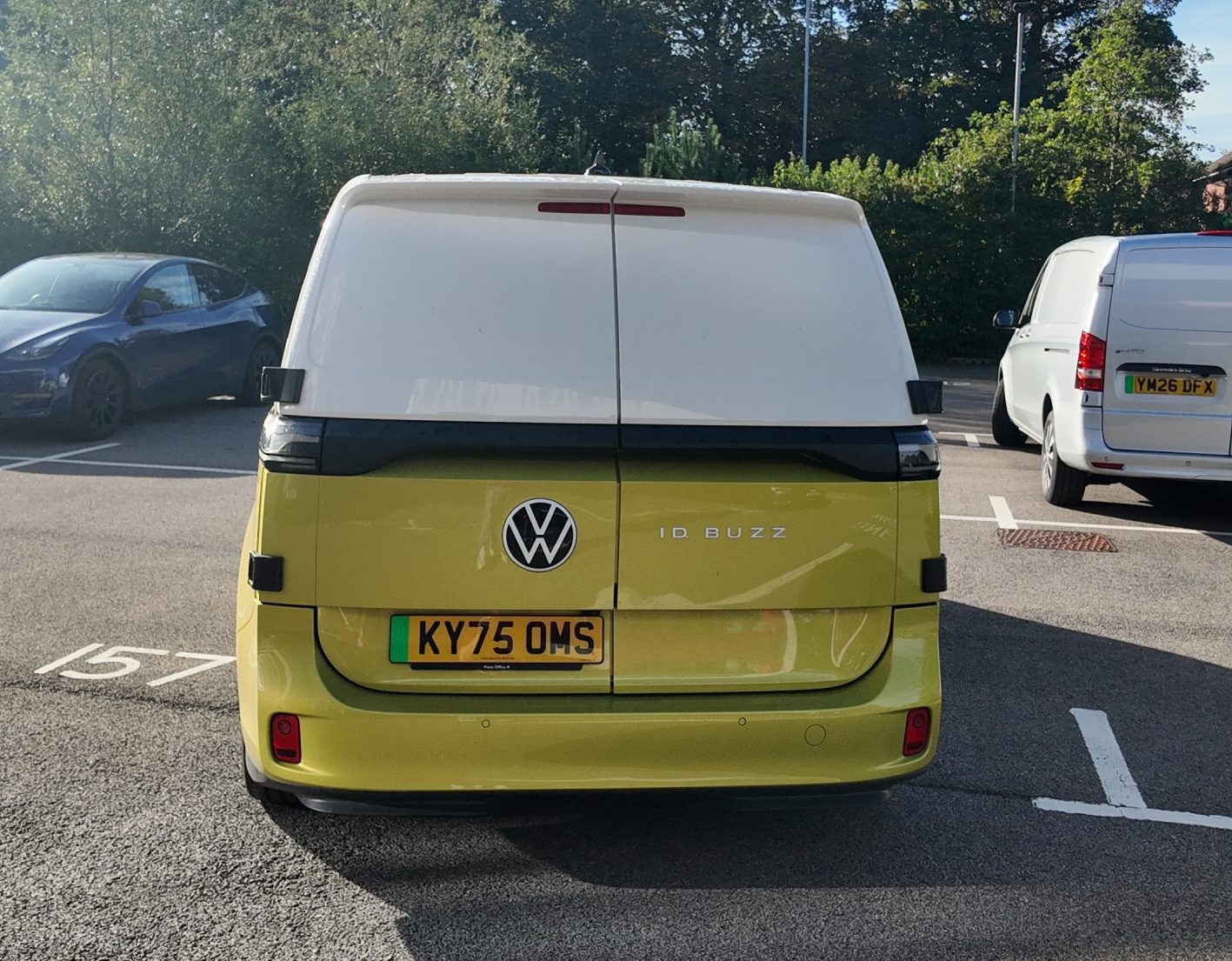
Where the Buzz Cargo falls materially behind the segment, though, is in raw numbers. The load volume is 3.9m³ against the Farizon V7E’s 6.95m³ and the Ford E-Transit Custom’s 5.8m³, and the payload is modest too, in the 516–647kg range depending on specification (the 4Motion’s heavier dual-motor setup pulls it towards the lower end of that range). If your fleet needs to move pallets or heavy loads, this isn’t the van for you. For moving tools, equipment, parcels and professional kit, it’s absolutely fine. Match it to the right duty cycle.
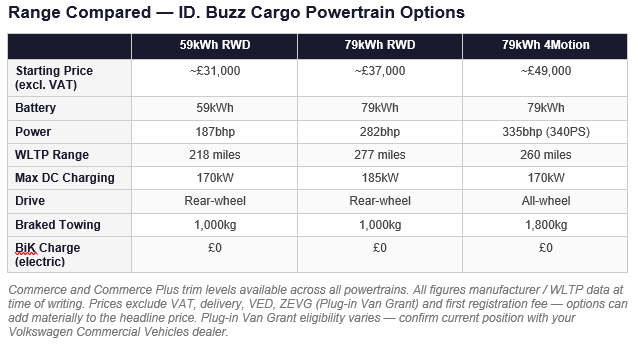
The real headline for the 4Motion variant though is the braked towing capacity: 1,800kg. That’s a huge uplift over the 1,000kg of the rear-drive versions, and genuinely class-leading in this segment, almost double what the Farizon V7E can pull. For a fleet operator with trailer-primary duty cycles; landscape and groundscare, event logistics, small plant movement, horsebox work, car recovery, this capability combined with the 4Motion traction suddenly becomes a very compelling proposition that no other medium electric van matches.
Battery, Range and Charging
The 79kWh battery pack delivers an official 260 miles WLTP in the 4Motion configuration (the rear-drive 79kWh versions get a slightly higher 277 miles). In my mixed driving across the test week; motorway, urban and B-road, I saw an indicated real-world range around 200–220 miles depending on how heavy I was with the right foot. That’s a genuinely workable number for most medium-van duty cycles, materially better than the 130–140 miles I was seeing on the Mercedes eVito last month.
DC fast charging peaks at 170kW on the 79kWh battery, which is class-competitive and allows a 5–80% top-up in around 30 minutes on a suitable charger. That’s quick enough to not interrupt a working day, take a proper break at a service area, grab lunch, come back to a van ready for another 150–plus miles. At home or depot on an 11kW three-phase wallbox, a full charge takes around 7.5 hours; on a 7kW single-phase wallbox, closer to 11 hours. Overnight depot charging is entirely comfortable.
The heat pump fitted as standard on the Buzz Cargo is a genuine fleet-relevant advantage. Through the UK winter it preserves real-world range materially better than a van without one — a 10–20% range penalty becomes a 5–10% penalty. For a fleet planning around guaranteed daily range in all seasons, that’s a proper benefit.
Safety and Warranty
Standard safety equipment is comprehensive: autonomous emergency braking with pedestrian and cyclist detection, Travel Assist combining adaptive cruise with lane keeping, Side Assist blind-spot monitoring, driver alert fatigue monitoring, Intelligent Speed Assist, Car2X hazard warning that communicates with other VWs about road hazards ahead, and a full set of airbags including side and curtain protection (something not every medium van bothers with). The Commerce Plus trim adds the rear-view camera, front and rear parking sensors, and Park Assist Plus with Memory Function that can autonomously manoeuvre the van into and out of tight spots.
The warranty package is where the Buzz Cargo is more middle-of-the-road. Mercedes-Benz gives you three years unlimited mileage; VW gives you three years and 100,000 miles with roadside assistance for the full duration. The battery gets a separate eight-year/100,000-mile capacity warranty, there’s a 12-year anti-perforation corrosion warranty on the body, and, critically for fleet operators, the service intervals are a genuinely generous two years with no mileage cap, which is a real whole-life cost advantage over most rivals’ annual servicing schedule. Over-the-air software updates mean infotainment and driver-assistance improvements arrive without a dealer visit.
VW’s UK dealer network is one of the deepest and most established in the country, no fleet manager will be worrying about service and parts availability. VW came 24th out of 30 brands in the most recent major reliability survey, which is honest to flag though not disastrous.
The Fleet Case
The Buzz Cargo gets the usual stack of UK electric van tax advantages:
- Plug-in Van Grant (Zero Emission Van Grant) applies at up to £5,000, subject to eligibility
- Zero Benefit-in-Kind charge for electric vans provided to employees for private use
- Full VAT recovery for VAT-registered businesses on the purchase price
- Zero fuel benefit charge
- Class 1A NIC exemption for the van benefit
- Zero congestion charge in London and ULEZ-compliant everywhere
- Full access to Clean Air Zones and zero-emission zones
But let’s be honest about where the Buzz Cargo 4Motion sits in the market: at around £49,000–£52,000 ex-VAT list price for the Commerce Plus 4Motion, this is a proper premium offering. That’s meaningfully above the Mercedes eVito Select I reviewed last month, and in a different financial universe to the Farizon V7E at £30,500. Whole-life cost per mile against a volume-focused rival like the Ford E-Transit Custom or Farizon V7E will not come out favourably on a pure spreadsheet comparison. If you’re running a cost-per-mile fleet, the Buzz Cargo loses on the maths.
The case for the Buzz Cargo is different, and it’s a real one. The retro design holds value materially better than most vans, and depreciation is the biggest line in any whole-life cost model, and the Buzz is predicted to hold value exceptionally well versus the segment. The driver appeal is genuine and translates to retention and recruitment benefits for businesses in sectors where good drivers are hard to find. The towing capacity of 1,800kg combined with 4Motion traction opens up fleet applications no other medium electric van can serve; landscape and ground maintenance businesses, event logistics, horse trade, car recovery, light plant movement. And the brand presence it brings to a customer’s drive is a legitimate marketing asset for premium service businesses.
Fleet audience it’s right for: premium service and trades businesses, high-touch mobile engineers, event logistics with trailer requirements, landscape and ground maintenance, horsebox-primary operations, executive crew transport, and any fleet where driver quality and welfare are proper priorities over pence-per-mile.
The Competition
The Buzz Cargo doesn’t really have a direct competitor. The closest in philosophy is probably the Mercedes eVito Select I reviewed last month, another premium cabin, driver-focused medium van but it is less distinctive-looking, has shorter range and nothing like the 4Motion’s towing capability. The Ford E-Transit Custom is the volume class benchmark and considerably cheaper but offers neither the design presence nor the towing capacity. The Farizon V7E and Kia PV5 Cargo serve very different segments at very different price points. For any fleet operator considering serious towing with electric power and medium-van packaging, the Buzz Cargo 4Motion is essentially unopposed in the UK market today.
The Verdict
The VW ID. Buzz Cargo Commerce Plus 4Motion is a genuinely excellent vehicle that comfortably earns its four stars. It’s the first electric van I’ve tested this year where I’d actively enjoy driving it as a daily tool, and the combination of standout road presence, upscale cabin, superb driving dynamics, genuinely low driver fatigue over long days, generous equipment and the 4Motion’s class-leading 1,800kg towing capacity makes it a properly compelling package for the right fleet audience. The heat pump, through-load partition, universal C-rail floor, LED load lighting and thoughtful USB-C distribution all show a manufacturer that’s thought about actual working use.
It’s not perfect. The touch-sensitive climate controls are a persistent niggle. The 3.9m³ load volume and 516–647kg payload are modest for the segment and will rule it out for high-volume logistics work. The warranty is good but not segment-leading. And the sticker price is a proper premium that only makes sense for fleets whose use case genuinely justifies what the Buzz Cargo delivers over the cheaper mainstream competition.
Four stars from me, and if your fleet matches the use case, this is a van you should be shortlisting with real intent. For a traditional cost-per-mile logistics operation it will struggle to justify the maths; for a premium service business, driver-first fleet or trailer-primary operation, it’s genuinely close to unopposed in the UK market today. VW has turned the retro icon into something properly serious for 2026, and the market is better for it.