

Top 5 fleet management platforms for commercial fleets
Running a commercial vehicle fleet without the right technology can quickly become a costly exercise. Fleet operators need to keep vehicles moving, driver compliance, maintenance under control and customers informed, while also managing fuel, safety and increasingly complex reporting requirements.
This article from US-based TenTrucks, compares five of the best management platforms and what they offer to fleet management.
For UK operators, compliance adds another layer of responsibility. Depending on the vehicles and journeys involved, fleets may need to manage tachograph records, drivers’ hours, working-time requirements, vehicle defects and maintenance records, as well as the wider responsibilities associated with operating a compliant commercial fleet. GOV.UK guidance states that tachographs record driving time, breaks, rest periods, other work, availability, speed and distance, making effective tachograph management an important part of fleet operations.
At the same time, many fleet operators work across borders or use platforms originally designed for international markets. That makes it important to look beyond a platform’s country of origin and assess how well it supports the specific operational and regulatory requirements of your fleet.
After reviewing a range of fleet management and transportation platforms, this guide compares five options worth considering in 2026, with particular attention to their relevance for UK operators and their ability to support wider international operations.
The Research Approach for This Ranking
Each platform was assessed using publicly available information from official product pages, software review platforms, industry publications, user feedback and documented customer experiences.
The assessment considered several factors:
- Fleet tracking and vehicle visibility
- Driver and vehicle compliance
- Tachograph and drivers’ hours management
- Maintenance and defect management
- Fuel and operational cost monitoring
- Driver safety and behaviour
- Dispatch and workflow management
- Reporting and analytics
- Integration capabilities
- Suitability for different fleet sizes and operating models
The objective was not simply to identify platforms with the longest feature lists. Instead, the focus was on how useful each platform could be in real commercial fleet operations.
Top 5 Fleet Management Platforms for Commercial Fleets
- Webfleet – Best for UK and European fleets focused on tracking, routing and compliance
- Samsara – Best for larger fleets requiring connected operations and advanced safety technology
- TenTrucks – Best for smaller trucking fleets and owner-operators requiring transport management tools
- Truckbase – Best for growing carriers and transport businesses looking to streamline dispatch
- AscendTMS – Best for transport companies and logistics businesses requiring broader transportation management
The right choice will depend heavily on whether you operate primarily in the UK, across Europe, or internationally.
Why Fleet Management Platforms Matter for Commercial Fleets
Commercial fleet management involves considerably more than knowing where a vehicle is.
Operators need to monitor vehicle utilisation, driver performance, fuel consumption, maintenance schedules, compliance records and delivery activity. Without a centralised system, this information can become fragmented across spreadsheets, paper records, separate telematics systems and manual processes.
For UK operators, compliance is particularly important. Vehicles subject to assimilated or AETR drivers’ hours rules must use an approved tachograph to record relevant driving and working activity. GOV.UK guidance also sets out specific requirements around drivers’ hours and tachographs for goods vehicles operating in Great Britain and internationally.
The regulatory picture also continues to evolve. For example, from 1 July 2026, assimilated rules apply to certain light goods vehicles over 2.5 tonnes undertaking international journeys between the UK and EU.
A good fleet management platform can therefore help operators maintain visibility over:
- Driver hours and tachograph information
- Vehicle location and utilisation
- Maintenance schedules
- Defects and inspections
- Fuel consumption
- Driver behaviour
- Route performance
- Delivery progress
- Compliance documentation
- Vehicle and asset availability
For international fleets, the platform may also need to support different regulatory environments. US operators, for example, commonly work with electronic logging device and hours-of-service requirements, while UK and European operators have their own tachograph and drivers’ hours frameworks.
The terminology differs, but the underlying objective is similar: giving fleet managers reliable information to keep vehicles, drivers and operations compliant.
The platforms serve somewhat different purposes, so the ranking should not be interpreted as a simple one-to-five hierarchy. A smaller UK operator may benefit more from a straightforward fleet management system than from an enterprise platform with a much larger feature set.
TenTrucks – Best for Owner-Operators and Small-to-Mid-Sized Fleets
What Does TenTrucks Do?
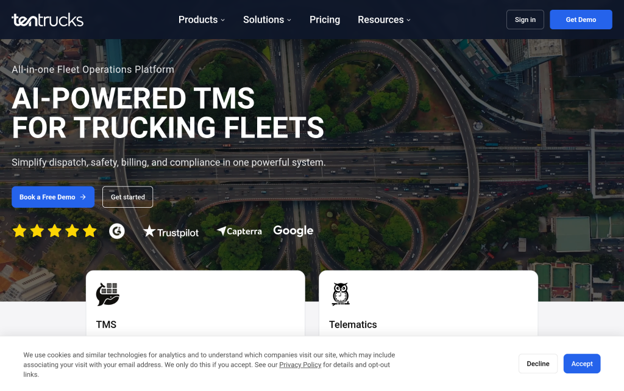
TenTrucks is a fleet operations platform built for owner-operators and small-to-mid-sized carriers who need serious tools without enterprise-level overhead. Their trucking management software covers TMS, dispatch, ELD compliance, automated IFTA reporting, driver settlements, and invoicing inside a single system. The built-in system catches errors before they become costly problems (think missed compliance deadlines or billing mistakes). No setup fees, no annual contracts, and a mobile driver app round out a platform that’s genuinely built for smaller operations, not scaled down from something designed for a 500-truck enterprise.
Why Does TenTrucks Stand Out for Platforms For Commercial Truck Fleets?
Smaller fleets often get stuck juggling five different tools just to stay compliant and get paid on time, and TenTrucks was built to fix exactly that problem. The combination of flat-rate pricing, QuickBooks connection, and native ELD connections with providers like Motive and Samsara makes it one of the more practical choices for operators who want results without a dedicated IT team.
Summary of Real User Reviews:
Users consistently point to the clean interface and how fast the platform gets a new dispatcher up to speed. The AI-assisted error catching gets mentioned more than once as something that saved real money. For a platform launched in 2024, the feedback tracks with something built by people who actually understand how small fleets operate.
For US-based operators, ELD functionality is particularly relevant. For UK businesses considering the platform, however, it is important to confirm that the available integrations and compliance functionality match the specific requirements of their UK operations.
Summary of User Experience
The platform is particularly suited to smaller transport businesses looking for a central system rather than a complex enterprise implementation.
Its appeal comes from combining several transportation functions within one platform and reducing the administrative burden placed on smaller teams.
For a UK operator, the key consideration is whether its available integrations and workflows adequately support UK-specific requirements.
Webfleet – Best for UK and European Commercial Fleets

What Does Webfleet Do?
Webfleet is a fleet management platform with a strong European heritage and a broad range of tools for commercial vehicle operators.
Its platform provides real-time vehicle tracking, route optimisation, fuel monitoring, maintenance management, tachograph management, driver performance tools, video telematics and reporting. It also supports trucks, vans, cars, trailers and other commercial assets.
For UK operators, one of its key advantages is the combination of vehicle tracking and compliance functionality. Webfleet provides tachograph management capabilities for monitoring and archiving relevant driving-hours information, alongside routing, vehicle diagnostics and maintenance features.
Why Does Webfleet Stand Out?
UK and European fleet operators often need to balance operational efficiency with regulatory compliance.
Webfleet’s combination of live tracking, route planning, tachograph management and maintenance tools means operators can manage several important aspects of fleet activity from one platform.
The route optimisation functionality can also help operators reduce unnecessary mileage and improve vehicle utilisation. Fuel monitoring and driver behaviour tools provide additional visibility into operating costs.
For fleets that operate across the UK and Europe, the platform’s European focus can be particularly relevant.
Summary of User Experience
The platform’s broad feature set makes it suitable for businesses that want more than basic GPS tracking. Operators can use it to monitor vehicles, manage routes, analyse driving behaviour and keep track of maintenance and compliance-related information.
Its biggest advantage is arguably its balance between fleet visibility and practical day-to-day transport operations.
Samsara – Best for Connected Fleet Operations and Safety
What Does Samsara Do?
Samsara is a Connected Operations Platform designed to bring fleet vehicles, equipment, drivers and operational workflows together.
Its platform includes GPS tracking, vehicle diagnostics, fuel and energy monitoring, video telematics, driver safety tools, compliance management, digital workflows and integrations. Samsara says its UK offering includes automated tachograph downloads, digital walkaround checks, driver licence verification and defect reporting. That makes the platform particularly relevant to UK fleets that want to combine telematics with compliance and safety management.
Why Does Samsara Stand Out?
Large commercial fleets often need more than vehicle tracking.
A fleet manager may need to understand why a vehicle is consuming excessive fuel, whether a driver is displaying risky behaviour, whether a vehicle has an outstanding defect, and whether relevant compliance information has been collected.
Samsara brings many of these functions together.
For UK operators, its compliance tools are particularly relevant because they address areas such as tachograph downloads, digital vehicle checks and defect reporting.
The platform is also designed for international operations. This makes it useful for businesses operating across different markets where the specific compliance requirements may differ.
Summary of User Experience
Samsara has developed a strong reputation for its combination of telematics, video safety technology and operational analytics.
Users frequently highlight real-time visibility and driver safety functionality as major advantages. The platform’s scale also makes it suitable for businesses managing large numbers of vehicles and assets.
The main consideration for smaller operators is whether the breadth of the platform justifies the investment compared with a simpler fleet management system.
Truckbase – Best for Growing Trucking Carriers
What Does Truckbase Do?
Truckbase is a transportation management system designed for growing trucking carriers.
The platform focuses on dispatch, load management, truck tracking, invoicing, driver settlements and customer-facing workflows.
It is particularly aimed at carriers that have outgrown spreadsheets and basic administrative tools but don’t necessarily need the complexity of a large enterprise system.
Why Does Truckbase Stand Out?
Growing transport companies frequently encounter the same problem: the business becomes more complicated faster than the systems supporting it.
A dispatcher might start with a spreadsheet, email and phone calls. As the number of vehicles and customers increases, that approach becomes difficult to maintain.
Truckbase is designed to centralise many of those processes.
Its ELD integrations and load-management capabilities make it particularly relevant to North American trucking operations. For UK fleets, however, operators should assess the availability of UK-specific integrations and compliance functionality before committing.
Summary of User Experience
Users commonly value the platform’s focus on dispatch efficiency and reducing administrative work.
The system is most compelling for growing carriers that need more structure without immediately moving to a highly complex enterprise transportation platform.
AscendTMS – Best for Transport Companies and Logistics Operations

What Does AscendTMS Do?
AscendTMS is a transportation management platform developed by InMotion Global.
It provides tools covering load planning, shipment tracking, billing, driver settlements, carrier payments and other transportation management activities.
The browser-based platform is designed to reduce the technical barrier to getting started and provides a broad range of functions for transport and logistics businesses.
Why Does AscendTMS Stand Out?
Not every fleet needs a dedicated telematics-heavy platform.
Some transport companies are primarily concerned with managing loads, carriers, customers, billing and transportation workflows.
AscendTMS is particularly relevant to that type of operation.
Its broader transportation-management focus can make it useful for companies that sit between fleet operations and freight brokerage or logistics management.
For UK operators, however, the same consideration applies as with other internationally developed platforms: local compliance requirements and available integrations should be checked before implementation.
Summary of User Experience
The platform’s breadth is one of its biggest advantages.
Businesses can access a wide range of transportation-management functionality without necessarily maintaining multiple separate systems.
The trade-off is that a broader platform can require more time to configure and learn, particularly when a business uses its more advanced functionality.
UK vs US Fleet Compliance: Why the Difference Matters
One of the biggest mistakes when evaluating an international fleet management platform is assuming that compliance requirements are interchangeable between markets.
They aren’t.
In the UK, commercial vehicle operators may need to manage tachograph data, drivers’ hours, working-time requirements, vehicle maintenance and other operator responsibilities. GOV.UK guidance explains that tachographs are used to record driving time, breaks, rest periods, other work and periods of availability.
US operators commonly use electronic logging devices and hours-of-service systems instead.
These systems address similar operational objectives, but the terminology, regulations and implementation requirements differ.
For international fleets, this means a platform should be evaluated based on the markets in which the vehicles actually operate.
A system that works extremely well for a US trucking company isn’t automatically the right choice for a UK haulage operator. Likewise, a platform with strong UK tachograph functionality may not provide everything a US carrier requires for ELD and hours-of-service compliance.
What UK Fleet Operators Should Look For?
- Tachograph downloads and data management
- Drivers’ hours monitoring
- Digital vehicle walkaround checks
- Defect reporting
- Vehicle maintenance scheduling
- Driver licence checks
- Real-time vehicle tracking
- Fuel and mileage monitoring
- Driver safety and behaviour
- Route planning
- Proof of delivery
- Compliance reporting
- Integration with existing transport systems
The exact requirements will depend on the fleet, vehicle types, journeys and operating model.
Research Methodology and Selection Process
The purpose of this research was to identify fleet management platforms capable of providing practical operational value rather than simply offering an extensive list of features.
Each platform was assessed using publicly available information from multiple sources, including official product documentation, software review platforms, industry publications, customer case studies and fleet technology resources.
Initial Data Collection
The process began by identifying fleet management and transportation platforms used by commercial vehicle operators across the UK, Europe and North America.
Platforms were then reviewed across multiple categories, including tracking, compliance, maintenance, safety, dispatch, reporting and integrations.
The goal was to avoid selecting platforms based purely on marketing claims.
Shortlisting Phase
The initial group was narrowed according to several factors:
- Relevance to commercial vehicle operations
- Evidence of active customer adoption
- Availability of fleet-specific functionality
- Compliance capabilities
- Range of integrations
- Usability
- Suitability for different fleet sizes
Platforms with limited evidence of commercial fleet usage were deprioritised.
Verification of Claims
Product descriptions were compared with information from independent review sources and documented customer experiences wherever possible.
Particular attention was paid to claims involving operational efficiency, safety improvements, compliance management and administrative savings.
UK and International Relevance
Because fleet technology increasingly crosses borders, the research also considered whether each platform could support international operations.
However, international capability does not automatically mean UK compliance capability.
UK operators should verify that a platform supports the specific tachograph, drivers’ hours, maintenance and compliance requirements relevant to their operation.
How to Choose the Right Fleet Management Platform
Choosing fleet management software is less about finding the platform with the most features and more about finding the one that fits your operation.
Fleet Size and Complexity
A five-vehicle business and a 500-vehicle operation have very different requirements.
Smaller fleets may prioritise simplicity, affordability and ease of implementation.
Larger operators may need advanced analytics, video telematics, integrations, workflow automation and multi-site management.
UK Compliance Requirements
For UK operators, compliance should be one of the first considerations rather than an afterthought.
Check how the platform handles tachographs, drivers’ hours, vehicle checks, defect reporting and compliance records.
The rules can also change depending on whether vehicles operate solely within the UK or undertake international journeys.
Tracking and Telematics
Basic GPS tracking may be sufficient for some businesses.
More sophisticated fleets may need:
- Live vehicle locations
- Vehicle diagnostics
- Fuel monitoring
- Driver behaviour analysis
- Video telematics
- Geofencing
- Route optimisation
- Asset tracking
The more data a business generates, the more important it becomes to have a platform capable of turning that data into useful operational decisions.
Maintenance and Vehicle Health
Vehicle downtime can quickly become expensive.
A good fleet platform should make it easier to monitor servicing schedules, identify defects and keep maintenance records organised.
Some platforms can also connect vehicle diagnostic information with maintenance workflows, helping operators identify potential problems earlier.
Safety
Driver safety is another increasingly important consideration.
Look for tools that can identify risky driving behaviour, monitor incidents and provide managers with actionable information.
Video telematics can be particularly useful for larger fleets where manually reviewing every incident isn’t practical.
Integrations
No fleet management platform operates in isolation.
Check whether the system can connect with:
- Fuel card providers
- Accounting software
- Transport management systems
- Vehicle manufacturers
- Tachograph systems
- Payroll systems
- Customer platforms
- Navigation tools
- Reporting software
Integration can be the difference between genuinely centralising operations and simply creating another data silo.
International Operations
If your business operates across the UK, Europe or North America, don’t assume that one compliance module will cover every market.
Instead, check whether the platform supports the relevant regulatory frameworks and vehicle types in each country where you operate.
Bottom Line
The best fleet management platform isn’t necessarily the one with the longest feature list.
For UK commercial fleets, compliance, vehicle maintenance, driver safety and operational visibility should be central to the decision.
Ultimately, the right choice depends on where your vehicles operate, how large your fleet is, which compliance requirements apply, and how much of your operation you want to bring into one system.
For UK operators, that means looking beyond generic fleet-tracking features and asking a more practical question: can this platform help us run a safer, more compliant and more efficient fleet under the rules that actually apply to our vehicles and drivers?