
Turning telematics data into decisions with AI
AI is going to transform how we use telematics data. One of the biggest criticisms of the technology over the years is around the amount of data being generated. Many fleets do not have the time or resources to convert this information into decisions, but this is now changing with the latest innovation. This will be about unlocking the intelligence of telematics and getting a system to perform to its full capacity.
Steve Thomas, UK Managing Director of Ctrack, looks at how AI can add value and insights into collected telematics data.
Whatever the size of a fleet, there is a huge opportunity. Something we hear a lot from smaller vehicle operators is that they use their telematics systems for real-time tracking and then a small number of scheduled reports. A larger fleet, meanwhile, is often swamped by the scale of data available, so unable to use telematics how it wishes. For both, the technology adds value and is certainly worthwhile, but the problem is often the same. Neither has the resources available to make the most of the system.
Results-based Reporting
Simply put, AI is going to make it much, much quicker and easier to interpret large volumes of data to get the information that individual companies need to improve their fleet operations. Historically, there has been a need to provide reports that can be exported in multiple formats, such as CSV files or PDFs, because fleet managers want to interrogate the data further or cross-reference it with information from another system.
The need to export data to enable further, time-consuming analysis will become a thing of the past. Moving forward, the system will be doing all the hard work of interrogating the data. There will be fewer constraints on what can be analysed, with reporting limited only by our ability to shape a request and the data points the telematics system captures or imports.
Reporting will become much more results-based, providing the exact insight required in an easy-to-use format. It will be possible to generate very specific information, so a fleet manager can access what is most important to them. Simply ask the system the question that needs answering to gain an immediate answer: Who started late this week? Which are my least utilised vehicles? Who used their vehicles on the weekend? What are my worst vehicles for MPG? The potential questions are endless and could be as straightforward or complex as required.
For example, being able to immediately pinpoint the drivers with the worst average MPG among those covering the highest monthly mileage offers significant savings potential. What if you could then factor in other data, such as road types, terrain, routes, loads, vehicle checks and fuel prices? This would deliver intelligence that was simply unobtainable previously.
Connecting Systems
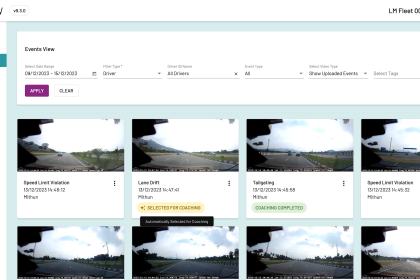
For video telematics, AI has increasingly been used on the camera device to detect fleet and driver risk, including distraction, fatigue and mobile phone usage events, while for software applications it can be used to better manage the volume of captured footage. This continues to improve as the technology becomes more sophisticated, but the next big advance will be the ability to identify a type of video and analyse it alongside other supporting data.
If you could pinpoint instances of driver distraction that resulted in a lane departure, harsh braking or a near miss, it would be hugely powerful. You could get even more specific: show me any footage where people are not wearing a seatbelt while driving at more than 60mph. A fleet manager could quickly determine where fleet risk exists, without having to wade through hundreds of videos.
Looking beyond this, there is further opportunity to combine telematics with data from integrated third-party systems. Fuel management, maintenance planning, routing and scheduling and licence checking are just some that could be brought together, adding extra layers of understanding. Weather data could help flag changing risks on certain routes; detailed mapping could highlight journeys that pass schools during opening and closing times; and fuel card data could be checked against driver behaviour stats to identify areas of inefficiency.
Imagine being able to ask: “Show me the most frequent speeders who have nine points on their licence.” With just one more speeding fine potentially taking those drivers off the road, the fleet manager could step in before it happens. As more data sets are added, the scope to answer very focused questions that deliver business and operational value becomes greater.
Tracking Trends
AI will also be critical for trend analysis, spotting repetition and patterns within historical data. This will allow detailed scrutiny of operational inefficiencies, underutilisation or safety hazards. A fleet could quickly calculate accurate cost of life data by vehicle brand, while stripping out driver variables, to support a fleet replacement strategy.
Alternatively, areas of concern could be investigated to determine whether a certain scenario poses greater risk. Is there a link between poor driving and Friday afternoons because people are rushing home, or is this simply due to different traffic or driving conditions? What is the impact of tiredness on road safety during the early hours of the morning? These are all questions that could be answered almost immediately using AI support.
Telematics is information, but the key to success has always been how that information is used. With AI now able to interpret huge volumes of disparate information and quickly determine what needs attention, the value no longer lies in the data itself, but in the answers it delivers. For fleets willing to act on the available insight, the opportunity to improve safety, efficiency and performance has never been greater.