
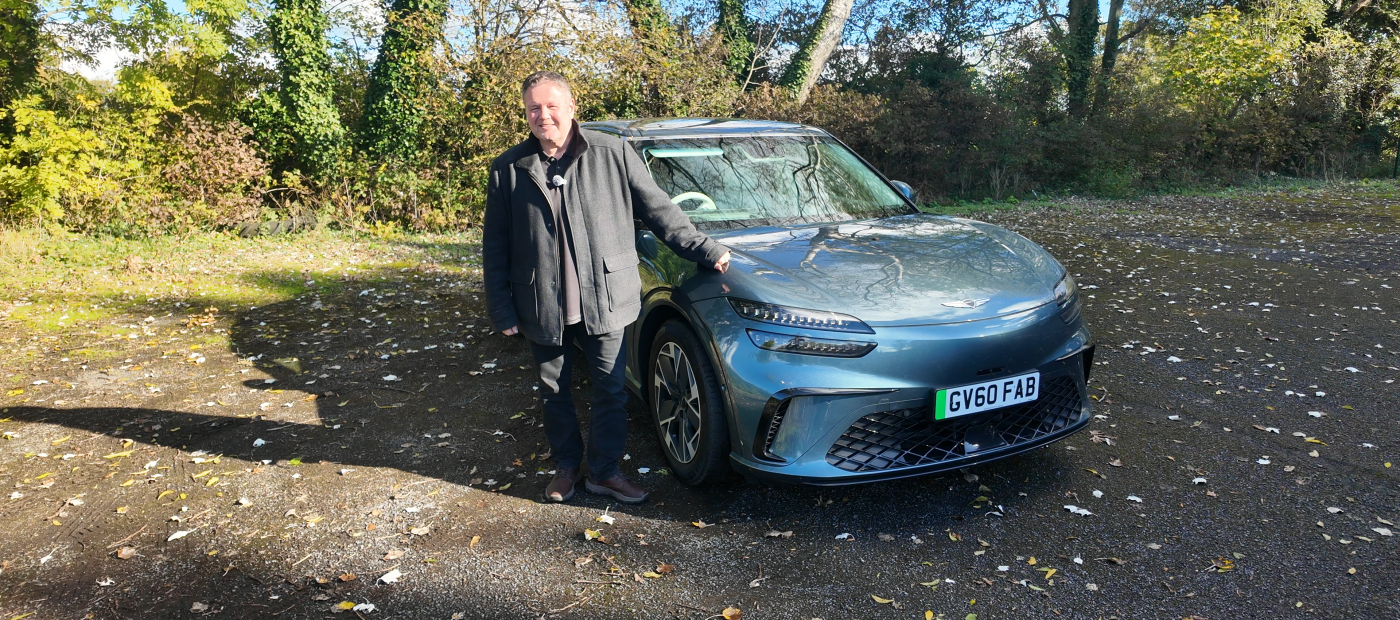
Genesis GV60 Review: The Electric SUV Nobody Is Talking About!
Watch the review — click here (opens YouTube in a new tab)
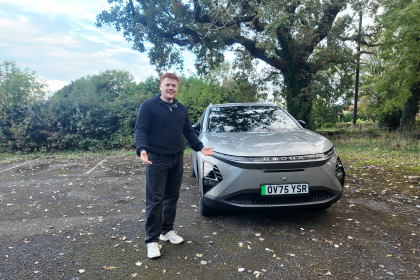
A week with the Genesis GV60, reviewed by Ian Smith.
First Impressions
Bit of a step up this month. After eight months of mostly sub-£40k electric cars aimed at everyday fleet drivers, I’ve just spent a week in something properly different: the 2026 facelift of the Genesis GV60, in top Performance trim. Genesis is Hyundai’s luxury brand (same group as Kia), and the GV60 is their flagship electric SUV. The facelift brings a bigger 84kWh battery, a cleaner exterior, and — the big visual change — a 27-inch OLED screen that stretches across the dashboard. It feels like a large, comfortable moving palace.
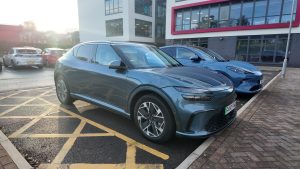
First impressions were strong. It’s chunky and upright, properly SUV-sized, and the moment you get in it feels special. The cabin is very quiet, the materials are plush, and the driving position is excellent. It’s a clear step up from most of what I’ve driven this year, including the Mercedes eVito back in October. This is a car you actually want to spend time in.
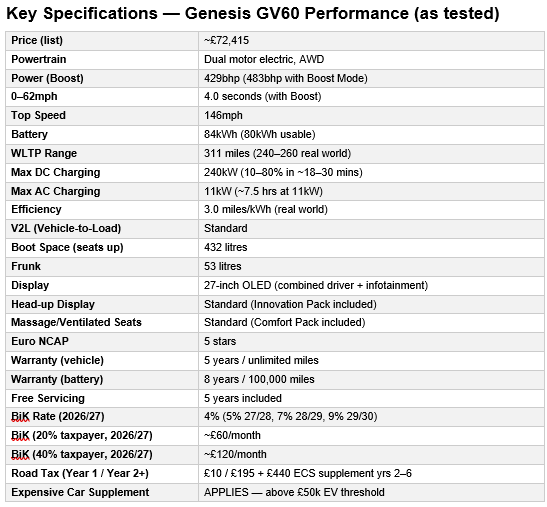
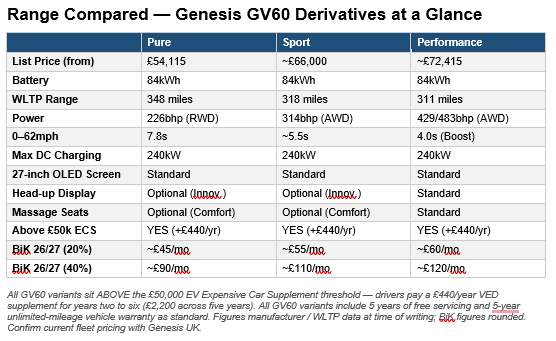
Fleet headline first, because it needs saying: this is an expensive car. The Performance lists at around £72,000 and even the entry Pure starts at £54,115, so every version sits above the £50,000 Expensive Car Supplement threshold for EVs. That’s an extra £440 a year in VED from years two to six (£2,200 over five years). The 4% Benefit-in-Kind rate for electric cars means my test car works out at roughly £60 a month for a 20% taxpayer and £120 a month for a 40% taxpayer — still cheap compared with a petrol equivalent, but there’s no getting away from the fact it’s premium money. You can, however, see where most of it has been spent.
Design and Interior
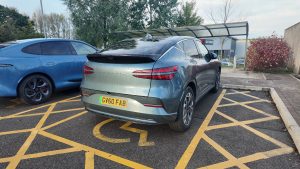
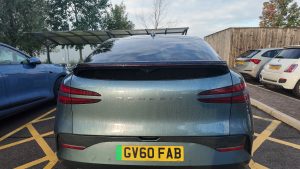
The facelift tidies up an already distinctive exterior. The split-level “Two-Line” LED daytime running lights front and rear are still Genesis’s signature (nobody else does lights quite like this), and the 2026 updates bring cleaner body surfacing and some new wheel designs. On the Performance’s 21-inch alloys and in the deep metallic paint of my test car, it looks expensive. Not everyone will love the slightly egg-shaped proportions, but it has a strong identity and stands out in a Costa car park full of German SUVs.
The interior is where it earns the money. This is a high-class cabin in the proper sense: Nappa leather with nice quilted stitching on the Performance, soft materials almost everywhere, properly machined metal switchgear, and the kind of attention to detail you usually only find on cars that cost a lot more. The crystal ball drive selector on the centre console that spins upside-down when you press Start is pure theatre — the sort of thing that normally stays on a concept car. It makes the start of every journey feel like a small event.
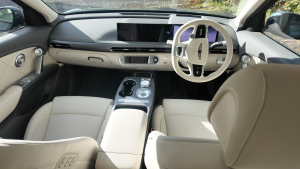
The driving position is one of the best I’ve sat in this year. You’re somewhere between SUV-high and hatchback-low, the seats have electric adjustment including power lumbar, and the steering wheel moves through a good range. On the Performance you get 18-way electric front seats with heating, cooling and massage. The massage is genuinely nice — it gently works your lower back and bum as you drive, and after a long week I noticed the difference when I got back into something without it. The heated seats are also excellent, though a warning: the top setting is fierce. Most people will like it; if you’re sensitive, turn it down.
One small caveat on the seats: the cushioning is a bit firm. You notice it on short trips, but on a longer motorway run that firmness is actually helpful — you don’t sink into the seat and end up fatigued the way you can in softer chairs. After 300 miles I felt fresher than I would have in a lot of rivals. For a fleet of people who do long distances, that’s useful.
Rear space is good rather than massive. A six-footer can sit behind another six-footer with decent legroom, but the sloping roof eats into headroom a bit and the middle seat is slightly raised, so taller people in the centre will have to duck. The 432-litre boot is honest rather than class-leading (a BMW iX3 or Tesla Model Y will take more), but there’s a useful 53-litre frunk under the bonnet for cables so the main boot stays clear. For a family of four with weekend bags it works fine.
Wife test (twelfth consecutive month) was passed without argument. She liked the materials, the massage seats, the crystal ball, the quiet, and said — her words — “this is the nicest car I’ve ever been in.” High praise.
Infotainment and Physical Controls
The big change is the new 27-inch OLED display that runs across the dash. It combines the driver display and the central touchscreen in one piece of glass and it looks excellent. Sharp resolution, rich colours, and it gives the cabin a proper high-tech feel. Graphics are crisp, it responds quickly, and the layout is straightforward — no endless sub-menus. This is what premium infotainment ought to look like.
Genesis has also resisted the urge to put everything on the screen. There’s a proper rotary controller between the seats so you can scroll and select without reaching for the display, which is less distracting on the move. Climate controls have their own strip of physical buttons below the screen. Steering-wheel buttons are physical, not haptic. Volume dial, tuning dial, drive-mode selector — all physical. At this price that matters, and it’s better than several German rivals I’ve driven recently.
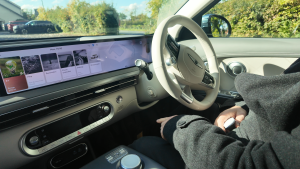
Wireless Apple CarPlay and Android Auto are standard and both connected cleanly every time. The 17-speaker Bang & Olufsen system (standard on Performance) is very good for music and podcasts. The head-up display projecting speed, navigation and ADAS warnings into your eyeline is another highlight — once you’ve lived with a good one you notice its absence elsewhere. Augmented-reality navigation is included on the Performance via the Innovation Pack: when the sat-nav tells you to turn, an arrow is overlaid on the live camera feed showing which exit or junction to take. Useful in cities.
On the Road
The Performance’s twin motors deliver 429bhp normally and 483bhp with Boost Mode. 0–62mph is four seconds flat with Boost — Taycan 4S territory — and the delivery is as instant as you’d expect. Warn anyone in the back before you use Boost; the shove is properly strong and in a car this big and refined it can catch people out.
For a bit of fun the Performance has Genesis’s “Virtual Gearshift” (shared with the Ioniq 5 N). It electronically simulates an automatic gearbox so you can shift with the paddles. It’s completely synthetic — the car still has a single-speed gearbox — but the response is realistic enough that you can enjoy pretending. More gimmick than essential, but a good one.
Where it really scores is refinement and quiet. At motorway speeds the cabin is extremely hushed — wind noise is almost absent, road roar is well suppressed even on the 21-inch wheels, and the electric drivetrain is near-silent. On a long stretch of the M6 it was one of the most relaxing cars I’ve driven this year. Combined with the massage seats, you arrive fresher than you left.
The ADAS is worth calling out. Genesis’s system is one of the most effective I’ve used this year. Lane-centring is smooth and doesn’t bounce between the lines the way some cheaper systems do. Adaptive cruise holds distance sensibly and accelerates and brakes smoothly. On the motorway sections of the test week it almost drove itself. For company-car drivers who spend a lot of time on the motorway, that reduction in fatigue is a real benefit.
Through corners the Performance handles its weight (around 2,200kg) with decent composure. There’s less body roll than you might expect, and in Sport mode the steering firms up and the seat bolsters tighten for support. It’s not a driver’s car in the way something like an Alpine A390 is, but it’s a comfortable, refined and surprisingly capable large SUV that copes with British B-roads without complaint.
Battery, Range and Charging
The facelift’s larger 84kWh battery (80kWh usable) gives an official WLTP range of 311 miles on the Performance — the price you pay for the dual-motor power. In mixed real-world driving I saw roughly 240–260 miles depending on how hard I was using it. For most daily use that’s comfortable. The entry Pure RWD manages 348 miles WLTP, which is more useful if range matters more than performance.
DC rapid charging peaks at 240kW thanks to the 800-volt architecture (same as the Kia EV6 and Hyundai Ioniq 5). On a suitable ultra-rapid charger a 10–80% charge takes as little as 18 minutes; on more common 150kW chargers you’re looking at 20–50 minutes. For a long trip you stop for a coffee and the car is ready. At home on 11kW three-phase AC it’s around 7.5 hours; on a standard 7kW wallbox closer to 11 hours. V2L is standard so you can power external devices from the battery — handy for events or mobile working.
The Niggles
For a five-star car there aren’t many. The seats are a touch firm, as I said, but that pays back on longer journeys. The top heat setting on the seats is volcanic. Rear visibility is restricted by the tapered roofline — the 360-degree camera on the Performance helps a lot, but the physical view out the back isn’t great. The 432-litre boot is honest rather than huge. The sloping roof eats into rear headroom slightly — tall passengers in the back will notice the ceiling.
And the big fleet point: every variant sits above the £50,000 Expensive Car Supplement threshold, so drivers pay the £440-a-year VED supplement from years two to six. That’s not Genesis’s fault — the car is priced where it is for a reason — but it needs to go into the whole-life-cost model. If your organisation has a hard £50,000 choice-list cap, the GV60 is simply off the list. If your cap is higher, the supplement is a line to acknowledge.
Safety and Warranty
The GV60 has a full five-star Euro NCAP rating, with strong scores for adult and child occupant protection — better than the Nissan Ariya in both categories when they were tested together. Standard safety kit is comprehensive: eight airbags, autonomous emergency braking with pedestrian and cyclist detection, lane-keeping assistance, blind-spot collision avoidance, rear cross-traffic alert, driver attention monitoring and Intelligent Speed Assist. The 360-degree camera on Performance is useful for tight urban manoeuvres.
The warranty package is one of the stronger parts of Genesis ownership. You get five years of vehicle cover with unlimited mileage (better than Mercedes’ three years or BMW’s three years on equivalent cars) and the battery gets an additional eight years / 100,000-mile capacity guarantee. On top of that, five years of free servicing is included, plus five years of over-the-air software updates. For a fleet running a typical four-year, 80,000-mile cycle, free servicing is a useful cost removed from the whole-life model.
Genesis is still relatively new in the UK so there isn’t a long reliability track record yet. However, the GV60 shares its platform, batteries and major components with the Hyundai Ioniq 5 and Kia EV6 — both of which have done well in industry surveys — and the Hyundai Motor Group generally scores strongly. The Genesis UK dealer network is still being built and is focused on major cities, so rural operators should check their nearest Studio before ordering.
The Fleet and Sal-Sac Case
Pure electric cars sit at 4% BiK for the 2026/27 tax year, rising to 5% in 2027/28, 7% in 2028/29 and 9% in 2029/30. For the Performance at a P11D of £72,000 that works out at:
- 20% taxpayer, 2026/27: around £60 per month in BiK (£720 a year)
- 40% taxpayer, 2026/27: around £120 per month in BiK (£1,440 a year)
For a car at this list price those are small numbers. Compared with a petrol luxury SUV in the 35%+ BiK bracket, a 40% taxpayer is typically saving £800+ a month in company car tax. Over four years that’s nearly £40,000 back in the driver’s pocket. For a C-suite driver who would normally be in a petrol or diesel BMW X5 or Audi Q7, the tax maths alone make the GV60 Performance hard to ignore — before you even factor in that it’s a nicer place to spend time.
Two more fleet points. First, the Expensive Car Supplement already mentioned — £440 a year from years two to six. There’s no way around it at this price and drivers will see it on their VED bill. Second, five years of free servicing is a material benefit worth putting in the whole-life model. At a typical £200–£400 per service for a car at this level, that’s potentially £1,000–£2,000 saved over four years. The two roughly balance each other out.
On salary sacrifice the GV60 is a serious proposition for senior staff. Broker figures I’d expect for the Performance land somewhere around £700–£900 a month net for a 40% taxpayer, all-in (insurance, servicing — which is free anyway — tyres and often a home charger). For a 20% taxpayer, closer to £850–£1,100. For a C-level executive currently in a petrol SUV costing them £1,500+ a month in tax and running costs, the switch to a GV60 Performance on sal-sac is an easy case to make.
The Competition
The GV60 competes with the proper premium electric SUV crowd. The BMW iX3 is the obvious benchmark — better range on paper and sharper to drive, but less luxurious inside. The Mercedes GLC Electric is more polished for cabin materials but costs more trim-for-trim. The Audi Q4 e-tron undercuts the GV60 on price but can’t match the interior quality. The Polestar 4 has similar cabin ambition at similar money but no rear window and a love-it-or-hate-it exterior. The Tesla Model Y is quicker, has longer range and a bigger boot, but the cabin is in a different league — the GV60 feels like a luxury car in a way the Tesla doesn’t. For a fleet operator putting senior executives into something that feels special without stretching to a Porsche Taycan, the GV60 Performance has few real equals.
The Verdict
The Genesis GV60 Performance is a very good car. The 2026 facelift — bigger battery, 27-inch OLED, revised exterior — lifts an already strong package. The interior is high-class with good leather and stitching, soft materials, and build quality that puts most of the German competition on notice. The 27-inch screen looks excellent and feels like the direction in-car tech is heading. The ADAS is among the best I’ve used — the system almost drives itself and makes long motorway runs less tiring. The ride is smooth, the cabin is quiet, and the massage seats are a daily highlight. The crystal ball drive selector is the kind of theatrical touch you remember.
It’s not perfect. The seats are a little firm at first, though that pays back on longer trips. The top heat setting on the seats is fierce. The boot is honest rather than huge and rear visibility isn’t the best. And every variant sits above the £50,000 Expensive Car Supplement threshold, which adds a £440-a-year VED supplement to the whole-life bill. But at this price and in this segment that’s expected — and five years of free servicing plus a five-year unlimited-mileage warranty is a useful counterweight.
Five stars from me. For fleet managers putting senior executives, directors or long-distance drivers into something that is objectively a nicer place to be than almost anything else on the UK market right now, the Genesis GV60 Performance is close to unbeatable. A really nice place to spend time, and yes — you can see where the money has gone. Grand car, grand brand, grand experience. Genesis has done what the facelifted GV60 was supposed to do.