

Global shocks are pushing fuel, parts and maintenance costs sharply higher. For trades businesses and small fleet operators, the margin for error has never been thinner – and the window to act is short.
FleetHive AI CEO, Hein Du Plessis, analyses the current position of global trade and fleet costs, suggests how those costs are likely to rise and what fleet and logistics operators can do now to mitigate against those rises.

Image: FleetHive AI
Nobody in business wants to think about their vehicles. They’re a means to an end – the thing that gets you to the job, the customer, the site. But right now, ignoring them is becoming an expensive habit.
Brent crude has surged above $115 per barrel. Container freight indices have rebounded sharply since mid-2025. Carriers rerouting around the Red Sea and the Strait of Hormuz are adding distance, fuel burn and cost at every step – and those costs travel all the way down the chain to the repair bill sitting on your desk.
For large fleet operators with procurement teams, this is uncomfortable. For a plumber running four vans, or an electrician with two engineers on the road, it can be genuinely dangerous to the business.
What’s actually going up – and by how much (so you can plan your cash flow)
The cost increases are not theoretical. They are already moving through the supply chain and will land on operators in stages over the coming weeks and months.
Here are the realistic percentage increases SMEs can expect, based on current commodity and freight data:
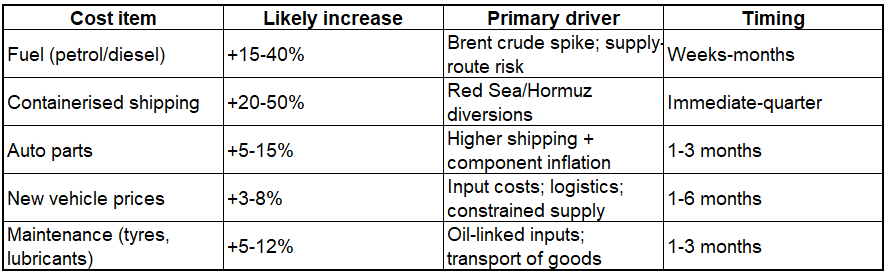
Source: FleetHive analysis based on published commodity and freight indices, March 2026
These numbers aren’t just headlines – they’re cash-flow forecasts you can use today. A typical small fleet spending £2,000 a month on fuel and parts could see an extra £300-£800 hitting the books every month once the increases fully flow through. Build that into your next quarter’s budget now, and you stay in control instead of reacting when the invoices arrive.
The hidden cost most operators miss
The numbers above capture direct costs. What they don’t capture is the cost of an unexpected breakdown – not the repair bill itself, but the day’s work that doesn’t happen because the van isn’t on the road.
For a trades business, a van off the road is not an inconvenience. It is a direct hit to revenue. It is a customer who waits, a job that slips, a reputation that takes a small dent. Multiply that across a fleet of any size and the numbers start to matter.
The frustrating truth is that most breakdowns are predictable. A service missed here, an MOT that crept up there, a tyre worn past the point it should have been replaced. The vehicle was telling someone something – there just wasn’t a system in place to listen.

Image: FleetHive AI
What operators can do right now (realistic steps that protect margins)
There is no single answer to a global supply shock. But there are levers that every operator – regardless of fleet size – can pull immediately:
- Know what you’re spending. The first step is visibility. Most small fleet operators have a rough idea of their vehicle costs – not an accurate one. Until you know the real number, you cannot manage it.
- Treat maintenance as revenue protection, not admin. A service on time is almost always cheaper than a breakdown out of nowhere. Preventive maintenance is not a cost – it is an insurance policy against a much larger one.
- Know what fair looks like. When a repair quote lands on your desk, do you have any basis to assess it? Data on typical costs for your makes and models gives you the ability to push back when you should.
- Reduce the cognitive load. For most small businesses, vehicle admin sits alongside everything else the owner carries in their head. MOT dates, service intervals, renewal deadlines – the things that slip are the ones nobody is actively tracking.
- Look at your procurement – and use collective buying power. Fuel timing, parts sourcing and supplier relationships are all areas where buyers with data negotiate better. Better still: join a collective buying group. Pool demand with thousands of other SMEs and you immediately access the lowest possible prices on fuel, parts, tyres and lubricants – the very items now rising fastest. One decision can turn a 15-40% fuel hike into something far more manageable.
The operators who will feel this least are not necessarily the largest ones. They are the ones with the clearest picture of what their vehicles cost, what they need, and when – and who use that clarity to buy smarter through collective power.
That is not a technology problem. It is a visibility problem. The data exists – service records, MOT history, repair costs – but for most small operators it lives in emails, receipts, and memory. The difference between a business that sees a breakdown coming and one that doesn’t is usually just whether someone organised that information.
Right now, with costs rising across every line of the vehicle cost stack, the operators who have that clarity – and who combine it with collective buying – will make better decisions faster. The ones who don’t will pay more, wait longer, and lose days they cannot afford to lose.
The squeeze is coming. The question is whether you see it before it arrives – and whether you act on it with the right tools and buying power.
FleetHive AI helps trades businesses and vehicle owners stay on top of MOTs, services and running costs – and connects you to collective buying groups that secure the lowest possible prices on the parts and fuel you need. Free to start at www.fleethive.ai