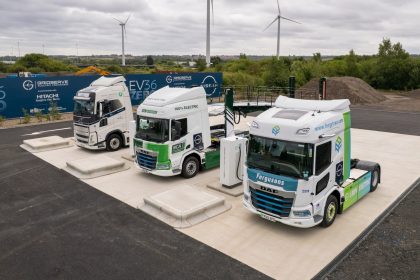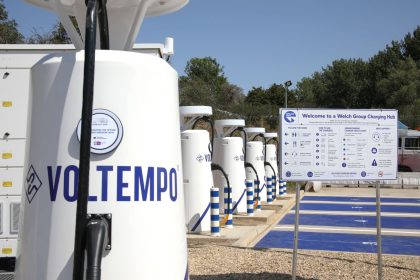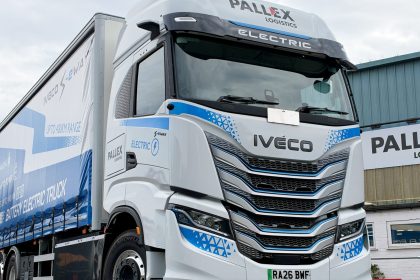


ScotVolt invites Scottish hauliers to test electric truck planning tool
Scotland’s truck operators now have a new way to test the switch from diesel to electric before they buy a single vehicle or charger. ScotVolt is an interactive planning dashboard that simulates electric HGV operations on Scotland’s busiest freight routes. Transport Scotland commissioned it, and researchers at Heriot-Watt University built it.
Heriot-Watt announced the tool on 13 October 2026. Truck fleet owners, hauliers, delivery companies and logistics firms are now invited to test ScotVolt against their own routes and send feedback.
The tool aims to speed up the decarbonisation of road freight in Scotland. It shows where operators will need charging, how much electricity their trucks will draw and whether the local grid can cope. For fleet managers weighing up their first electric lorries, that evidence could remove much of the guesswork.
What is ScotVolt?
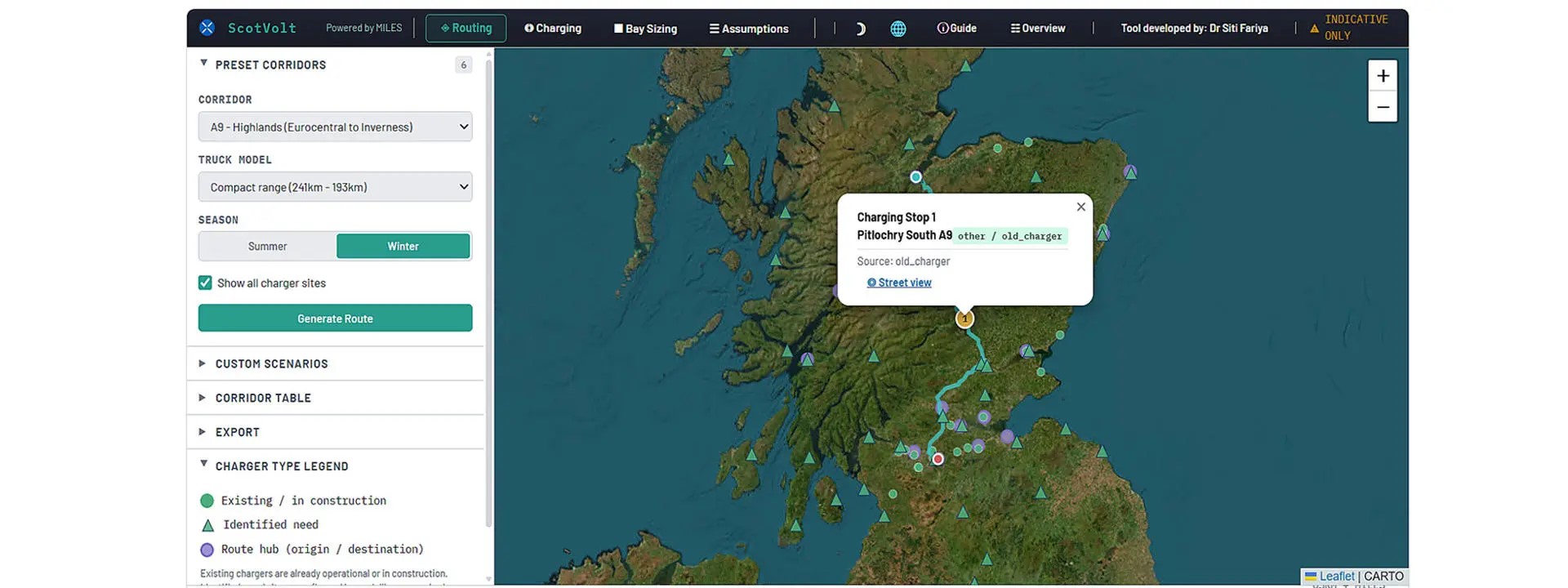
ScotVolt is an online dashboard that explores what happens when Scotland’s heavy goods vehicles switch from diesel to electric. Users can pick a season, a route, a depot type and a battery size. They then load the scenario and watch the results appear on a series of maps and charts.
The tool turns a complex question into something practical. Most operators know the broad case for electric trucks. Far fewer know how a specific route, with a specific vehicle, would work in January on the A9. ScotVolt aims to answer that kind of question.
The dashboard draws on around 80,000 real truck journeys in Scotland. It also builds on two years of research for Transport Scotland and the Scottish Government. That research forms part of the HGV Decarbonisation Pathway for Scotland, which ministers published in March 2024 to help the sector move to zero emission trucks.
Who developed ScotVolt for Transport Scotland?
Transport Scotland, the country’s national transport agency, commissioned the work. Researchers at Heriot-Watt University in Edinburgh built the tool with The Centre for Sustainable Road Freight. That centre is a collaboration between the University of Cambridge, Heriot-Watt University and the University of Westminster. It brings together researchers and industry leaders to improve road freight efficiency and reduce its environmental impact.
Dr Siti Fariya, a transport and logistics researcher at Heriot-Watt, led the development of the interactive dashboard. Professor Phil Greening, Deputy Director of the Centre for Sustainable Road Freight, is among the co-authors. The research team also includes Dhanan Utomo, Alan Logan, Tushara Kodikara, Guy Walker, David Cole, Zoe O’Connor and Adam Gripton. All of them work at Heriot-Watt.
ScotVolt follows two earlier phases of research for Transport Scotland. The first phase identified which busy freight routes would need electric HGV charging points. The second phase went further and used telematics data from around 2% of Scotland’s HGVs to model where en-route chargers should go. That work found that Scotland needs at least 63 en-route charging locations on major freight routes, including the A9, A90 and M74. Twenty-six of those sites are already operating or under development, which leaves 37 still to find.
The wider project also revealed a data gap. Governments do not hold enough information about how HGVs move around Scotland. ScotVolt tackles part of that problem by putting real-world journey data into a tool that anyone in the industry can explore.
How does ScotVolt work?
The researchers used a technique called agent-based modelling. It simulates how individual agents, such as trucks, interact with each other and with their environment. In ScotVolt, each simulated truck makes journeys, uses energy and looks for chargers when it needs them. The model then adds up the results across the network.
The dashboard simulates operations over a one-year timeframe. It covers 56 different scenarios. These reflect variables such as battery size, the availability and speed of charging stations, and whether fleet depots can charge trucks overnight. The model also captures the seasonal swing in energy use, because batteries use more power in the colder months.
Users see the results on two side-by-side maps. The left-hand map shows how many vehicles visit each charger. The right-hand map shows how much energy those vehicles draw from the grid. Operators can also see how many charging bays each site needs, based on simulation data. They can check which charging stops a truck would need on a given route, based on its battery range and the chargers available.
The grid layer may prove the most useful feature for infrastructure planners. The maps show the nearest electricity substation to each charger, where one exists. They also show whether charging demand meets or exceeds what the grid can supply. Popups give extra detail for each site. They show how many vehicles visited during the simulated day, the maximum number charging at once, and the total electricity delivered.
The charging sites in the dashboard include existing and planned locations that are already operational or in construction. They also include new locations where the researchers identified a need. Users can build custom routes between any two hubs as well.

Dr Fariya explains how operators can get started. “Truck operators can test our tool by starting with a scenario they know,” she said. “They can pick a season, route, depot type and battery size that matches one of their own routes and then load it. They can then flip any of the variables to see the impact. For example, what happens if they switch from 500 to 1000 kWh vehicle battery? Or if they install electric charging bays in their depot? Ultimately our aim is to help fleet owners and operators make decisions about their own transition to electric trucks.”
The six freight corridors in ScotVolt
ScotVolt maps six key freight corridors across Scotland and northern England. Together, they cover the routes that carry much of the country’s road freight.
The A9 Highlands route runs from Eurocentral to Inverness. The A90 North East route runs from Eurocentral to Aberdeen. The A1 East Coast route links Bathgate with Newcastle. On the west side, the M74 West Border route links Bathgate with Carlisle. The A77 Western Port route connects Bathgate to Cairnryan. Finally, the A75 South West route runs from Carlisle to Cairnryan.
The mix matters. Some routes are long, remote and exposed to harsh winter weather, particularly the A9 through the Highlands. Others link Scotland to English markets or to the ferry ports at Cairnryan. An operator running a Highland route faces different charging questions from one serving the border or the ports, and ScotVolt lets each of them test their own case.
Earlier research found that the busiest charging sites would sit on the M74 and A9 corridors. The two busiest locations would fall within roughly 5km of Annandale Water and Dalwhinnie. That research also estimated that around 70% of routes could finish without an extra stop for charging, and that most other trips would need only a short diversion.
Five themes the data has already revealed
The research team has already identified five recurring themes in the simulations. Each one carries lessons for operators and infrastructure providers.
Battery size dominates infrastructure need. Doubling the battery on an electric HGV from 500 kWh to 1000 kWh roughly halves the number of trucks needing en-route stops. It also cuts the daily energy demand at highway chargers to around a quarter, because more charging moves to depots. Vehicle specification and infrastructure planning therefore go hand in hand.
Winter is heavier than summer. For the same network and battery, winter uses about 50% more power than summer. Cabin heating, denser cold air and battery efficiency losses all push consumption up. As a result, some charging sites that look feasible in summer become grid-constrained in winter. Operators who plan only for summer conditions risk an unpleasant surprise.
Depot charging multiplies sites, not total load. If depots across Scotland added electric truck charging, the number of charge sites would roughly triple. Total daily energy use would rise by only 20% to 40%. Demand also spreads more evenly across local depots, which eases pressure on the busiest highway sites.
Grid feasibility is highly local. In one scenario, 80% to 90% of chargers might meet demand at their nearest substation, while the remaining 10% to 20% exceed the available capacity elsewhere. Feasibility is not a single national figure. It depends on which substation serves each site and how much headroom that substation has left.
Peak simultaneous use drives bay count. The busiest sites will still need many bays, even if their daily energy use looks modest. When lots of trucks charge at once, queues build quickly. ScotVolt uses a queuing formula to reflect this peak demand rather than relying on average throughput.
Industry backs the tool
Stephen Flynn, Cabinet Secretary for Economy, Tourism and Transport in the Scottish Government, framed ScotVolt as a milestone in the government’s work with industry. “We pledged in our HGV Decarbonisation Pathway for Scotland to work collaboratively with industry to understand and overcome the barriers to zero emission HGVs in Scotland,” he said. “The development of ScotVolt is a critical milestone in this work. It gives us a better understanding of what electric truck charging infrastructure is needed in Scotland – and helps operators explore their own transition to zero emission HGVs.”
Professor Greening highlighted the role of risk. “One of the main barriers to decarbonising road freight is the inherent risk and uncertainty involved in such a large-scale transformation,” he said. “It’s difficult for governments or businesses to invest in zero emission vehicles or technologies without a clear understanding of what this involves and what impact it could have. This is where computer modelling tools like ScotVolt can use real-world data to provide some answers – and derisk decision-making around freight decarbonisation.”
The Road Haulage Association (RHA) has followed ScotVolt’s development as a member of Scotland’s Zero Emission Truck Taskforce. Chris Ashley, the RHA’s Net Zero lead, said operators are already moving. “Our members are already bringing electric vehicles into their fleets,” he said. “But where and how those fleets will charge is still uncertain for many operators. ScotVolt sheds welcome light on this question and gives operators a practical tool to test their own real-world scenarios.”
The Scottish Wholesale Association, which represents Scotland’s food and drink wholesale sector, also supported the dashboard’s development. Chief Executive Colin Smith pointed to the association’s own trials. “Our own trials have shown that electric HGVs can match, and in some cases exceed, diesel performance on local wholesale delivery routes,” he said. “The challenge now is making sure Scotland has the right charging infrastructure in the right places to give businesses the confidence to make that transition.”
He went on to explain why the tool matters. “ScotVolt is a valuable tool because it uses real-world freight data to help identify where charging will be needed and allows operators to explore what electrification could mean for their own routes,” said Smith. “That kind of evidence will be vital in helping industry, along with infrastructure providers, plan effectively and accelerate the transition to zero-emission road freight.”

How to test ScotVolt and send feedback
Heriot-Watt wants real operators to put the tool through its paces. Fleet owners, hauliers, delivery companies and logistics firms can load a scenario that matches one of their routes. They can then change the variables, compare the outcomes and send their feedback to the research team.
You can reach the dashboard from the Charging Needs for Trucks in Scotland page on the Heriot-Watt University website. The team has also published a video tutorial on YouTube for first-time users. The same page lists the email contacts for sending feedback.
A practical approach works best. Start with a route you run today, such as a regular trunk run between your depot and a customer. Choose the season and battery size closest to your current or planned vehicles. Then test the effect of depot charging, and compare winter against summer. Notice where the tool flags grid constraints, because those findings may shape conversations with your network operator or charge point provider.
Feedback also helps the researchers. Their earlier work rested on a small sample of Scottish fleets, and they have asked operators to contribute more journey data. The more real-world detail the model receives, the sharper its answers become. Transport Scotland is also developing a national forum that brings together fleet operators, charge point providers and infrastructure investors.
Why ScotVolt matters for Scotland’s freight sector
Road freight is hard to decarbonise. Trucks cover long distances, carry heavy loads and run to tight schedules. Operators cannot afford to invest in the wrong vehicles or the wrong charging setup. At the same time, infrastructure providers hesitate to build chargers without clear demand.
ScotVolt addresses both sides of that standoff. Operators can see what electrification might mean for their routes. Infrastructure providers and planners can see where demand will concentrate and where the grid will need reinforcement. Policymakers gain a clearer view of the investment required.
The earlier research found that whole-fleet battery electric HGV operation is possible on current routes. It depends on depot and en-route charging reaching the right locations across Scotland. That finding gives the tool its purpose. The question is no longer whether electric trucks can do the job, but where chargers need to go, how big they should be and how quickly the grid can support them.
For operators, the sensible next step is a small one. Spend an hour with ScotVolt, test a route you know well and see what the numbers say. Then tell the researchers what worked and what did not. The tool will only improve if the industry it serves helps shape it.