
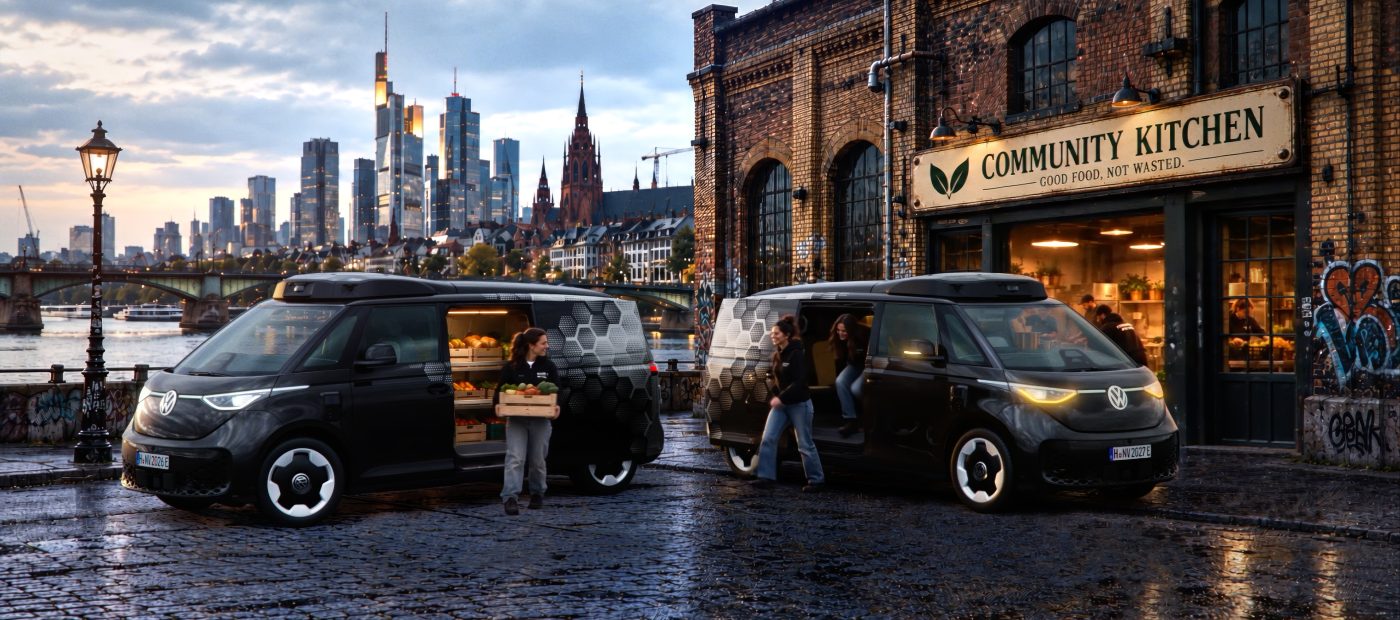
Volkswagen Commercial Vehicles showcases the autonomous ID. Buzz
Volkswagen Commercial Vehicles is showcasing the autonomous ID. Buzz at NVIDIA GTC Berlin. The company presents the van as a flexible, industrialised vehicle platform. It combines series-production quality with the integration potential that advanced technology demands. That makes it a strong fit for scalable passenger and commercial transport.
The stationary exhibit shows how the NVIDIA DRIVE AGX Hyperion 10 reference architecture fits into an autonomous ID. Buzz. Visitors can see how a leading autonomous-driving technology stack sits inside a vehicle built to series-production standards.
More than a base vehicle
Volkswagen Commercial Vehicles offers far more than a base vehicle. The brand contributes series-production quality, integration engineering and vehicle-side validation. Together, these elements form a robust foundation for scalable autonomous applications.
The autonomous ID. Buzz pairs proven vehicle engineering with genuine flexibility. It can accommodate qualified autonomous-driving systems from different developers. It also supports a wide range of use cases, from mobility services to commercial transport and logistics.
That flexibility matters because operators rarely share identical needs. A passenger mobility service has different requirements from a logistics fleet. A common platform lets both build on the same reliable base, rather than starting from scratch each time.
What is on show in Berlin
The vehicle on display in Berlin is a long-wheelbase autonomous ID. Buzz with a mobility-as-a-service interior. Its NVIDIA DRIVE AGX Hyperion 10 reference configuration includes 14 cameras, nine radars and three lidars.
Each sensor type plays a different role. Cameras capture detailed visual information, while radars measure the distance and speed of objects around the vehicle. Lidars map the surroundings in three dimensions. Combined, they give the system a broad, layered view of the road.
This compute and sensor architecture illustrates how an advanced Level 4 technology stack can be integrated into a vehicle developed to series-production standards. Level 4 describes automation in which the vehicle drives itself within defined conditions, without a human driver needing to step in. For operators planning driverless services, that level of capability is the key milestone.
Why the platform strategy matters
The showcase underlines the platform strategy of Volkswagen Commercial Vehicles. Autonomous-driving developers and operators can combine their high-tech solutions with a robust, series-production-based vehicle. They do not need to develop vehicle integration from the ground up.
This approach can reduce complexity. It can also support the scalable deployment of different passenger and commercial transport applications on a common vehicle foundation. In practice, a shared platform lets partners concentrate on their own strengths, such as software, services or fleet operations, while Volkswagen Commercial Vehicles handles the vehicle engineering and validation.
Scalability is central to this idea. A vehicle that works for one pilot project is useful. A vehicle that works across many customers, use cases and markets is far more valuable. By building on series-production processes, the autonomous ID. Buzz aims to deliver the consistency that large-scale deployment requires.
The ambition behind the autonomous ID. Buzz
Volkswagen Commercial Vehicles aims to establish the autonomous ID. Buzz as the series-production-quality platform for scalable driverless passenger and commercial transport. It wants to serve customers and markets around the world with a single, proven foundation.
At GTC Berlin, NVIDIA DRIVE AGX Hyperion 10 demonstrates how an additional qualified high-tech approach can be integrated into this common platform. The message to the industry is clear. Autonomous technology providers can bring their expertise, and Volkswagen Commercial Vehicles will provide the vehicle that carries it to market.