

HM Revenue and Customs (HMRC) has published the latest Advisory Fuel Rates (AFRs) and Advisory Electric Rates (AERs) that employers and fleet operators should use when reimbursing business mileage on company vehicles from 1 March 2026. These rates influence how businesses handle reimbursements for petrol, diesel, LPG and electric company cars, helping ensure tax-efficient mileage payments and compliance with HMRC guidance.
Advisory fuel and electric rates are reviewed quarterly, and while the recent update sees stability for many petrol and diesel vehicles, there are slight adjustments for LPG and public electric charging. Employers can continue to use the previous set of rates for up to one month after the new figures take effect.
Fleetpoint
For many businesses, keeping up-to-date with AFR and AER tables is more than an administrative task; these figures directly affect reimbursement policies, tax liabilities and internal accounting. In a climate of changing energy costs and a growing transition to electrified fleets, the March 2026 update aligns mileage allowances with recent cost trends.
What the New AFR Tables Show
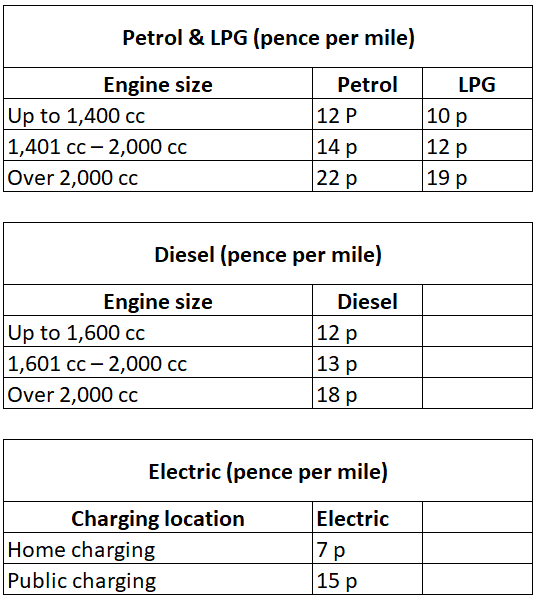
Under HMRC’s March 2026 update, petrol and diesel AFRs remain unchanged from the previous quarter, offering continuity in mileage rates for many companies. However, LPG rates see modest decreases across all engine sizes. Hybrid vehicles are still treated as either petrol or diesel for the purposes of advisory fuel rates.
For petrol cars with engines up to 1,400 cc, the rate remains at 12 pence per mile, with mid-range engines (1,401 cc to 2,000 cc) at 14 pence, and larger engines above 2,000 cc at 22 pence per mile. LPG rates, by contrast, have been reduced slightly: cars with engines under 1,400 cc see 10 pence per mile (down from 11 pence), mid-range 12 pence (down from 13 pence) and larger LPG engines 19 pence (down from 21 pence).
Diesel rates are steady, with vehicles up to 1,600 cc at 12 pence per mile, 1,601 cc to 2,000 cc at 13 pence, and over 2,000 cc at 18 pence per mile. These unchanged diesel rates reflect previous quarterly figures, offering certainty for fleets largely powered by traditional fuel types.
Advisory Electric Rates: Home and Public Charging
Electric vehicle drivers continue to see differentiated Advisory Electric Rates based on charging location. The home charging rate remains at 7 pence per mile, showing no change on the previous quarter. Meanwhile, the public charging rate increases from 14 pence to 15 pence per mile, reflecting the higher costs associated with public charging infrastructure.
The split rate recognises the different pricing structures drivers face: charging at home is often cheaper and more predictable, whereas public chargers can be more expensive depending on network and speed of charge. By increasing the public-charging AER, HMRC acknowledges evolving patterns in electricity costs for electric vehicle users.
Why the March 2026 Update Matters
These advisory rates are not arbitrary. HMRC bases the AFRs primarily on prevailing petrol, diesel, and LPG prices, alongside operational costs. For electric vehicles, the AER is linked to electricity price data and vehicle efficiency figures. Keeping these rates aligned with economic realities helps employers reimburse staff fairly without creating taxable benefits.
In practical terms, paying employees at or below these advisory rates means that employers do not have to report mileage reimbursements to HMRC for tax purposes, simplifying payroll and reducing administrative burden. Conversely, paying above these rates can trigger taxable benefits unless employers can justify higher payment levels based on actual costs.
Commenting on the update, Mark Checksfield, Head of Operations at Fleetmaxx Solutions, said “These figures are more than just administrative updates. They shape reimbursement policies, influence cost forecasting, and ensure that businesses remain aligned with HMRC guidance when employees use company cars for business travel. Even small movements, such as the LPG reductions or the public charging increase, can have a cumulative impact across larger fleets.
“Staying aligned with HMRC rates protects your business. It keeps mileage claims accurate, prevents over or under reimbursement, and supports correct VAT treatment. In short, it keeps your processes robust and compliant.”
Looking Ahead
As more businesses transition to electric fleets, the role of the Advisory Electric Rate is set to grow in importance. With public charging infrastructure expanding and electricity prices fluctuating, future quarterly updates may continue to reflect shifts in cost patterns. For now, employers and fleet managers should ensure their reimbursement policies align with the new rates effective from 1 March 2026 to avoid potential tax complications