
Renault E-Space Concept: The electric MPV reviving a family icon
Renault has used the 2026 Paris Motor Show to unveil the E-Space Concept, an electric MPV that sets out the brand’s new values. The car turns its back on the mainstream SUV. Instead, it gives a contemporary twist to the design cues of the MPV, a format Renault pioneered with the launch of the Espace in 1984.
Renault built the concept around its own history and, as a result, around the human factor. The designers began with the living area and created the interior first. They then wrapped it in bodywork with a wide expanse of glass on the sides and roof, letting the light flood in just as the finest architectural designs do.
A voiture à vivre for the electric era
Renault describes the E-Space Concept as a voiture à vivre with strong emotional appeal. It is designed for and around people, and it uses genuinely useful technology such as an electric powertrain. The car sits squarely within the values on which the brand is building its future. Four key fundamentals support those values, and they converge on a shared vision of people-centred cars that inspire emotion and deliver useful technologies underpinned by electrification.
Fabrice Cambolive, Renault Brand CEO & Renault Group Chief Growth Officer, said: “E-Space Concept shows how our heritage can inspire the future. When Renault created Espace in 1984, it invented a new way of designing cars by putting people and their lives at the centre. With E-Space Concept, we revisit that pioneering spirit for the electric era. This design exploration pushes the ‘voiture à vivre’ philosophy to new heights, imagining a versatile, generous and fully electric vehicle designed around the needs, aspirations and lifestyles of tomorrow.”
Alexandre Malval, Renault Brand Design Director, explained that the team created the concept as a tribute to the original. “Following the success of our iconic models, we designed this concept car as a tribute to the 1984 Espace – the very first MPV – which continues to fully embody the values of Renault as a brand designing voitures à vivre.
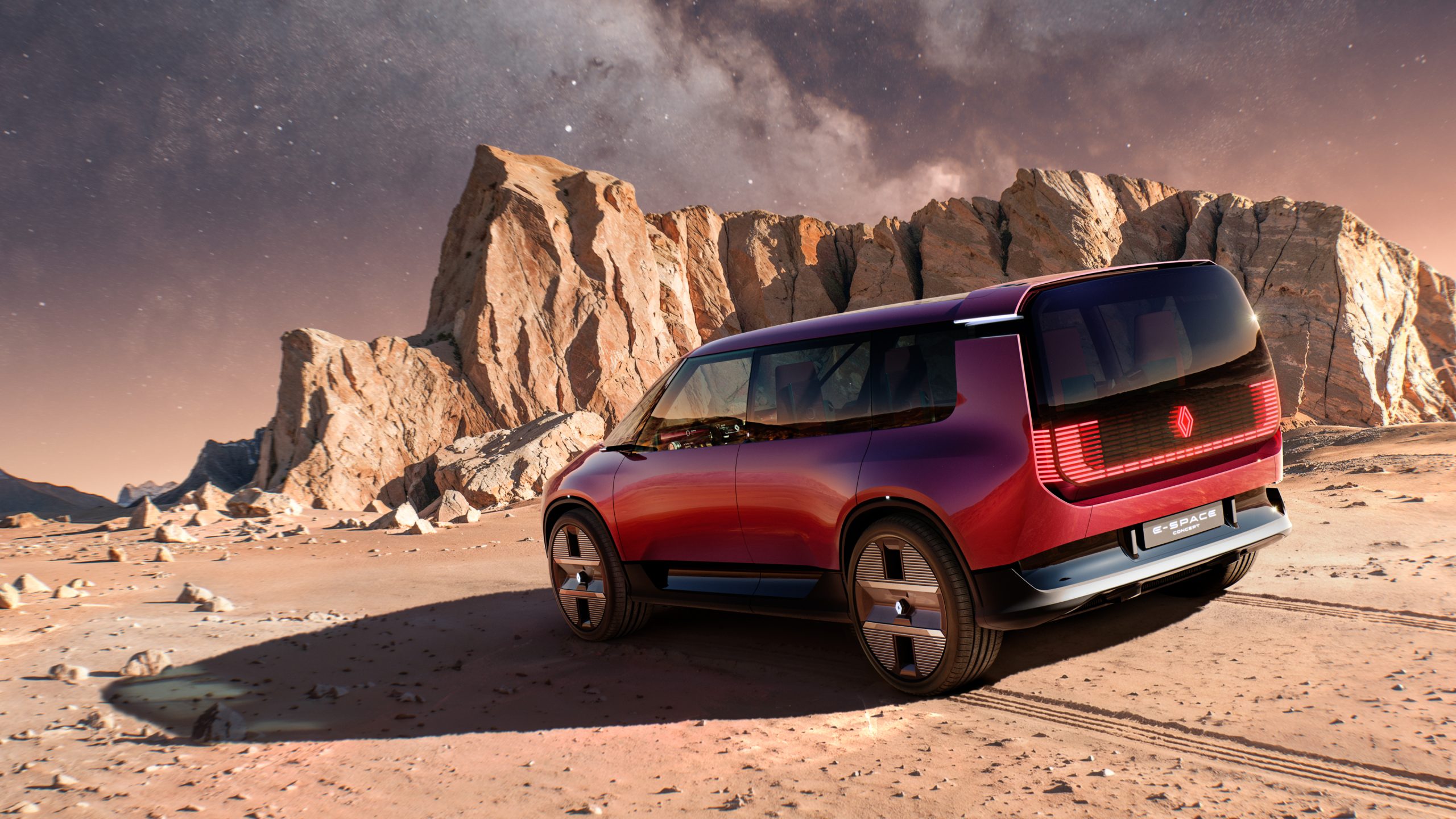
“Behind the form of the bodywork, designed to be legible and easily identifiable with its exceptionally clean lines, we have captured the iconic character of Espace. And at the same time, we have taken it into the future with cutting-edge technology and style.
“Inside the car, the soft features – such as the textiles on the door panels – convey a sense of comfort, forming a strong contrast with the high-tech finish of the screens, console and other details.
“In the ever-changing world of global automotive design, currently dominated by SUVs, Renault E-Space Concept proves that the brand has everything it needs to make its mark with intelligence and appeal.”
A formal design language with a clean, high-tech approach
The design language of the E-Space Concept celebrates simplicity. Lithe, clean forms dominate, and subtle lines of tension give them structure. The result is a visual language that reads instantly and reflects the brand’s values.
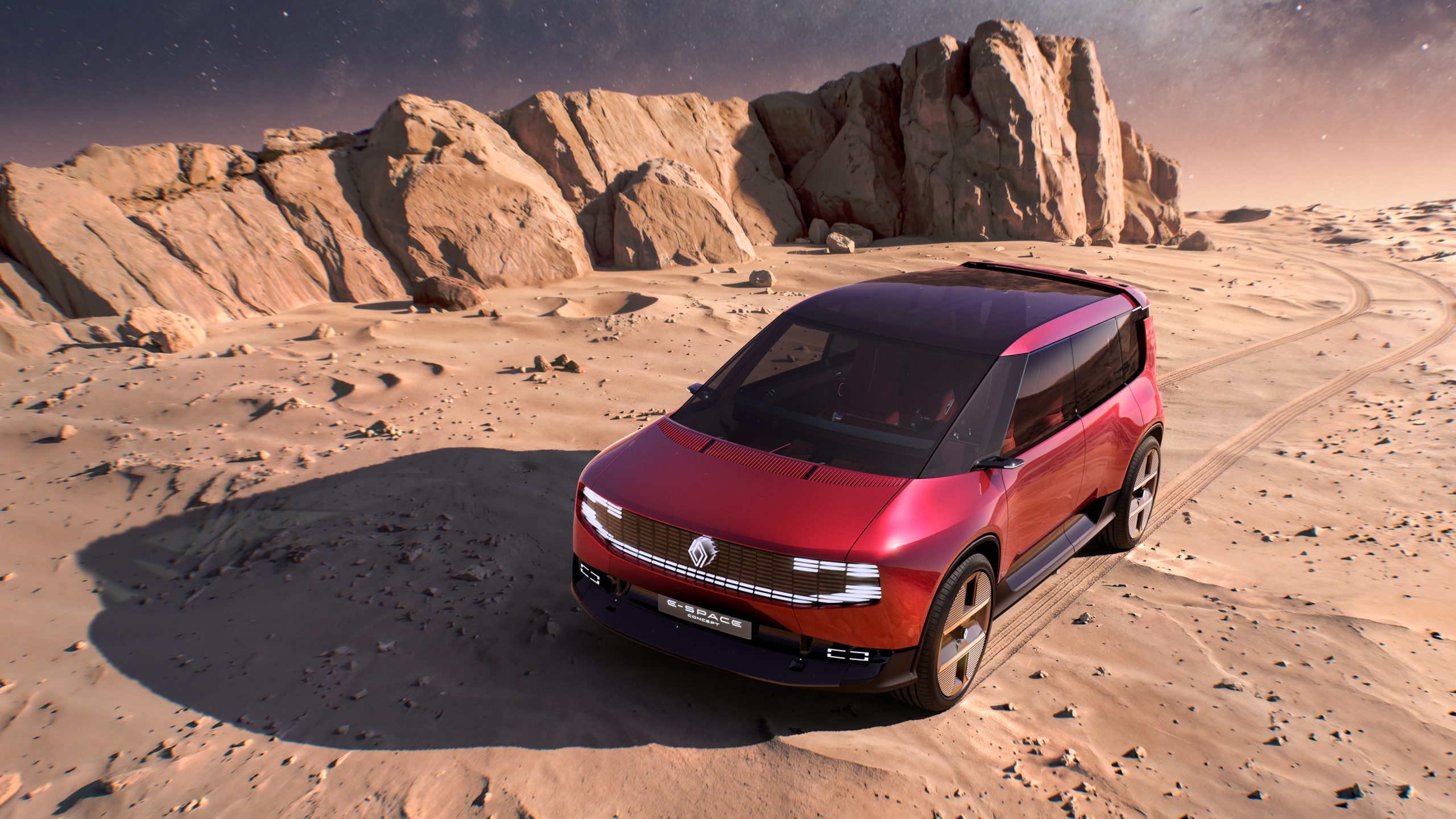
The car introduces a new light signature at both front and rear. A large “U” shape runs like a line of light around the entire grille. At its centre, an illuminated logo appears to float, as though a play of pixels suspends it.
Malval described the thinking behind the approach: “Stripped of anything that might distract the eye, the design language pursues simplification to the point where all that remains is the essentials, the clarity of the theme, with absolutely no fear of emptiness.”
Inspired proportions
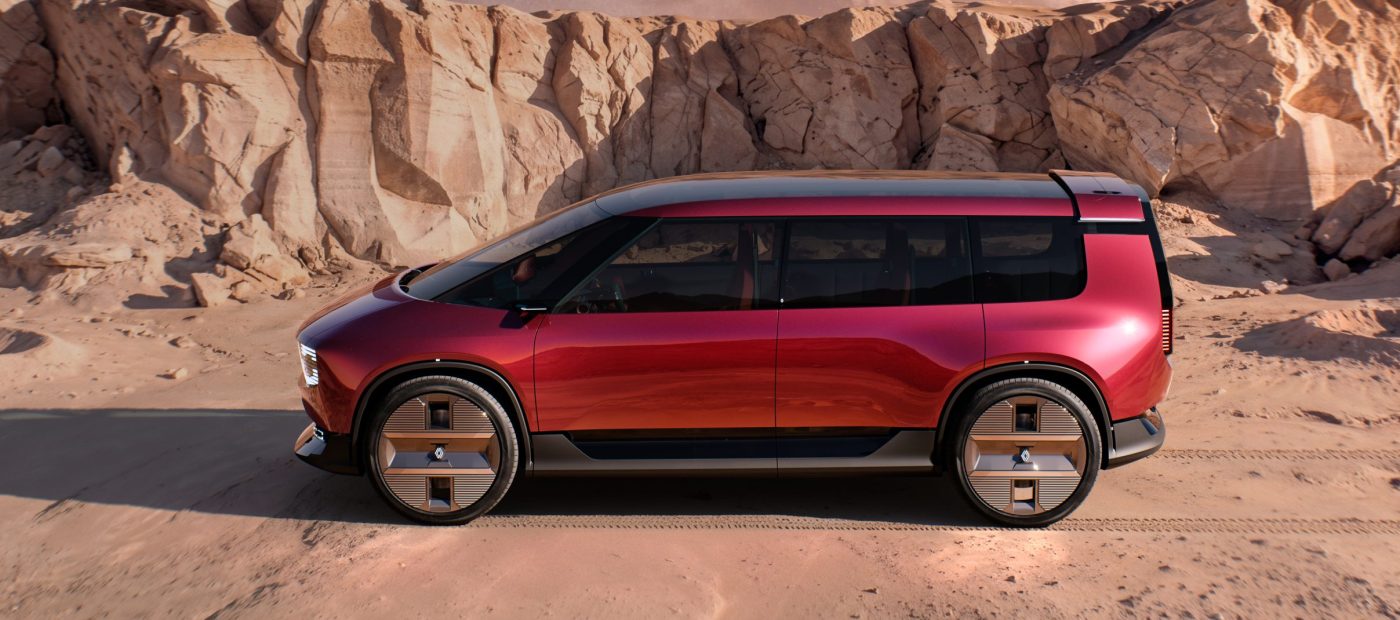
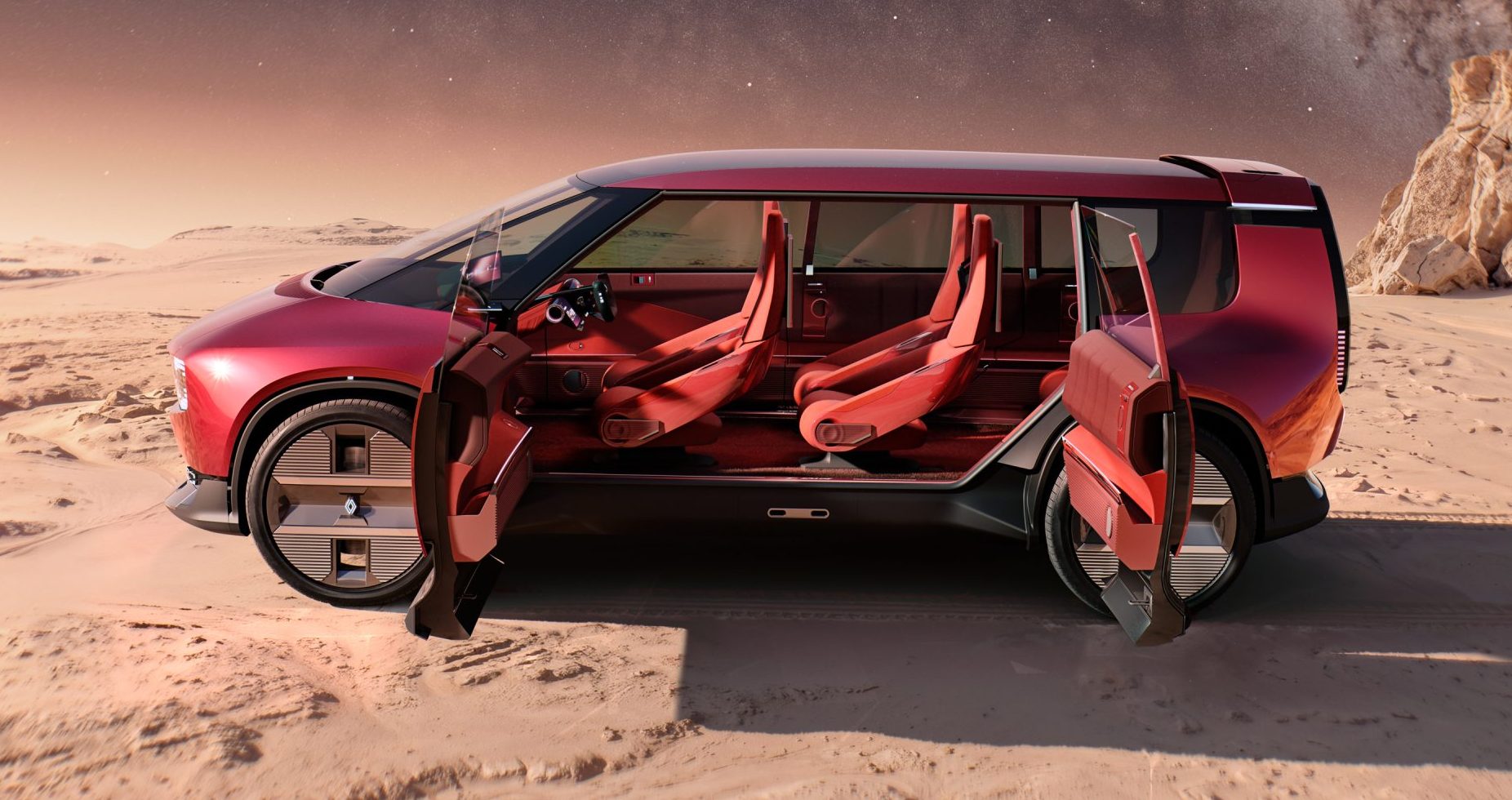
The E-Space Concept is a generously sized vehicle. It measures 4.70m long, 2.02m wide and 1.67m tall. Look beyond those dimensions and you will find that its height and length-to-width ratio resemble the first Espace. A modern twist comes from the short overhangs, which push the 23-inch wheels out to the four corners of the body.
The concept sits close to the ground, with a low waistline and moderate clearance. These proportions state the new cues of contemporary design and set the car clearly apart from the SUV. The windscreen flows on from the bonnet, a nod to the MPV’s DNA and, in particular, to the “TGV train” profile of the first Espace in 1984. The front splitter is mobile, so it can lower closer to the road and improve aerodynamics at high speeds. At the rear, vertical lines convey a sense of space and modularity, while the spoiler recalls a similar feature on the Espace 2 and 3.
A black skateboard reduces the visual mass when you view the car from the side. It suggests the technical systems, including the battery and a host of aerodynamic features, much like the sidepods on an F1 car. The bold black line of this technical “baseplate” continues onto the wheel design when the wheels align. The darker finish on the lower bodywork also echoes the wide grey side protection on the first Espace.
Romain Gauvin, Renault Brand Head of Advanced Design & Concept Cars, pointed to aviation as a source of inspiration: “Renault E-Space concept is inspired by the world of aeronautics, with smooth lines and a generous expanse of glass for all the passengers.”
A glass-walled cabin
Natural light sits at the heart of the concept. The designers therefore began by creating a fully glazed cabin inspired by Bauhaus architecture, and in particular by the work of Ludwig Mies van der Rohe (Farnsworth House, Plano, Illinois, 1951).
The glass roof and side windows extend well beyond the already very low waistline. The team wanted to attach the body panels to this glass cabin without creating a clear visual boundary between glass and metal. From outside, you can literally see the glazing continuing down behind the body panels, below the waistline. Specially designed lighting highlights the thickness saved between the windscreen and the bodywork, and the rear pillar seems to float.
Gauvin said: “With the low waistline, you can see into the cabin when standing next to the car. And once again, you can drive with your elbows on the door. Renault E-Space Concept is built on a chassis with a technical and precise design language, while the interior is encased in a glass bubble clad in smooth body panels of flowing lines.”
An interior bathed in light
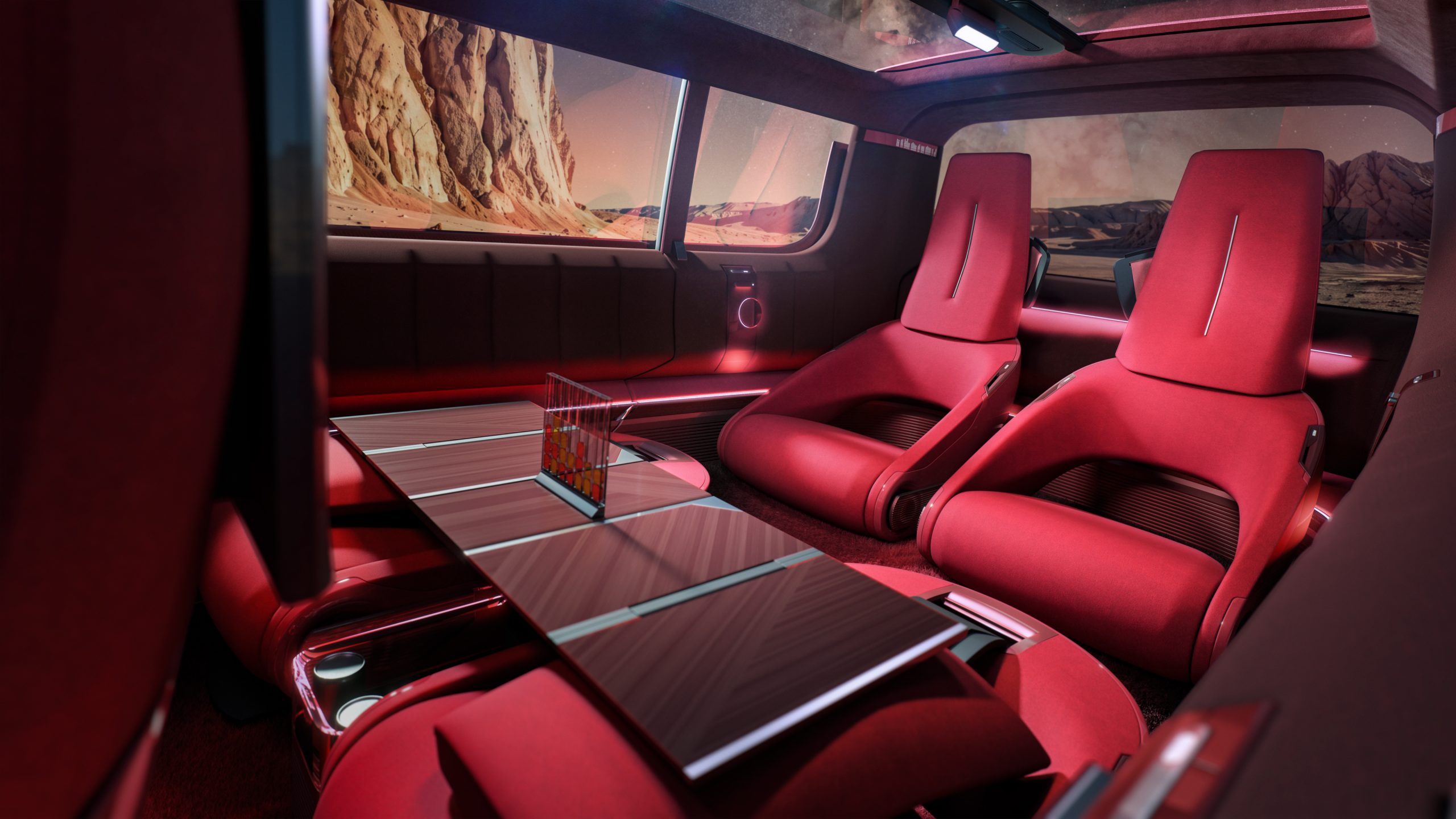
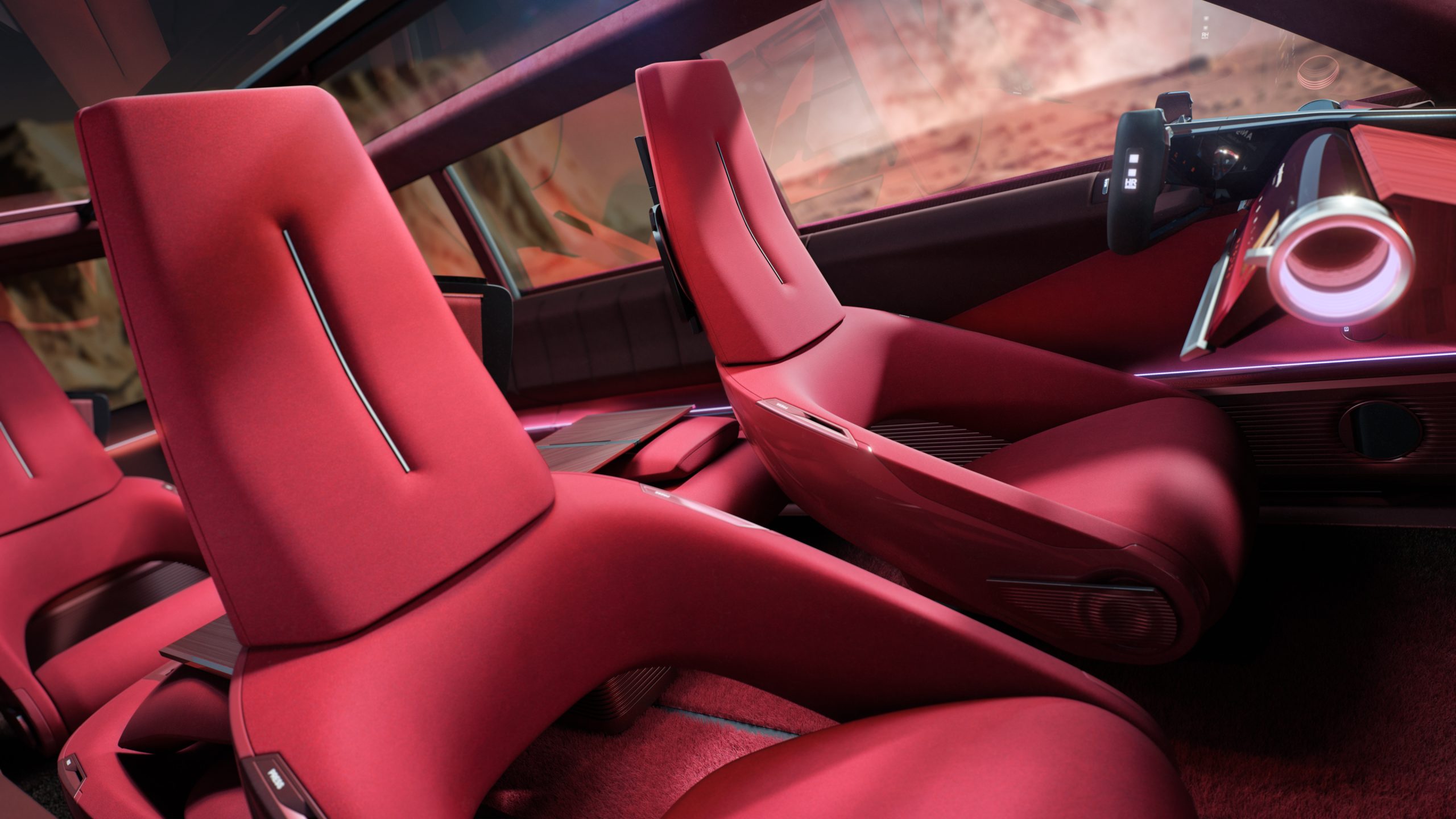
Double rear-hinged doors without a central pillar open onto an interior that is both high-tech and welcoming. The cabin feels airy and holds six individual seats on a completely flat floor. These seats break free from the traditional bucket seats of the automotive world. They borrow instead from interior design, with lacquered shells that bring to mind the style of Pierre Paulin. The seats are visually light and particularly slim at the top, much like those in the 1984 Espace, so they appear to float in the cabin.
Technically, the seat design is both modular and sophisticated. Alongside space and natural light, a modular interior is a key part of the Espace’s DNA. It matters even more to the voitures à vivre philosophy, the brand signature that remains as relevant as ever.
The six seats are identical in size and design, and each one rotates slightly on its axis to invite passengers to sit down. Their characteristics vary from row to row. The two seats in row two swivel through 180° and form a “TGV train square” with row three. In the standard forward-facing position, row-two passengers can use folding tray tables, each with a 12.3-inch screen mounted on the back of a row-one seat. In the four-seat configuration, the row-two seats fold down completely and create a large table for the row-three passengers. Those passengers can still see the screens on the backs of the row-one seats.
The table also carries a remote-control console that slides along the cabin’s central spine. The console includes an air purifier, a small fridge and video game controllers. It also contributes to the friendly ambience so important in voitures à vivre with a conventional game of “Connect 4”.
The door handles are clean and simple in design, and quilted fabric covers them. This lends the interior a cosy, cocoon-like feel without losing a sense of strength. The low waistline makes armrests unnecessary, so passengers can rest their elbows directly on the window ledge.
An illuminated line runs along the bottom of the cabin and echoes the exterior design at the waistline. Softer lights enhance the ambient lighting further, alongside night lights built into the speakers and reading lights on a longitudinal rail in the centre of the glass roof.
Stéphane Maiore, Renault Brand Head of Interior Design, said: “Inspired by furnishings rather than cars, the seats do not overwhelm the interior space. They are designed to swivel for easy access or to create a cosy seating area. We wanted to create an in-car ambience that is both futuristic and welcoming, with a touch of nostalgia.”
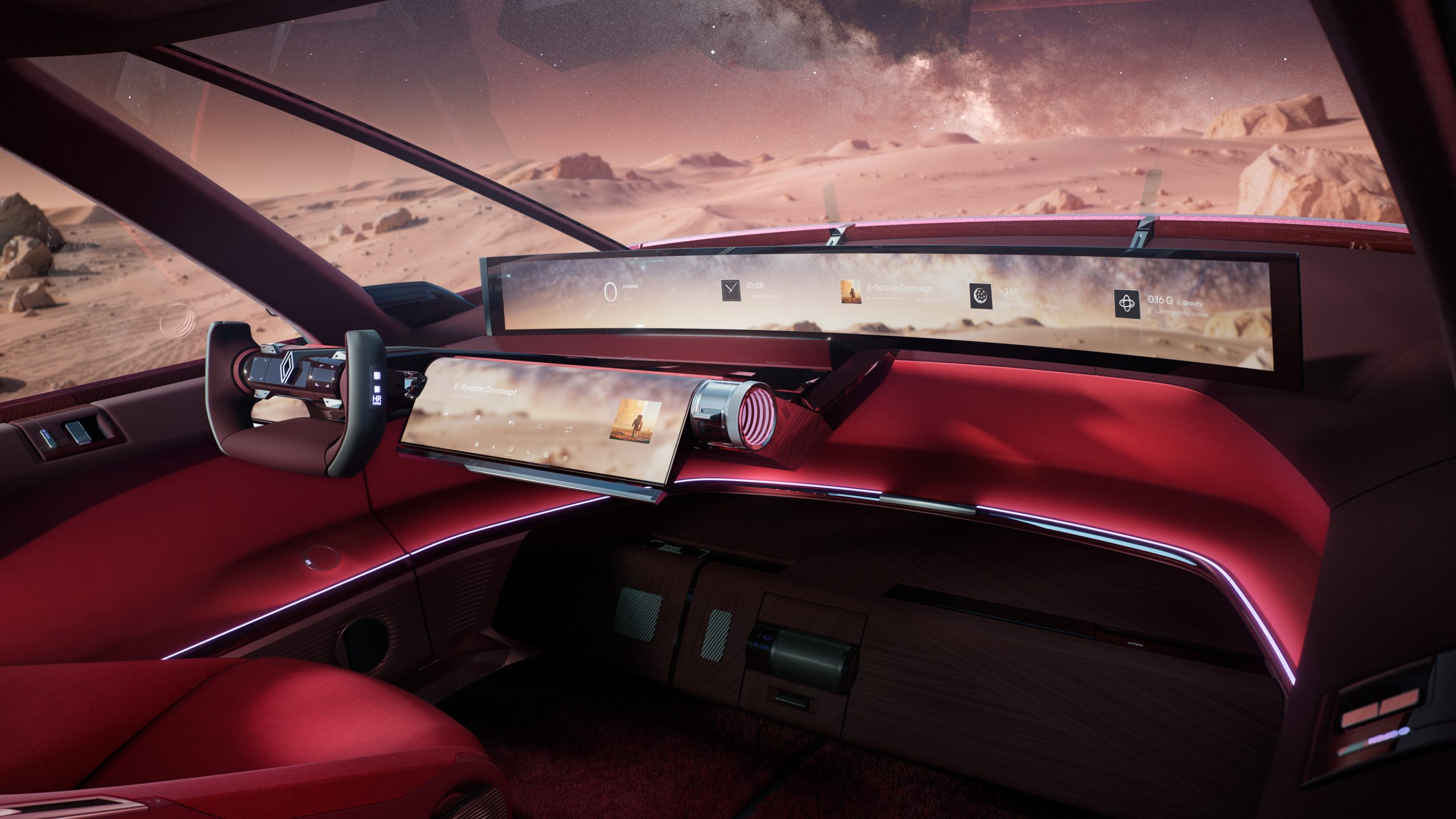
A high-tech dashboard
Technology makes its statement through a screen that spans the entire width of the cabin and measures 1,130 x 110 mm. Renault calls this curved “pillar to pillar” display OpenR Panorama. It will feature in upcoming models in the brand’s executive line-up, and the next-generation Rafale and Scenic will be the first to gain it.
OpenR Panorama provides all the necessary information and effectively replaces the conventional dashboard. It is not touch-sensitive. Renault positions it as close as possible to the road, which improves driving ergonomics and safety. The front passenger has no dashboard in front of them, so the large screen appears to hang in the passenger compartment. This original design frees up considerable space in row one and adds to the airy feel.
Two flexible screens handle the touch controls for the OpenR Panorama functions. They swivel around a tubular base that also carries the steering wheel, so the driver can maximise or minimise the amount of information as required. The layout also increases the space in front of the front passenger. Below the dashboard, the lower bulkhead abandons conventional automotive cues and adopts a curved storage unit instead. This unit spans the full width of the cabin and incorporates both the sliding console and the pedals, with their mechanism fully concealed.
The compact steering wheel gives an unobstructed view of the panoramic screen. It uses steer-by-wire technology and has no mechanical links, so drivers can control the steering angle as required.
Maiore explained the thinking: “Using steer-by-wire technology, we have been able to design a steering wheel free from all the physical constraints generally associated with steering. The cylindrical shape of the crossbar echoes that of the dashboard. Fitted with a fixed hub, the steering wheel also features touch-sensitive controls that allow the driver to interact with the OpenR Panorama multimedia screen.”
Colour makes a comeback
Renault earned renown in the 1970s for its vibrant pop interiors, and it now revives that signature style. The E-Space Concept combines gleaming bodywork with interiors drenched in colour. Here, “colour” stays in the singular, with shades of red including scarlet, purple and even garnet. The 3cm thick carpet draws the eye immediately. Its coral centre gradually darkens as it spreads outwards, as if diffusing the intense colour.
Inside the cabin, the components and controls are primarily metal with a premium finish. They bring to mind jewellery rather than technology. The marquetry follows a similar approach, particularly on the tray tables on the backs of the seats. Straw replaces wood in this marquetry and adds a touch of fine craftsmanship.
Eléonore Lebec, Renault Brand Colour and Materials Designer, said: “Step inside the cabin to immerse yourself in colour! With the dashboard and textile-trimmed panels in shades of red, and the thick coral-coloured carpet with its gradient effect, the brightly coloured cabin offers a generously lit ambience that structures the interior and brings it to life.”
Materials close to nature
Renault has made a noteworthy commitment to include 30% recycled materials across its range. The E-Space Concept goes further and acts as a forward-looking exercise in bio-based materials. These renewable materials look appealing and meet high standards of technical performance.
The approach takes on new meaning here. The concept moves away from the bio-sourced materials the automotive industry uses most often, namely leather and wood, and explores new possibilities instead.
Dyed straw forms the trim features in the cabin, and the designers apply it directly to the support. A 100% wool, long-pile tufted carpet covers the floor. The paint inside the car uses a bio-based resin (18%). The steering wheel combines fabric with a material found in most Renault models, which contains 26% castor oil and 25% organic cotton. Other components also use natural content. The Michelin tyres, for example, include an average of 19% natural rubber from managed rubber plantations.
A glimpse of Renault’s future
The Renault E-Space Concept shows how the brand intends to blend heritage with electrification. It offers a flexible, light-filled alternative to the SUV and previews technology, such as OpenR Panorama, that will reach production cars soon.