
MG4 EV Extended Range Review: A fun, affordable fleet EV
A genuinely fun rear-drive hatch that’s also a salary sacrifice bargain, reviewed by Ian Campbell
First Impressions
This month I spent a proper week with the facelifted MG4 EV in Extended Range Premium trim, and I have to say up front; I had a really good time with it. I put this car through the paces properly: a decent road trip up the country, plenty of urban stop-start work, and a stretch of the sort of driver-friendly country roads that either flatter a car or expose it. The MG4 handled all three with genuine credit.
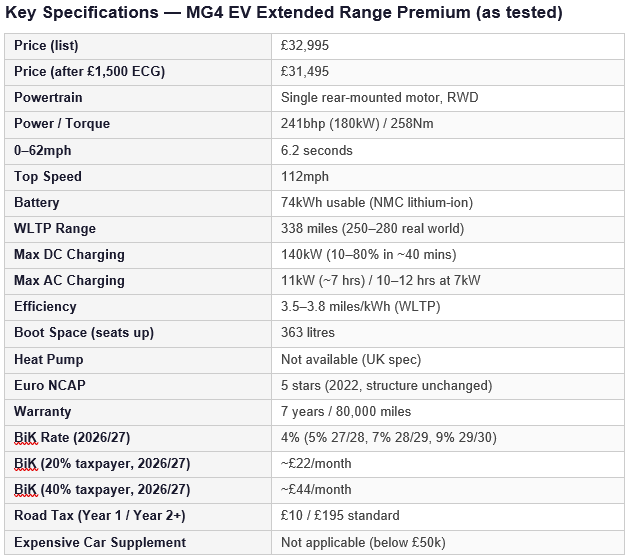
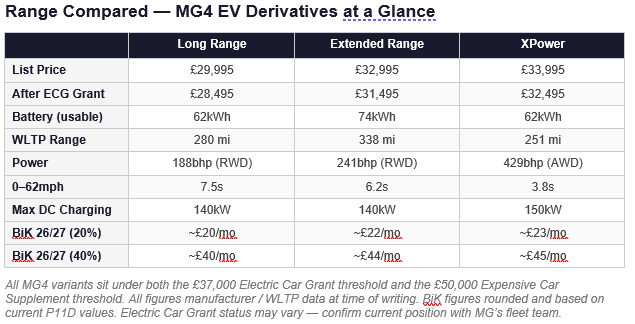
Let’s deal with the basics first. The MG4 range now consists of just three variants: the Long Range Premium at £29,995, my Extended Range Premium test car at £32,995, and the XPower hot version at £33,995. My car came with a 74kWh usable battery, a 241bhp rear-mounted motor, a claimed 338 miles of WLTP range and a 0–62mph time of 6.2 seconds. That last figure is quicker than most petrol hot hatches from a decade ago — and remember, we’re talking about a car with a list price under £33,000. Prices moving in the right direction, for once.
Here’s the fleet headline that had me thinking this is a fleet winner: at 4% Benefit-in-Kind for the 2026/27 tax year, a 20% taxpayer is looking at around £22 a month in BiK on this car. Twenty-two pounds. Forty-four for a 40% taxpayer. Then factor in that every MG4 sits below the £37,000 Electric Car Grant threshold and well below the £50,000 Expensive Car Supplement cutoff, and you’ve got a car that’s almost embarrassingly cheap to run through a salary sacrifice scheme. Electrifying.com called the MG4 their Salary Sacrifice Car of the Year in 2024, and I can see exactly why.
Design and Interior
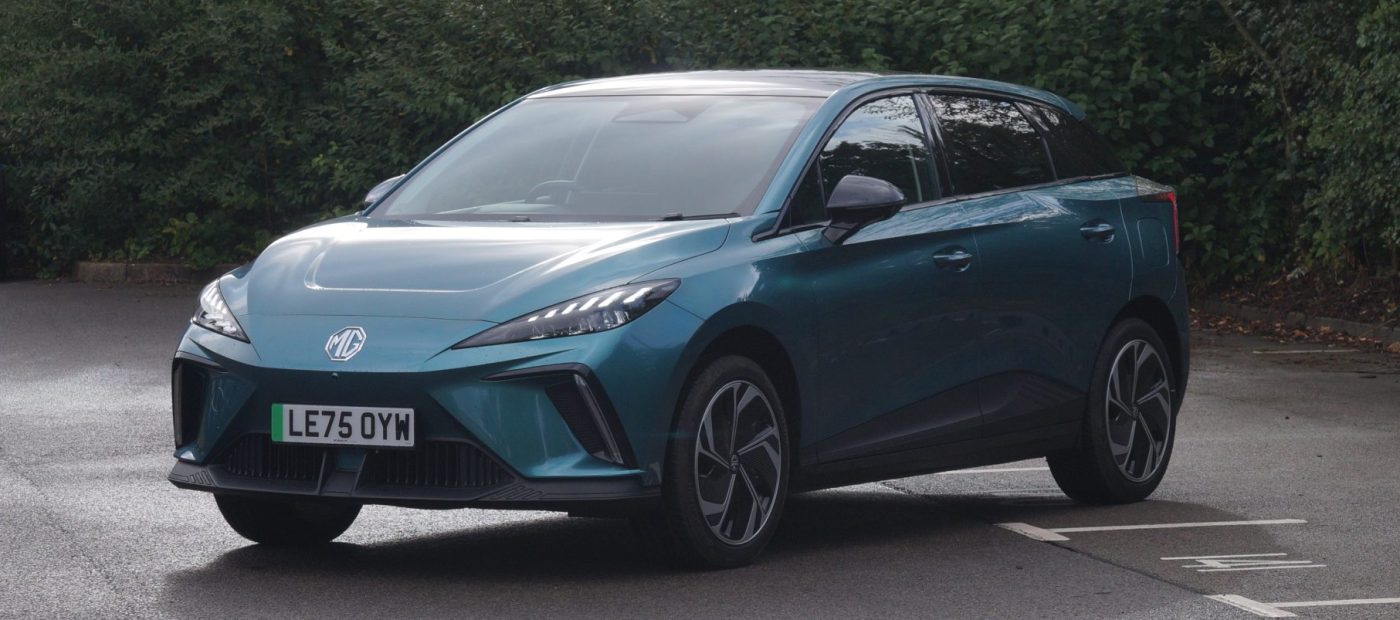
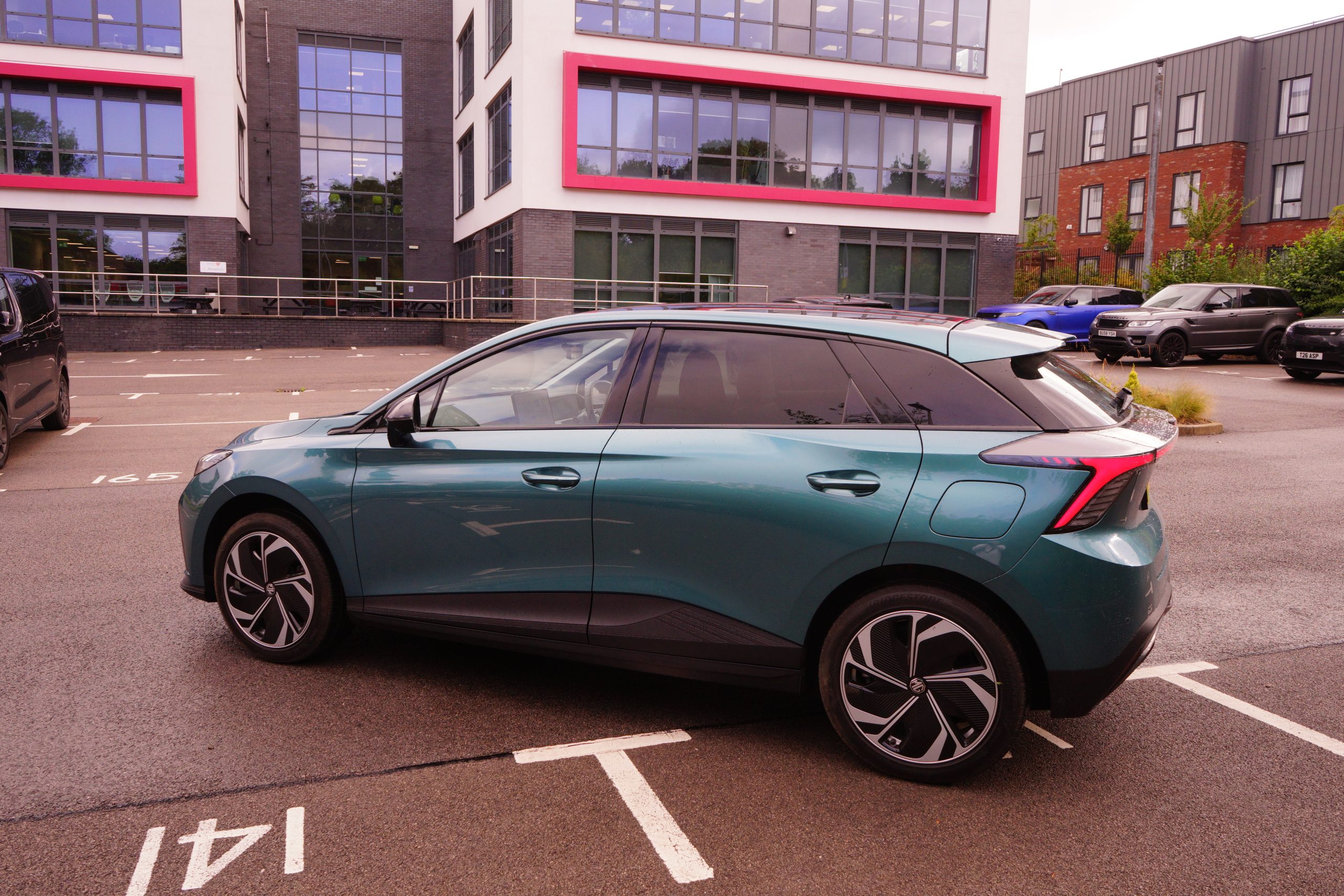
The 2026 facelift didn’t change the MG4’s face. The angular, insectoid front end that some love and some tolerate is unchanged, and there’s a subtle tidy-up to the rear spoiler that’s now a single plane rather than the split-wing arrangement of earlier cars. It’s a look that’s aged reasonably well; modern, distinctive, and undeniably a bit more interesting than the po-faced ID.3 it’s benchmarked against. In the metal it looks properly good, particularly on the two-tone paint options.
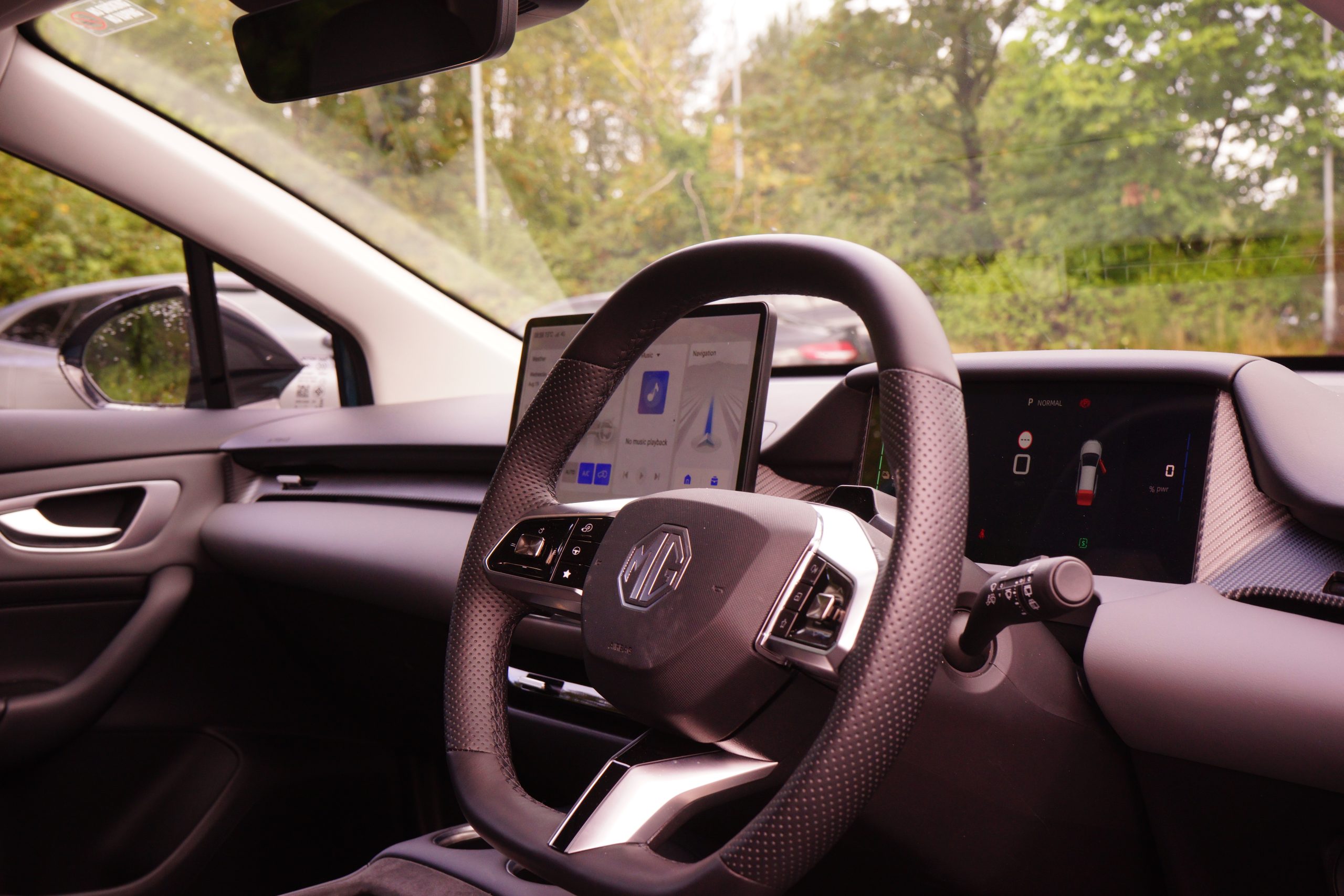
Where the facelift really earned its money is inside. The old MG4 cabin was functional but plasticky; the new one is a genuine step up. There are plush-feeling materials wrapping the upper dashboard and door tops, the seats have been reshaped and re-upholstered, and there are new metal switches on the centre console that feel properly premium in the hand. It’s still not going to trouble a Cupra Born for outright material quality, but for the money it’s absolutely fine — and in some places, actually rather good.
Now, the seats. I’ll come back to this in the road section, but the front seats have a proper sporty position. You sit low, they hug you in the right places, and getting comfortable took about ten seconds of adjustment. The MG4 comes with a standard six-way electric driver’s seat, which for the money is generous. Rear headroom and legroom are both good for a car of this size — four six-footers travel without complaint — and the boot at 363 litres is a decent size, but somehow I thought it should be better for this size.
The wife test, five months running, was passed with a caveat. She loved the driving position, liked the switchgear, and the chimes didn’t bother her — but she did comment on the rear visibility. Which brings me neatly to a niggle we’ll get to shortly.
Infotainment and Physical Controls
Big call-out first: I am genuinely a fan of what MG has done with the physical controls. In an industry hell-bent on burying every function behind a touchscreen, MG has kept a proper row of switches, knobs and buttons below the infotainment screen for temperature, fan speed, volume and drive settings. Adjusting the climate control while driving, or nudging the stereo down when a phone call comes in, remains a matter of feel rather than glancing away from the road to hunt for a screen icon. This is exactly how it should be, and I hope other manufacturers are taking notes.
Even better, and this was a real highlight for me, is the MG Pilot button. One press of that shortcut gets you to your preferred combination of driver assistance settings, so all the over-zealous lane-keep chimes and speed warnings that plague every new car can be knocked back to sensible levels without diving through menus. Every ignition cycle, one button, done. If you’re a fleet manager putting drivers into a car day after day, this single feature is worth a lot. It’s the most sensible thing any manufacturer has done in response to the ADAS regulation headache, and it deserves loud applause.
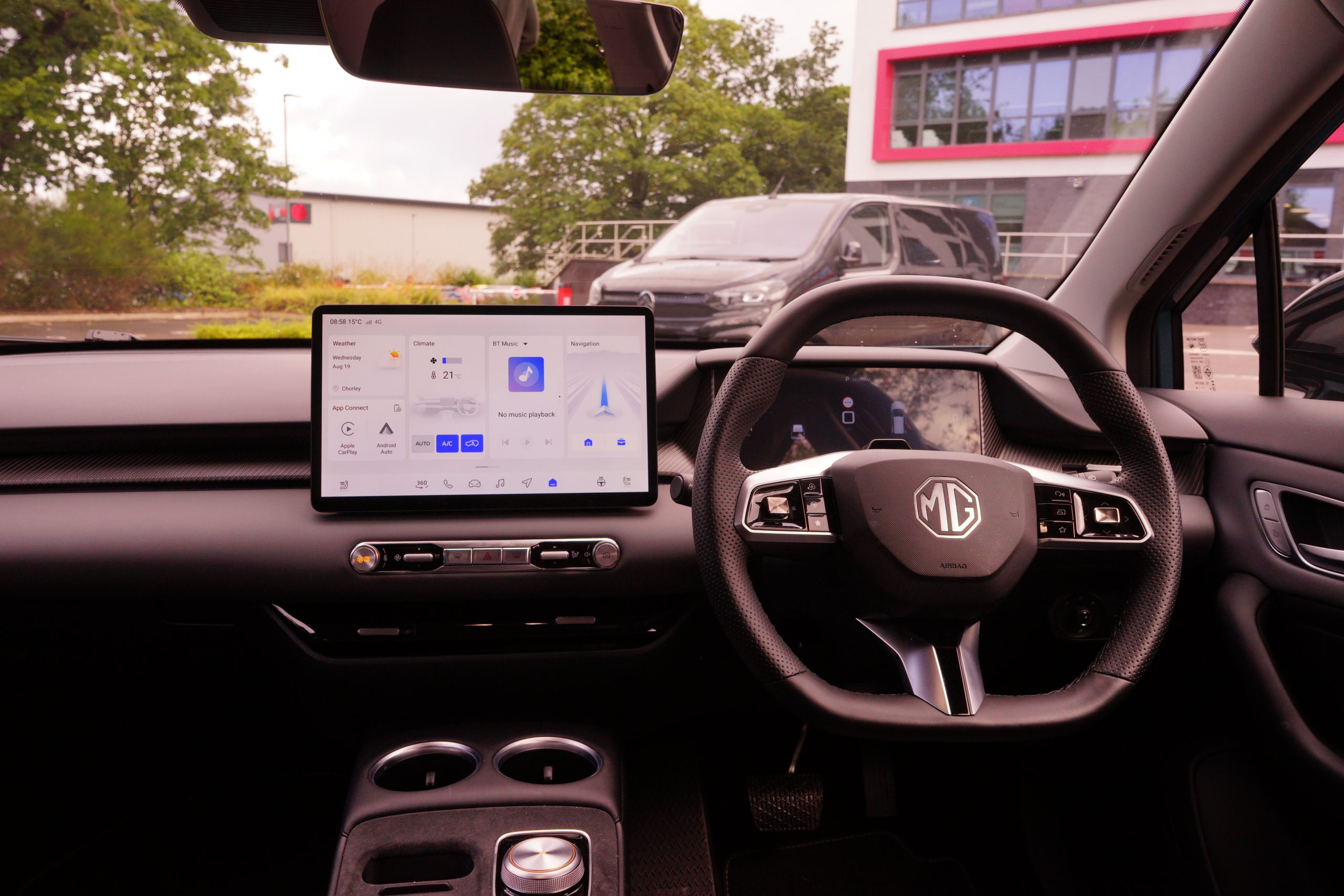
Now, the honest bit. The 12.8-inch central touchscreen itself is a mixed experience. When it works, the graphics are good, the layout is logical, and wireless Apple CarPlay connects seamlessly. When it works. During my week with the car, connection to CarPlay was properly a roll of the dice — sometimes it fired up on the first attempt, sometimes I spent five minutes at the start of a journey fiddling with the dash to get it to connect. And when I’m spending more time troubleshooting Bluetooth than concentrating on the road, that’s a problem. I have seen it flagged up as the the same issue in alternative long-term testing, so I don’t think it’s just me. Kudos to MG when the connection is stable — the software once running is genuinely good — but this is one area that needs an over-the-air update, urgently.
The six-speaker DAB stereo is, honestly, just okay. Nothing special. It does the job for radio and podcasts and won’t offend anyone, but if you’re an audiophile the MG4 isn’t your car. Wireless phone charging is standard on Premium trim and worked reliably during my test. The 10.25-inch driver display is clear, well laid out and shows you everything you need at a glance.
On the Road
Here is where the MG4 becomes genuinely special. The Extended Range Premium runs a single rear-mounted electric motor developing 241bhp, and the whole car is built on a dedicated EV platform with the battery low in the floor, a long wheelbase, near-perfect 50:50 weight distribution and a proper multi-link rear suspension. That’s the recipe for a sporting rear-drive hatch, and MG has genuinely delivered on it.
On the country roads it was an absolute joy to drive. You can feel the rear-wheel drive working under you as you power out of a corner — there’s a proper sense of the car being pushed rather than pulled, and the steering has enough weight and feedback to let you place the car with confidence. The 241bhp motor is properly punchy, the brakes are well-judged (a rarity in EVs), and the four levels of regenerative braking mean you can drive one-pedal in traffic or leave more coasting for a long motorway run. I think the MG4 sits in the fun-biased corner of this segment alongside the Cupra Born and Renault Megane. This car has actual character.
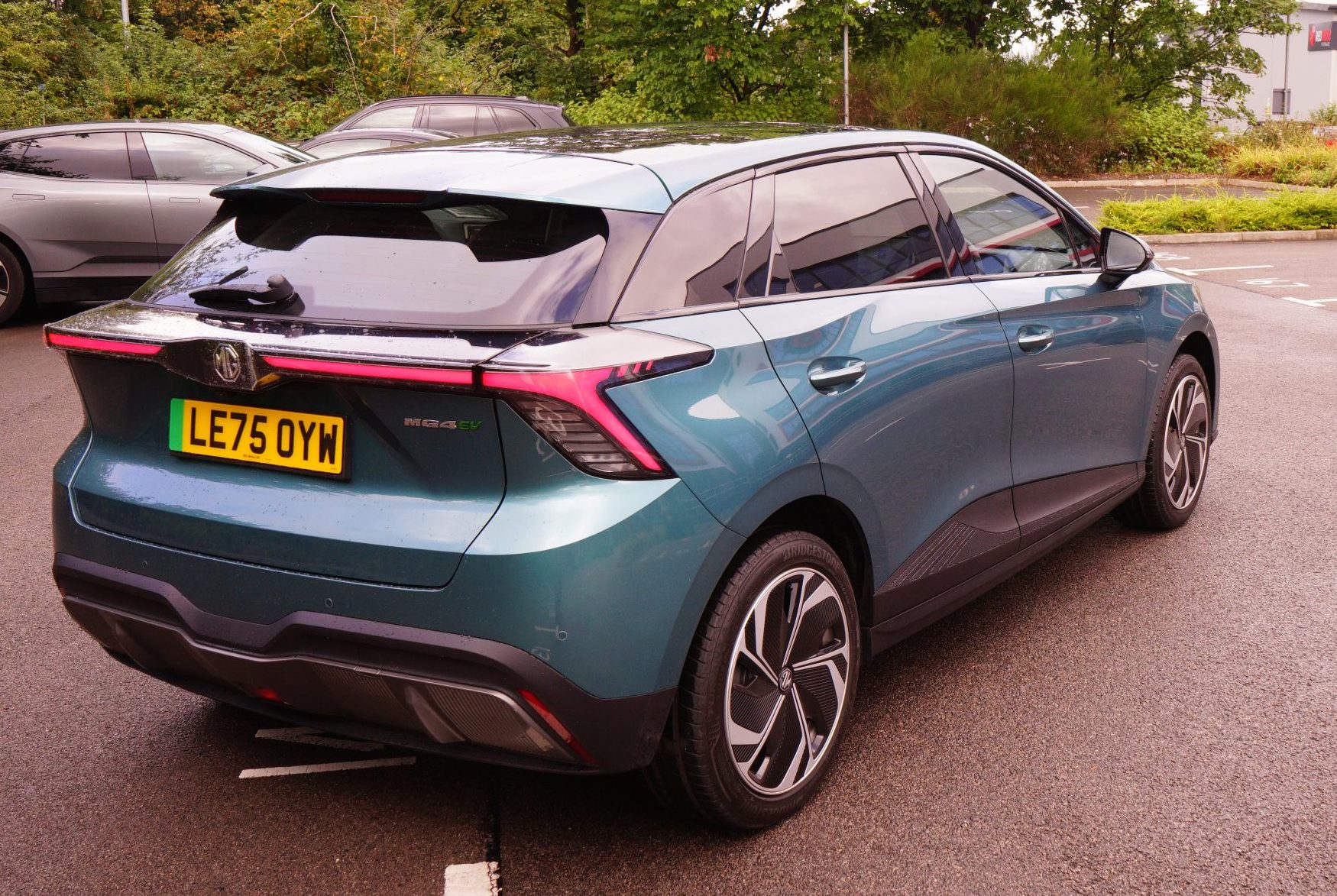
Around town it’s equally easy. The tight turning circle, light steering at parking speeds and standard 360-degree camera make city work no drama at all, and the immediate electric torque means you’re never left waiting when a gap appears. The one-pedal mode in strong regen becomes second nature within a day.
Now the honest bits from my road trip. First, cabin noise. At 70mph on the motorway there’s a fair amount of wind and road rustle around the A-pillars — more than a Renault Megane E-Tech, definitely more than a Cupra Born. It’s not intrusive to the point of a show-stopper (as I noted in my week with it), but it’s worth being aware of if your drivers spend a lot of time on motorway miles. Second, the seat. Sporty is great for a country road; less great for a five-hour continuous stint. By the end of my longest day I did have a bit of what my kids would call ‘numb bum’ — the sport-focused shape and firm cushioning don’t give you quite the long-haul comfort of a more traditionally shaped seat. For most journeys it’s a non-issue, but if your drivers are regularly doing three hundred miles a day, worth a test drive first.
Battery, Range and Charging
The Extended Range’s 74kWh usable battery delivers an official 338 miles WLTP. In real-world driving I saw an indicated range around 250–280 miles depending on the mix and the outside temperature. That’s enough for a comfortable working day for any driver, and the road trip element of my testing was completed with fewer stops than I’d expected.
DC rapid charging peaks at 140kW, which is not quite class-leading but is genuinely fine for a car at this price point. A 10–80% top-up takes around 40 minutes on the Extended Range. At home on a 7kW wallbox you’re looking at 10–12 hours for a full charge, or under seven at 11kW AC. Overnight charging is entirely comfortable.
A word of honest caution for fleet managers: the MG4 is not available with a heat pump in the UK, and you can’t add one as an option. That will hit your real-world winter range harder than it would on a rival with a heat pump fitted. For fleet operations in Scotland, the north of England, or anyone doing regular commercial mileage through winter, it’s a factor worth pricing into your total cost of ownership calculations. It’s also, to my mind, the single most surprising omission on an otherwise sensibly specced car.
The Niggles
First, rear visibility. The rear window on the MG4 is small to start with, and the addition of a middle headrest across the back seats (a positive safety upgrade that came with the facelift) genuinely does obstruct the view rearward. If I owned this car, I’d have that middle headrest out and in the boot within the first week to help with the situation. The standard 360-degree parking camera does a lot of heavy lifting to compensate, but if you’re a driver who relies on the mirror rather than the screen, this is worth being aware of.
Second, the CarPlay reliability I’ve already flagged. Third, the driver alerts; same regulatory nuisance every new car suffers from, though as I said above, MG’s single-button shortcut is by far the best mitigation I’ve encountered on any current model.
Safety and Warranty
The MG4 holds a full five-star Euro NCAP rating from its 2022 test, and the facelifted car is structurally the same as tested. Every trim comes with the full active safety package as standard: automatic emergency braking with pedestrian and cyclist detection, lane-departure warning, rear cross-traffic alert, blind-spot monitoring, adaptive cruise control and two rear-seat Isofix mounts. The standard alarm and immobiliser are welcome additions for a car often parked in supermarket car parks on the school run.
The warranty is seven years or 80,000 miles — slightly shorter than Kia’s 100,000-mile equivalent, but still one of the strongest in the industry. For a fleet operator running a typical four-year, 80,000-mile cycle, the car will be exactly at warranty expiry at defleet time. That’s a genuine risk-management advantage against a three-year warranty from most European rivals, and it’s a helpful counterweight against the reliability concerns I mentioned above.
The Fleet and Sal-Sac Case
Right, this is where the MG4 makes its strongest case. Pure electric cars sit at 4% BiK for the 2026/27 tax year, rising to 5% in 2027/28, 7% in 2028/29 and 9% in 2029/30. For the Extended Range Premium at a P11D value of £32,990, that translates to:
- 20% taxpayer, 2026/27: around £22 per month in BiK (£264 per year) • 40% taxpayer, 2026/27: around £44 per month in BiK (£528 per year)
Compare that with a similarly-sized petrol or diesel hatchback in the 25–35% BiK bracket, and you’re typically saving £150–£250 a month in tax alone. Over a four-year contract, that’s £7,000–£12,000 in your pocket rather than HMRC’s. For a fleet decision-maker rolling out an EV choice list, it’s a genuinely powerful pitch.
Where the MG4 particularly shines is on salary sacrifice. Broker-published figures put a 20% taxpayer at around £330 per month net through a typical sal-sac scheme, all-inclusive of the lease, insurance, servicing, tyres and often a home charger. A 40% taxpayer sits closer to £260. That is stunning value for a 241bhp rear-wheel drive hatchback with a 338-mile WLTP range. It’s also cheaper than a personal lease deal on the same car by a meaningful margin — exactly the kind of maths that gets a salary sacrifice programme adopted.
Two more genuinely important fleet-specific points to close on. Firstly, all three MG4 variants sit under the £37,000 Electric Car Grant threshold, meaning they qualify for the £1,500 Band 2 grant — effectively bringing the on-the-road price of my test car down to £31,495. Secondly, every MG4 sits well below the £50,000 Expensive Car Supplement threshold, so drivers avoid the £425 annual VED supplement that catches out pricier fleet EVs from year two to six. Both of those are meaningful money over a four-year cycle.
If your organisation is running or planning a sal-sac scheme aimed at giving lower-paid staff their first realistic shot at a decent EV, this is close to unbeatable.
The Competition
The MG4 sits in a properly contested segment. The VW ID.3 is the obvious rival, but it’s pricier trim-for-trim and less fun to drive. The Cupra Born is more polished and better-riding but costs meaningfully more. The Renault Megane E-Tech is more refined and roomier but similarly pricier. The BYD Dolphin is close on price but lacks the MG4’s driving character and refinement. The recently-launched Kia EV4 comes with a longer warranty but also a higher price point. What separates the MG4 is that it’s the fun, driver-focused choice at a value price — and with a range of grants and taxation advantages stacking in its favour, the whole-life numbers are hard to argue with.
The Verdict
The MG4 EV Extended Range Premium is a genuinely enjoyable car. It looks distinctive, it drives with proper character on a good B-road, the physical switches for the important stuff are a breath of fresh air, and the MG Pilot shortcut for the driver assistance settings is possibly my favourite single feature on any car I’ve tested this year. It also comes with a tax and grants position that for a Fleetpoint audience is very hard to ignore; 4% BiK, sub-£37k list price qualifying for the Electric Car Grant, and monthly sal-sac numbers that make a compelling story to any CFO.
It’s not perfect. The CarPlay reliability was genuinely frustrating during my week with the car and needs a software fix. The cabin noise creeps in at 70mph. The sport-shaped seat that was a joy on country roads did leave me a bit numb after five hours behind the wheel on the motorway. The rear window is small before you even add the middle headrest. And MG’s brand-wide reliability record needs an honest place in your fleet risk assessment.
But the balance is comfortably on the positive side. Four stars from me. For fleet managers running a mixed choice list on salary sacrifice, or looking to bring a properly enjoyable EV into the pool at a price point that opens the door to lower-paid staff, the MG4 Extended Range Premium is a serious contender. And for the drivers themselves — well, they’re getting a rear-wheel drive hatch that’s genuinely fun for the price of a Toyota Corolla. That’s a rare thing in 2026.