
Lepas L8 Elevate Review: The Best New Plug-In Hybrid You’ve Never Heard Of!
Watch the review — click here (opens YouTube in a new tab)
A week with the Lepas L8 Elevate, reviewed by Ian Campbell
First Impressions
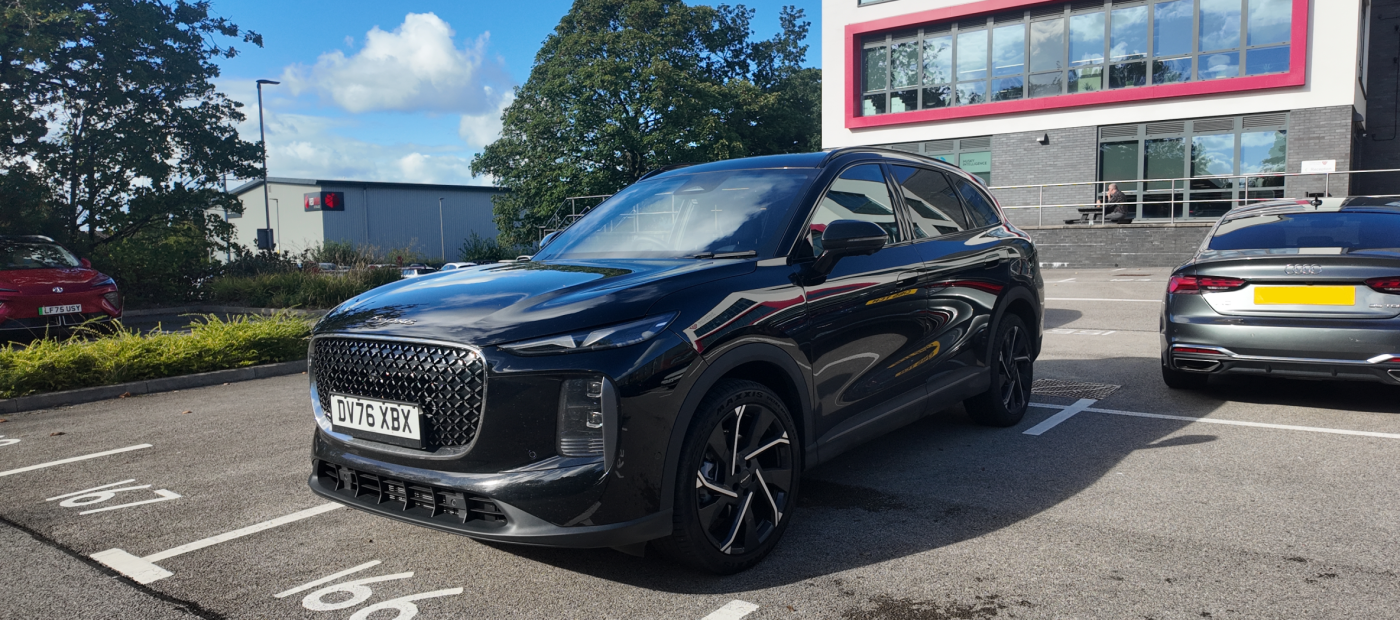
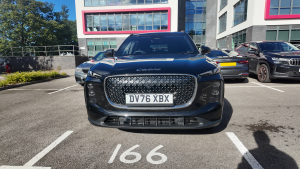
Back to the car side of the magazine this month, and we’re opening the door on a brand new UK name: Lepas. This is Chery’s premium brand — the parent group also behind Omoda and Jaecoo — and the L8 is the first model to arrive on these shores. A mid-size family SUV, plug-in hybrid only for now, with an unapologetic focus on space, equipment and value. On the drive, it immediately looks the part, with slim cat-eye LED daytime running lights, a confident grille with air inlets, and a full-width LED light bar across the back end that’s doing its very best impression of something considerably more expensive.
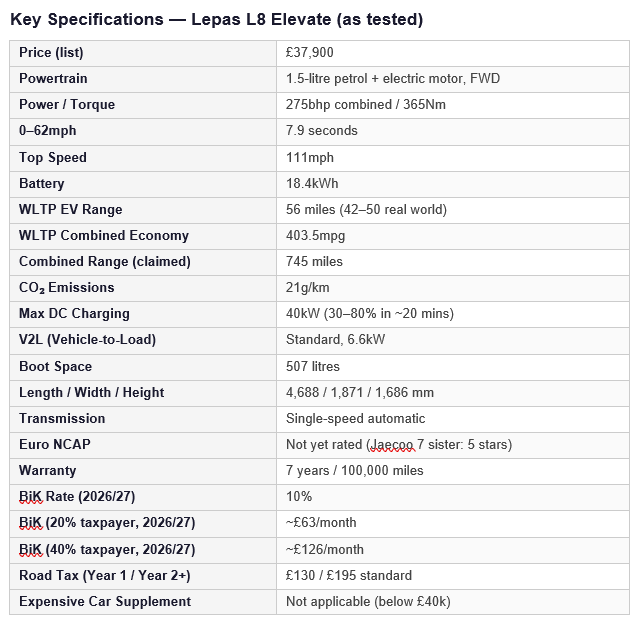
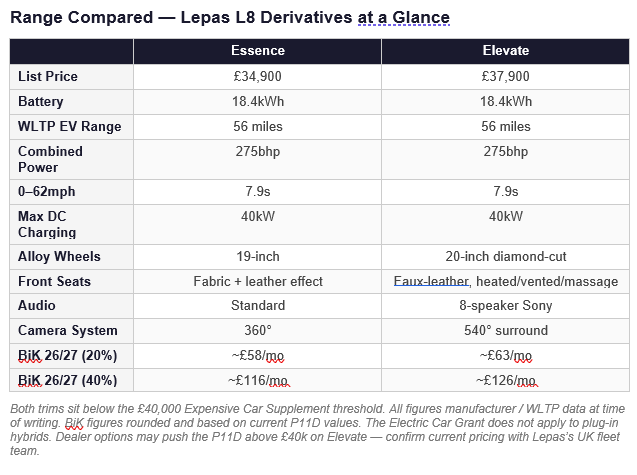
My test car was the top-spec Elevate at £37,900 — the Essence trim starts at £34,900 — and from the first moment behind the wheel I was impressed by the upper-class feel. The leather seats are properly lovely, the stitching detail on the steering wheel and seats lift the whole cabin into genuinely premium territory, and the driving position is excellent. The cabin is a very nice place to be, and that matters when a driver is going to spend hundreds of hours a year in it.
Here’s the fleet headline: at 10% Benefit-in-Kind for the 2026/27 tax year, a 20% taxpayer is looking at around £63 a month in BiK on this top-spec car. A 40% taxpayer, roughly £126. Compared to the equivalent petrol-only mid-size SUV in the 30%+ BiK bracket, that’s a meaningful tax saving. Combined with the fact that the Elevate sits well below the £40,000 Expensive Car Supplement threshold, this is a genuine value proposition on the fleet side as well as on the private side.
Design and Interior
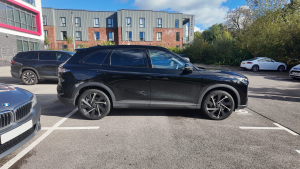
Lepas’s styling pitch is ‘premium brand that undercuts premium brands’ and the L8 largely delivers on that visual promise. From the outside it’s a clean, modern mid-size SUV with proper road presence. The grille has an identifiable face — you can tell Lepas when you see one — and there are genuine design cues borrowed sensibly from the European establishment: a full-width light bar at the rear, slim LED running lights up front, flush-ish surfacing on the flanks. Does it look a bit like a Porsche from behind, probably but I wasn’t complaining.
Inside is where the L8 Elevate really earns its upmarket positioning. Soft, squidgy materials cover most of the surfaces you actually touch. The faux-leather seats look and feel properly premium. There’s contrast stitching on the steering wheel and seats that genuinely lifts the ambience. 256-colour ambient lighting washes the cabin in your choice of mood colour, there’s a scent diffuser (a Mercedes S-Class trick that is daft and lovely in equal measure), and the Elevate’s power-adjustable driver’s seat with heating, ventilation and massage functions is one of the better front seats you’ll find at this price point. Six-way power adjustment on the driver’s side, four-way on the passenger’s side, plus the much-vaunted ‘Bentley-style’ folding tables on the back of the front seats that passengers in the rear can use with their laptops.
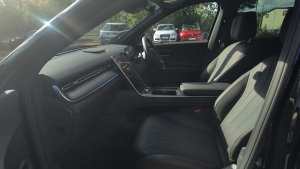
Space is a genuine highlight. Rear legroom is properly limousine-grade — a six-footer can sit behind another six-footer with inches of knee room to spare — and the rear seat backs recline for long-journey comfort. Headroom is generous even with the panoramic sunroof fitted. Passengers in the back of this car will travel in genuine comfort. The 507-litre boot comfortably beats the VW Tiguan eHybrid’s 490 litres and absolutely dusts the Toyota RAV4 PHEV’s 446, and there’s a useful underfloor compartment for the charging cables. For a family fleet car, the practicality is properly thought through.
Where the Elevate’s premium positioning takes a small knock, honestly, is the omission that caught me by surprise during a particularly cold morning on the test week: no heated steering wheel. For a car this quality-focused, at this price point, with heated-and-ventilated-and-massage front seats as standard, the lack of a heated steering wheel is a genuine oversight. On a chilly winter commute the wheel is cold to grip, and after everything else the Elevate throws at you to feel upmarket, this one absence stands out.
Infotainment and Physical Controls
Let’s start with the good bit. I was genuinely pleased to see a proper row of physical buttons on the Lepas’s dashboard. I’m not a fan of the minimalist approach where every function lives behind a touchscreen — climate control, media, drive mode selection, these all need to be reachable by feel while your eyes are on the road. The L8 has a bank of physical climate buttons on the centre console, a proper drive mode dial, and more physical controls near the driver’s right knee for lights and ancillaries. Credit where it’s due. The glossy black plastic they’re all mounted in does pick up fingerprints the moment you touch it, but the fundamental decision to retain real buttons is the right one.
The 13.2-inch portrait touchscreen is sharp and responsive. Graphics are crisp, pages load quickly, and the wireless Apple CarPlay connection worked reliably every time I got into the car. The 10.25-inch digital driver display is clear enough, though the layout is a touch cluttered — your speed gets pushed off to one side while a graphic of the car sits proudly in the middle. Small gripe, not a dealbreaker.
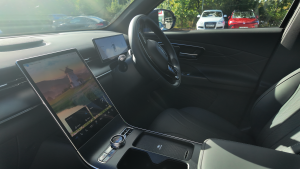
Where the infotainment got confusing — and this is a story worth telling in full — is in the settings menus. There are a lot of them, nested through sub-menus, and finding the toggle you actually want can be a hunt. During my test time my indicator sound suddenly disappeared. I spent a good while trying to work out what I’d touched, and ended up talking to the chap from Lepas, who explained that in trying to tone down one of the chimes I’d evidently switched off the overall ‘Alert sounds’ category — which, it turns out, included the indicator tick. Now, I ask you — should an indicator click really be classed as an ‘alert’? That might just be me, but to my mind the indicator click is a core driving feedback sound, not a safety alert the regulator wants you reminded about. Lepas, this is a quick menu fix. Please have a look.
Lepas has said over-the-air updates will land shortly to add a one-tap ADAS-disable shortcut and address several of these infotainment niggles. That’s welcome. Until it arrives, there is a bit of menu learning required.
On the Road
The L8 runs Chery’s ‘Super Hybrid System’ — shared across several of the group’s cars — which pairs a 1.5-litre turbocharged four-cylinder petrol engine with an electric motor and an 18.4kWh battery. Total output is 275bhp and 365Nm of torque, 0–62mph takes a brisk 7.9 seconds, and the whole thing drives through a single-speed automatic to the front wheels. In practice the L8 feels more like a range-extender than a traditional PHEV — the car runs on electric power most of the time, with the petrol engine firing up to generate electricity when the battery depletes. The result is smooth, uninterrupted power delivery that genuinely feels close to a pure EV most of the time.
Around town, with the battery topped up, the L8 is a lovely, quiet, comfortable thing to drive. The active noise cancellation and the laminated front side windows on the Elevate properly suppress what little mechanical noise there is. On the motorway it cruises smoothly, feels unflappable at legal speeds, and the ride copes well enough with British road surface imperfections — bumps and potholes get soaked up, though the thud they make as the suspension deals with them is a touch audible in the cabin.
Honest driving caveats to flag: this isn’t a car designed for enthusiastic driving. On winding B-roads there’s a fair bit of body roll through tight corners and the steering, while light enough for town work, offers very little feedback at speed. For the vast majority of fleet drivers doing the vast majority of ordinary journeys, none of this will matter in the slightest. For a driver who actively enjoys the backroad on a weekend, the L8 is a tool rather than a toy. Choose it for what it’s good at.
Battery, Range and Charging
The 18.4kWh battery delivers an official 56 miles of pure electric range on the WLTP cycle. In real-world driving across my test week, mostly in Lancashire weather conditions you’d politely call ‘mixed’, I saw an indicated 42–50 miles of EV range depending on how often the climate control was working hard. That’s the standard real-world drop you’d expect from this class of PHEV and is genuinely enough to cover most daily commute patterns on electrons alone, provided the driver can plug in overnight.
The L8’s charging credentials are better than most PHEVs: as well as the usual AC charging, DC fast charging is supported at 40kW. That gets you from 30–80% in around 20 minutes on a suitable rapid charger. V2L (Vehicle-to-Load) is standard at a healthy 6.6kW output, so the car can power tools, laptops or a coffee machine on-site — potentially useful for a mobile sales team or an event-focused business. V2V (Vehicle-to-Vehicle) is also supported.
Combined-cycle fuel economy is quoted at 403.5mpg WLTP — a classically optimistic PHEV figure that depends entirely on how often you charge. Plug in religiously and do mostly short journeys and you’ll see triple digits. Run the battery flat and rely on the petrol engine and realistic economy drops to the mid-40s. Treat it the way plug-in hybrids are supposed to be treated — charged nightly, driven mostly electric — and the maths looks genuinely compelling. Fleet operators planning around home-charging drivers will see real savings.
The Niggles
Let’s pull them together. First, the missing heated steering wheel on a car that otherwise feels properly premium — at this price point and with this specification, this is a surprising omission. Second, the indicator-sound-is-an-alert menu classification I flagged in the Infotainment section — easy enough to put right once you know where to look, but worth a quick fix in a future update. Third, the ADAS alerts generally are a bit over-zealous, particularly the lane-keeping assist on tight country lanes — Lepas say the over-the-air update bringing a one-tap disable is coming shortly.
One more worth flagging: the outside pedestrian alert noise, which the L8 plays at low speeds, seemed a little loud to my ears and I couldn’t find a way to turn it down. For drivers doing a lot of urban stop-start work it would be nice to have a bit more control over the volume. Worth asking Lepas about at the point of order.
Safety and Warranty
Standard safety equipment is comprehensive for a car at this price. Adaptive cruise control, autonomous emergency braking with pedestrian and cyclist detection, lane-keep assist, driver attention monitoring, blind-spot monitoring, rear cross-traffic alert, Intelligent Speed Assist — the full modern suite. The Elevate adds the 540-degree surround-view camera system (which is excellent for tight manoeuvres and is a legitimate step up on the already-standard 360-degree system). The Euro NCAP rating was not published at the time of writing — worth flagging honestly for fleet risk assessments — but the sister brand Jaecoo 7 holds a full five-star rating and the L8 shares much of its underlying structure.
The warranty is a genuine highlight: seven years or 100,000 miles. That’s amongst the strongest in the segment, matching Kia on term and comfortably ahead of VW’s three-year equivalent. For a fleet operator running a typical four-year cycle, the vehicle will still be inside warranty at defleet time, and the longer warranty period will help residual values on the used market. Chery’s UK dealer network — covering Omoda, Jaecoo and now Lepas — is growing rapidly across the country, which gives fleet buyers meaningful service and parts support.
The Fleet and Sal-Sac Case
The L8 sits in the 10% Benefit-in-Kind band for the 2026/27 tax year — the current PHEV banding for cars with 50+ miles of pure electric range. For the Elevate at a P11D value of approximately £37,890, that works out as:
- 20% taxpayer, 2026/27: around £63 per month in BiK (£758 per year) • 40% taxpayer, 2026/27: around £126 per month in BiK (£1,516 per year)
Compare that with an equivalent petrol-only mid-size SUV in the 30%+ BiK bracket — which would sting a 40% taxpayer with £450–£550 a month in BiK. The L8 saves a higher-rate taxpayer around £300–£400 a month compared to petrol-equivalent choices. Over a four-year cycle, that’s £15,000+ in tax savings. The maths is undeniable.
Compared to a pure electric mid-size SUV in the 4% BiK band though, the L8 is more expensive on the tax side — a Kia EV3 GT-Line I tested earlier this year sits at around £26/month for a 20% taxpayer. The L8’s case against pure EV competitors is that it has the petrol backup for longer trips without needing to plan around chargers, and it suits drivers who don’t have reliable home charging. For a fleet with mixed driver profiles — some can plug in at home, some can’t — the L8 Elevate deserves a slot alongside the pure EV options in your choice list.
Two more fleet-specific points. Firstly, the Elevate’s £37,900 list price sits comfortably below the £40,000 Expensive Car Supplement threshold, so drivers dodge the £425 annual VED supplement that catches out pricier fleet choices from year two to six. Secondly, the seven-year warranty is a genuine whole-life-cost advantage versus the three-year packages from most European rivals. For sal-sac programmes aimed at offering drivers a comfortable, well-equipped family car at a sensible monthly cost, the L8 Elevate stacks up well.
The Competition
The L8 arrives into a properly contested segment but offers a distinctly different value proposition. The VW Tiguan eHybrid is a more polished thing to drive and better finished in places, but costs around £7,000 more trim-for-trim. The Toyota RAV4 PHEV has a longer EV range (around 85 miles) and Toyota’s legendary reliability record, but costs materially more too. The Kia Sportage PHEV sits in similar territory to the Tiguan on price. The MG HS PHEV is the only PHEV in the segment that undercuts the L8, at £32,495, but its interior isn’t quite as plush. And the L8’s own sister car, the Jaecoo 7 SHS-P, actually costs £270 more than the Essence L8 — which is a slightly odd positioning quirk, but it does mean the Lepas is competitively placed within its own stable. For a driver who wants a genuinely upmarket cabin feel and generous equipment at a sensible price, the L8 Elevate currently has few direct rivals.
The Verdict
The Lepas L8 Elevate is a very credible debut from a brand nobody had heard of this time last year. The cabin genuinely feels upmarket — the leather, the stitching, the ambient lighting, the massage seats, the scent diffuser all combine to deliver a premium experience at a sub-£40,000 price point. Rear-seat space is limousine-grade. The infotainment screen is sharp and responsive. The decision to retain physical climate buttons is exactly the right call. The 7-year warranty is genuinely reassuring. And the 10% BiK on a car at this price makes it a sensible sal-sac proposition for fleet drivers who can’t quite commit to a pure EV.
It’s not perfect. The infotainment menu structure is confusing enough that I managed to accidentally mute my own indicator click — the fact that it’s classed as an ‘alert’ at all is worth Lepas revisiting. The ADAS alerts are over-zealous until the promised OTA update arrives. The handling is honest rather than engaging. And the missing heated steering wheel on an otherwise properly premium cabin is a genuine oversight that should be addressed on the next model year.
Four stars from me, and incredible value for money is the phrase I keep coming back to. For fleet managers looking to add a comfortable, well-equipped, properly spacious family PHEV SUV to the choice list at a sensible monthly cost — particularly for drivers who want the premium cabin feel without the premium brand price tag — the L8 Elevate deserves genuine consideration. Lepas has arrived in the UK with a properly credible first act. I’m already looking forward to the smaller L6 and L4 that are promised next.