
Why are truck makers are betting millions on hydrogen?
Europe’s biggest truck manufacturers are continuing to invest heavily in hydrogen technology despite a fundamental problem: the fuel remains expensive, low-emissions hydrogen production is limited and the infrastructure needed to refuel heavy trucks is still in its infancy.
Daimler Truck, Volvo Group and Toyota, alongside energy and technology companies including Bosch, Air Liquide, TotalEnergies and MB Energy, are now attempting to tackle that problem by developing the entire hydrogen ecosystem rather than simply building trucks.
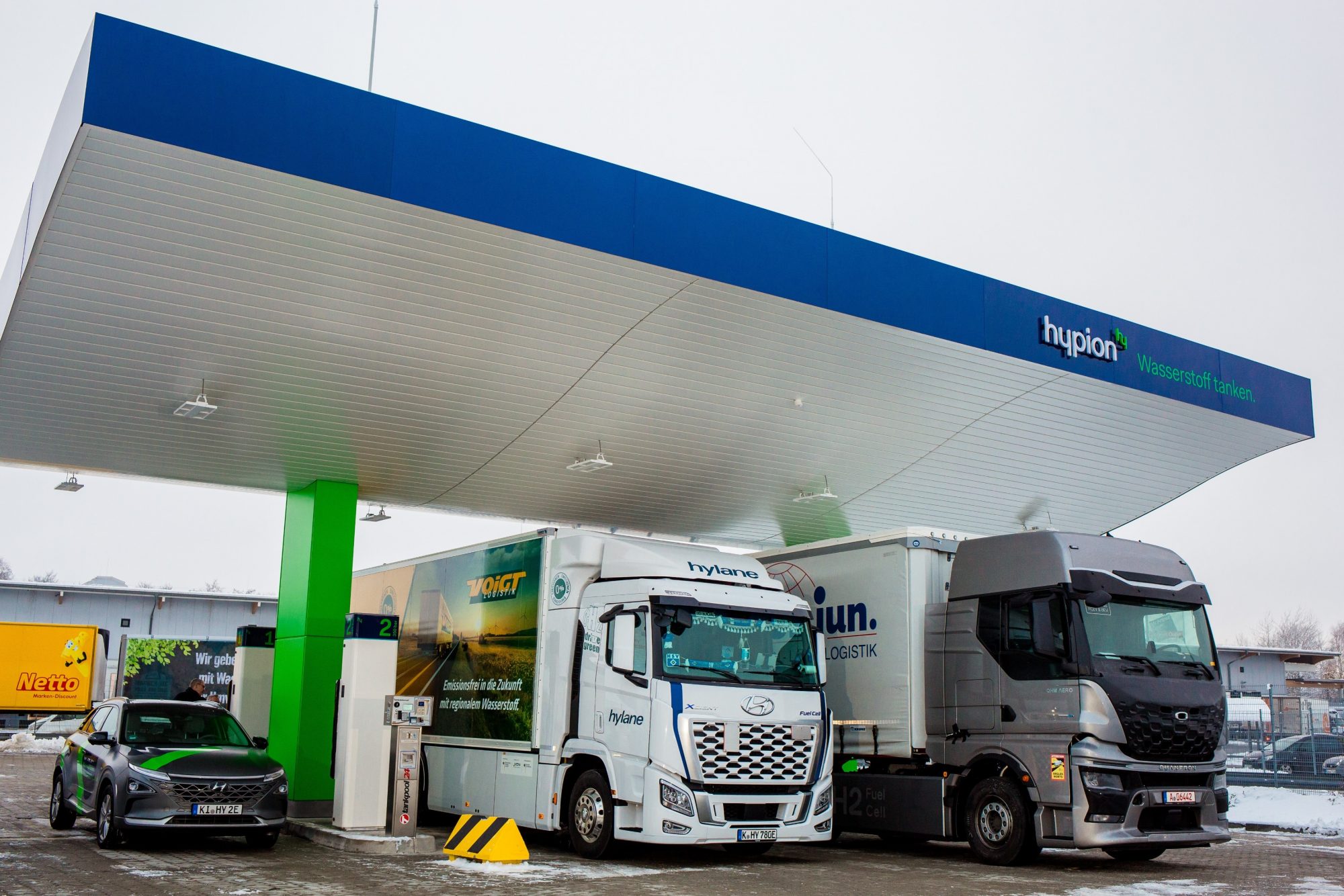
The companies unveiled plans at IAA Transportation 2026 to accelerate the deployment of hydrogen-powered trucks across Europe, with Germany being positioned as a potential blueprint for wider deployment by 2030. The strategy is based on synchronising vehicle production, hydrogen supply and refuelling infrastructure so that fleets are not asked to invest in vehicles for which there is nowhere to refuel.
The scale of the commitment is significant. Daimler Truck says it is investing a mid-three-digit million-euro sum in hydrogen trucks by the end of the decade, while Volvo Group is also investing significant amounts in hydrogen power solutions, including fuel-cell and hydrogen-combustion technologies.
For an industry under intense pressure to decarbonise, the argument is that waiting until hydrogen is cheap and widely available would leave manufacturers and infrastructure providers trying to build an ecosystem almost overnight.
Hydrogen’s biggest problem is also the reason for investing
Hydrogen has a particularly difficult chicken-and-egg problem in road transport. Fleets are reluctant to buy hydrogen trucks without reliable fuel supplies, while energy companies have limited incentive to build expensive refuelling stations before there is a substantial fleet of vehicles using them.
The manufacturers now believe the only way to break that cycle is to invest simultaneously in both sides of the equation.
“We need to get some trucks out on the road now,” Volvo Group CEO Martin Lundstedt said.
“At the end of the day, it’s not about the single use case. For me, it’s more thinking about the strategic balance sheet for the country or for a region.”
That approach reflects a recognition that hydrogen trucking cannot be judged solely by the economics of an individual truck today. It needs to be considered as part of a wider transport and energy system that could develop substantially during the remainder of the decade.
Karin Rådström, CEO of Daimler Truck, similarly acknowledged that significant scaling is still some way off.
“We will probably start scaling from around 2030,” she said. “That is why we are working hard now to prepare the infrastructure and the broader ecosystem. We don’t want to repeat the mistakes made during the battery-electric rollout. When we start scaling the trucks, we want infrastructure and an ecosystem capable of supporting customer adoption.”
That is perhaps the clearest explanation of why manufacturers are spending millions before the market is ready.
Hydrogen is not scarce – but affordable green hydrogen is
The description of hydrogen as scarce needs some qualification. Hydrogen is already produced in very large quantities, but the overwhelming majority is consumed by established industrial sectors such as oil refining, ammonia and chemicals.
The real shortage is of low-emissions hydrogen that can be supplied reliably and economically to road transport.
The International Energy Agency estimates that global hydrogen demand exceeded 100 million tonnes in 2025, but almost all of that demand remained concentrated in traditional industrial applications. Low-emissions hydrogen production reached almost 1 million tonnes, accounting for only a little more than 1% of total production.
Europe is making progress, but the pipeline remains uncertain. The IEA says the first large-scale low-emissions hydrogen projects are expected to come online in Europe during 2026, while slow policy implementation and uncertainty have delayed investment and scale-up.
That matters enormously to truck operators. A hydrogen truck can be technically capable of replacing a diesel vehicle, but the business case depends on being able to purchase sufficient hydrogen at a competitive price.
Daimler Truck has previously argued that hydrogen needs to fall towards €5 per kilogram to become economically attractive for transport operations, while acknowledging that hydrogen vehicle operating costs remain too high today, primarily because of energy prices.
The IEA similarly warns that low-emissions hydrogen remains more expensive than fossil-based hydrogen in most parts of the world and that policy support will remain necessary to close the cost gap in the near term.
Why hydrogen makes sense for some trucks
The strongest argument for hydrogen is not that it should replace battery-electric trucks everywhere. Rather, manufacturers see it as another tool for applications where battery technology can be difficult to deploy.
Long-distance HGV operations can involve high annual mileage, heavy payloads, limited downtime and routes that cross several countries. Adding substantial battery capacity can increase vehicle weight, require long charging stops or place significant demands on grid connections.
Hydrogen offers the possibility of much faster refuelling while retaining the flexibility of a conventional long-haul truck.
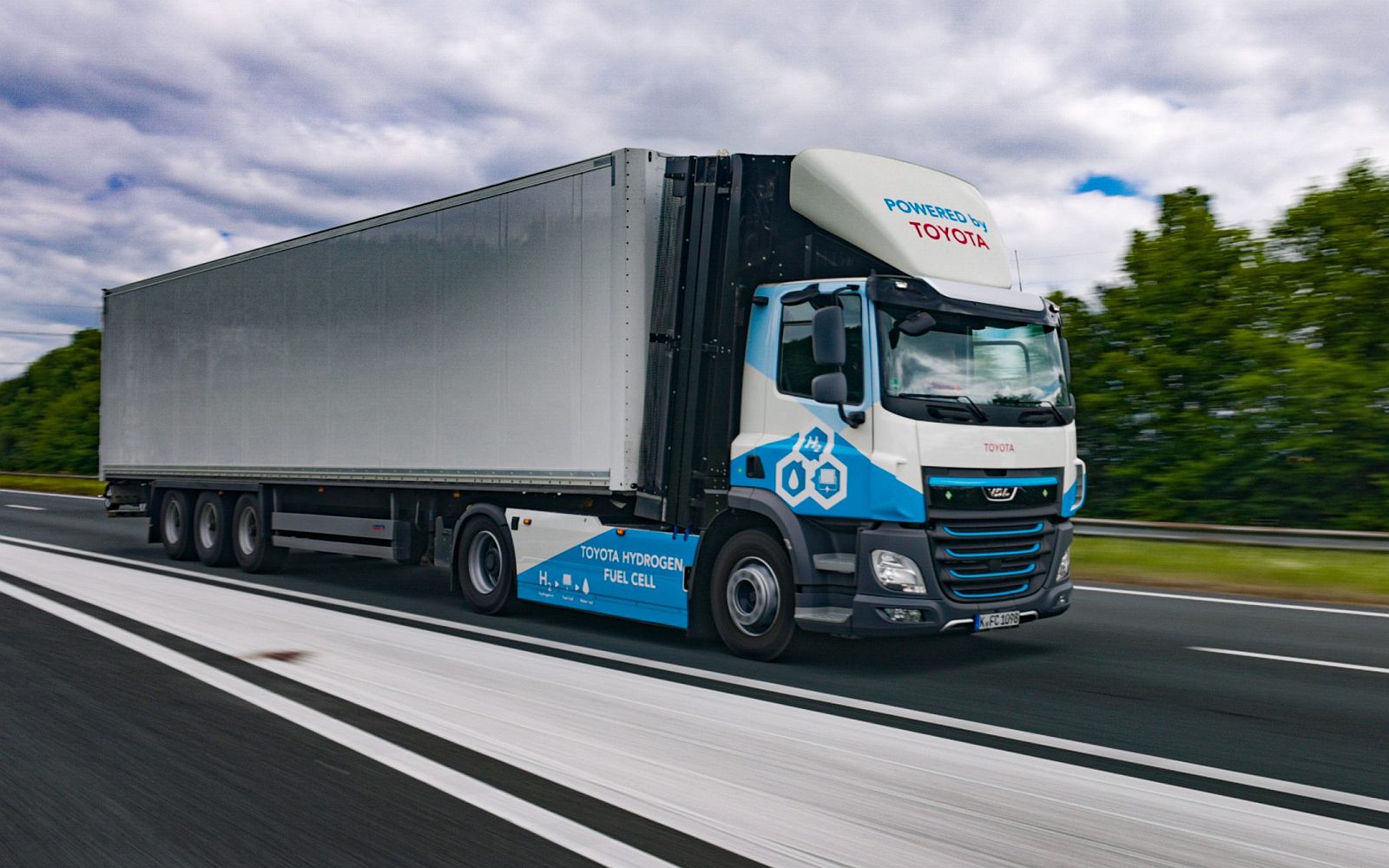
Toyota says hydrogen is particularly suited to applications where long range, high utilisation, fast refuelling, payload and operational flexibility are critical.
This is why the hydrogen strategy is being concentrated heavily on heavy-duty transport rather than attempting to establish hydrogen as the default technology for every road vehicle.
The European Commission has also recognised that the market is likely to develop differently across powertrain technologies. Its assessment of heavy-duty road transport found that battery-electric vehicles currently have the broader market offering, while the role of hydrogen heavy-duty vehicles remains less certain.
For truck manufacturers, however, uncertainty is not necessarily a reason to stop investing. It can instead be a reason to ensure that hydrogen remains commercially viable if the market develops in its favour.
Daimler is putting trucks into real-world fleets
Daimler Truck provides perhaps the clearest example of the industry’s strategy.
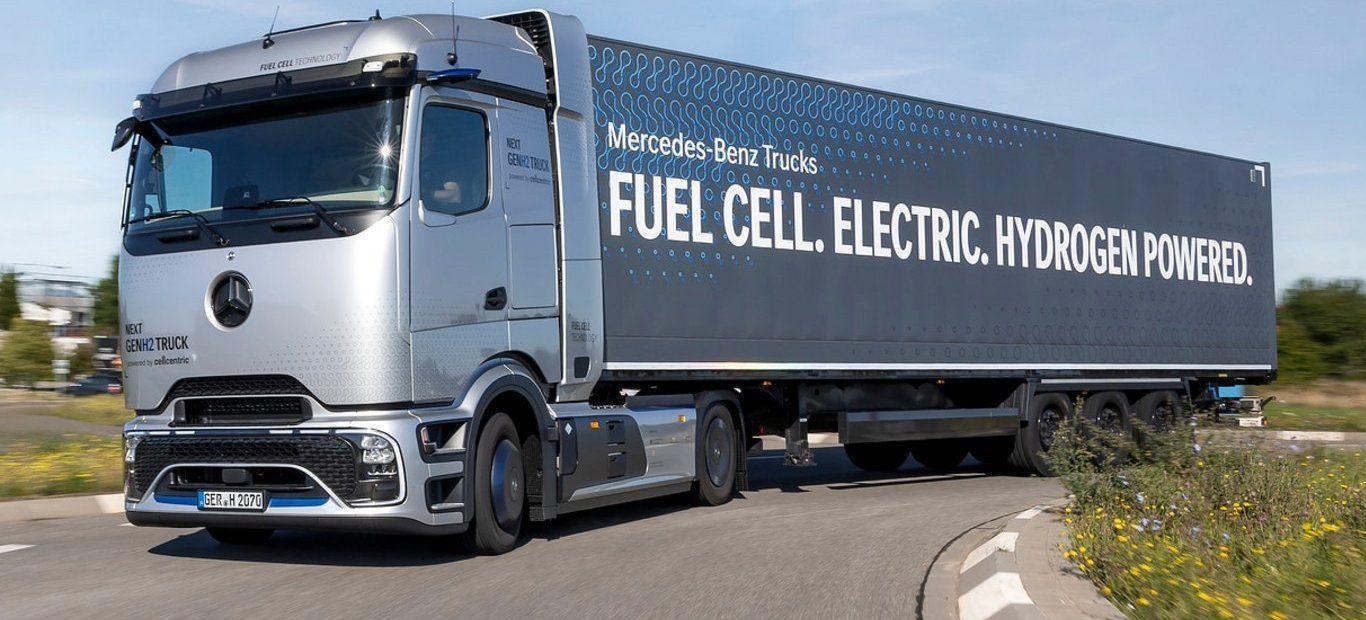
The company says customers have already driven almost 600,000 kilometres using its fuel-cell trucks. From the end of 2026, it plans to put around 100 next-generation Mercedes-Benz NextGenH2 Trucks into customer operations in Germany.
The first customer is logistics company Dachser, which will initially operate a liquid-hydrogen fuel-cell tractor from its Karlsruhe logistics centre. Two further vehicles are due to follow by mid-2027.
Daimler is also pursuing hydrogen combustion engines alongside fuel cells. Its first hydrogen combustion-engine trucks are being prepared for market launch in 2027.
This is significant because the company is not betting on a single hydrogen technology. Fuel cells offer zero tailpipe emissions, while hydrogen combustion can provide a route that builds on established internal-combustion expertise and manufacturing technologies.
The wider partnership is equally important. Daimler Truck and Volvo Group have developed cellcentric as their fuel-cell joint venture, with Toyota now set to become an equal shareholder. Toyota brings more than 30 years of fuel-cell development experience, while Bosch is contributing components and refuelling technology.
Volvo is pursuing more than one hydrogen route
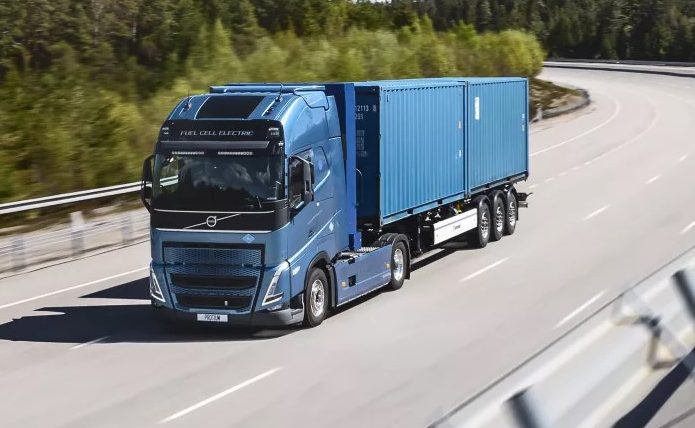
Volvo Trucks is similarly developing multiple hydrogen options.
The company has been developing hydrogen combustion-engine trucks, with customer testing scheduled to begin during 2026 and commercial availability planned towards the end of the decade. Volvo says such vehicles could be particularly useful for longer distances and regions where charging infrastructure is limited or where operators do not have time to recharge batteries.
At the same time, Volvo remains involved in fuel-cell technology through cellcentric.
The logic is consistent with the company’s broader multi-powertrain strategy. Battery-electric trucks can cover many applications, but hydrogen potentially offers another solution for long-haul and high-utilisation operations.
The investment also gives Volvo and Daimler an opportunity to share the considerable cost and risk associated with developing fuel-cell systems. Their original cellcentric partnership was explicitly designed to reduce development costs and accelerate the introduction of fuel-cell technology for heavy-duty transport.
Infrastructure is the real battleground
The biggest challenge may ultimately be neither the truck nor the fuel cell. It is infrastructure.
A hydrogen station for HGVs is not simply a larger version of a passenger-car hydrogen station. Heavy trucks require significantly greater quantities of fuel and high-throughput refuelling capability.
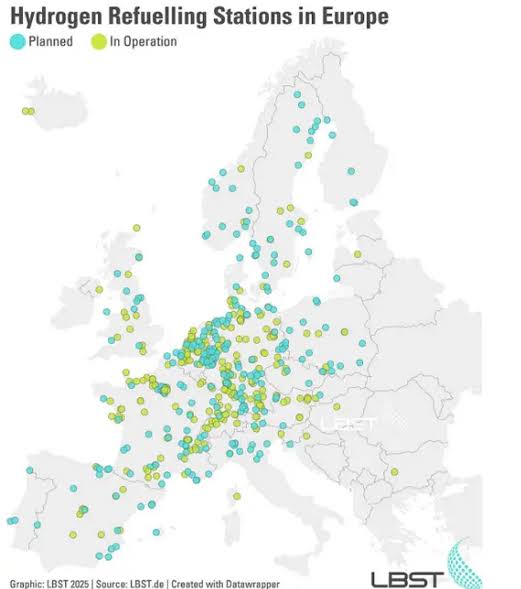
Industry estimates have repeatedly highlighted the scale of the infrastructure challenge. ACEA has said Europe would need hundreds of truck-suitable hydrogen refuelling stations during the transition and at least 700 by 2030 under earlier assessments, while its longer-term infrastructure analysis has identified around 1,000 stations as a potential requirement.
The latest industry plan therefore focuses on strategically located corridors rather than attempting to cover every road immediately.
Daimler, Volvo and their energy partners intend to develop high-capacity refuelling stations capable of serving large numbers of trucks. The companies say stations could eventually be designed to refuel up to 100 trucks per day, with hydrogen supply being developed alongside the vehicle rollout.
This is crucial because fleet operators need certainty about where vehicles can refuel before committing to them.
The economics must improve
The industry cannot expect fleets to adopt hydrogen simply because it is technically possible.
Transport operators ultimately buy vehicles to make money, and hydrogen has to deliver a competitive total cost of ownership against diesel and battery-electric alternatives.
The latest industry partnership explicitly identifies competitive hydrogen pricing as one of the conditions needed for adoption. The companies are therefore attempting to combine hydrogen production, distribution, refuelling and vehicle deployment so that costs can fall as volumes increase.
There is an important circular relationship here. More trucks create more demand for hydrogen, which can justify larger production projects and refuelling stations. Larger production and distribution networks can then reduce costs, making hydrogen trucks more attractive to fleets.
Without the initial investment, that cycle cannot begin.
Why manufacturers are willing to take the risk
The hydrogen investment therefore makes more sense when viewed as a strategic hedge rather than a declaration that hydrogen will replace batteries.
The European Commission says battery-electric trucks are currently expected to dominate the initial zero-emission heavy-duty market, while the role of hydrogen remains less certain.
But truck manufacturers have to plan beyond the immediate market. Vehicle development, fuel-cell manufacturing, hydrogen production and refuelling networks all require years to establish.
The IEA says the hydrogen sector continues to face high costs, uncertain demand, regulatory barriers and infrastructure constraints, while many announced projects have been delayed or cancelled.
That makes the decision by Daimler Truck, Volvo and their partners particularly significant. They are effectively betting that today’s expensive and fragmented hydrogen market can be transformed into a viable heavy-duty transport fuel market by 2030.
Whether that happens will depend on more than the truck manufacturers. It will require investment in renewable and low-emissions hydrogen production, energy infrastructure, refuelling stations, supportive regulation and, crucially, fleets prepared to put early vehicles into demanding real-world operations.
For fleet managers, the immediate question is therefore unlikely to be whether hydrogen is ready to replace diesel across the board. Instead, it is whether particular high-mileage, long-distance and high-utilisation operations could eventually provide the right environment for hydrogen.
The truck makers are clearly preparing for that possibility now. Their argument is that by the time hydrogen becomes economically attractive, the infrastructure and vehicles need to be ready to use it.
The next four years will determine whether that bet creates a viable third pillar of Europe’s zero-emission HGV market – or whether battery-electric trucks ultimately capture most of the applications the hydrogen industry is targeting.
Mark Salisbury, Editor