

FCS to build UK’s largest hydrogen refuelling system for HGVs
Fuel Cell Systems Limited (FCS), a designer and manufacturer of hydrogen refuelling systems, has signed a new agreement with HyHAUL Mobility Limited, part of the Protium group, to deliver the UK’s largest high-pressure hydrogen refuelling system for heavy goods vehicles.
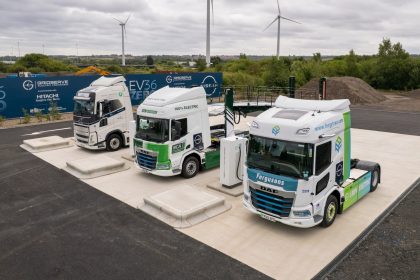
The deal will support the rollout of a commercially funded refuelling station capable of serving up to 30 HGVs a day, dispensing hydrogen at both 350 and 700 bar. It marks a significant step for the UK’s hydrogen mobility sector, which has been working to prove that zero-emission trucking can operate reliably at commercial scale rather than remaining confined to pilot schemes.

Under the agreement, a high-capacity refuelling hub will be built at one of Protium’s existing green hydrogen production and distribution sites. Co-locating the refuelling station with hydrogen production is intended to give fleet operators the reliable, high-availability refuelling they need to run zero-emission trucks on intensive commercial duty cycles. The approach is also designed to give operators the confidence to deploy fuel cell HGVs at scale, supporting the wider decarbonisation of freight across the UK.
Christopher Jackson, CEO and Founder of Protium, said: “HyHAUL set out to prove that green hydrogen trucking works on real routes, and that ambition has not changed. What has changed is how we get there. This agreement puts a serious piece of refuelling capability into the UK market and does it alongside the assets we already own and operate. We continue to see and hear from customers that hydrogen mobility solutions remain an important part of their plans for achieving net zero and as the largest high-pressure refueller in the UK, we believe this asset will be key to enabling the development of the ecosystem further.”
A high-capacity system built for commercial duty cycles
As part of the contract, FCS will design, manufacture, test and deliver a complete high-capacity hydrogen refuelling system. This will comprise a HyFleet refueller alongside its associated hydrogen storage, gas panels and tube trailer interfaces. The system has been engineered to dispense hydrogen at both 350 bar and 700 bar, giving it the flexibility to serve a wide range of fuel cell vehicles, and will be capable of delivering up to 1,450 kg of hydrogen to a single fleet within 24 hours.
To sustain that level of throughput, hydrogen storage will be configured into four separate banks, with automatic bank selection used to maintain high-throughput, back-to-back fuelling for heavy-duty vehicles. This configuration is central to the station’s ability to serve up to 30 HGVs a day without the queuing or downtime that can undermine confidence in early-stage hydrogen infrastructure.

Tom Chicken, CEO of Fuel Cell Systems, said: “This is the kind of high-capacity infrastructure the UK’s hydrogen HGV sector needs if fleet operators are going to move from trials to daily operations with confidence. By combining a secure supply and fast refuelling, we’re demonstrating what’s possible with a system designed around real commercial demands. Today we’re deploying the largest high-pressure hydrogen refueller in the UK – in the near future, we hope to see many more like it.”
From public funding to a fully commercial agreement
HyHAUL Mobility and FCS first contracted in July 2025 to deliver refuelling infrastructure for the HyHAUL programme. At that stage, the initial focus was on four refuelling stations along the M4 corridor, with the project supported by public funding through Innovate UK’s Zero Emission HGV and Infrastructure Demonstrator (ZEHID) programme.
Following a change to the public funding available, HyHAUL and FCS agreed a revised scope for the project, now funded entirely on commercial terms. The shift signals a maturing of the UK’s hydrogen HGV market, with operators and infrastructure providers increasingly prepared to back projects without relying solely on grant support. The final location of the new refuelling station is expected to be announced before the end of the year.
Supporting the case for hydrogen in heavy freight
Hydrogen fuel cell technology has long been viewed as a promising option for decarbonising heavy goods vehicles, particularly for operators running intensive, long-distance duty cycles where battery-electric alternatives can face challenges around range, payload and charging time. However, the sector’s growth has repeatedly been constrained by a lack of refuelling infrastructure capable of supporting fleets at scale.
By combining high-pressure dispensing, substantial daily throughput and direct co-location with green hydrogen production, the new station is intended to address several of the barriers that have historically limited fuel cell HGV adoption in the UK. For fleet operators considering a move to hydrogen, the ability to refuel reliably and repeatedly throughout the day is often as important as the environmental credentials of the vehicles themselves.
The agreement also underlines the role that specialist infrastructure providers such as FCS are playing in translating hydrogen mobility ambitions into deployable assets. As the UK works towards its net zero targets, freight and logistics remain among the harder sectors to decarbonise, given the demands placed on vehicles by long distances, heavy loads and tight delivery schedules. Infrastructure of this scale offers a signal to the market that hydrogen refuelling can be built to match those demands.
With the location of the new station due to be confirmed later this year, attention will now turn to how quickly fleet operators move to take advantage of the capacity on offer, and whether this project can serve as a template for further high-capacity stations elsewhere in the UK.