
H2Accelerate sets out Member State policy package
Hydrogen-powered trucking is moving towards early commercial deployment in Europe, but a new H2Accelerate policy paper warns that inconsistent support across Member States could slow investment and leave the European market fragmented.
The paper, “Effective Member State policies – a roadmap to TCO parity for hydrogen trucking”, identifies Germany and the Netherlands as leading markets where targeted policy measures are improving the commercial case for hydrogen heavy-duty vehicles (HDVs) and their associated refuelling infrastructure.
H2Accelerate says three policy mechanisms are proving particularly important: Renewable Energy Directive III (RED III) credit mechanisms for renewable hydrogen, road toll exemptions and reductions for zero-emission heavy-duty vehicles, and combined capital funding for hydrogen trucks and refuelling stations.
When deployed together, the measures can provide a route towards total cost of ownership (TCO) parity between hydrogen trucks and diesel equivalents, although the organisation says further policy support will remain necessary as the sector moves from demonstration projects towards wider commercial deployment.
Hydrogen trucks and refuelling infrastructure are increasingly moving beyond technology validation and into early commercial deployment. However, operators still face higher vehicle and infrastructure costs than with established diesel technology.
For fleet operators working on narrow margins, lifetime TCO is a critical factor in vehicle purchasing decisions. H2Accelerate says technology improvements are already helping to narrow the gap, with fuel cell efficiency, vehicle design and system integration continuing to improve.
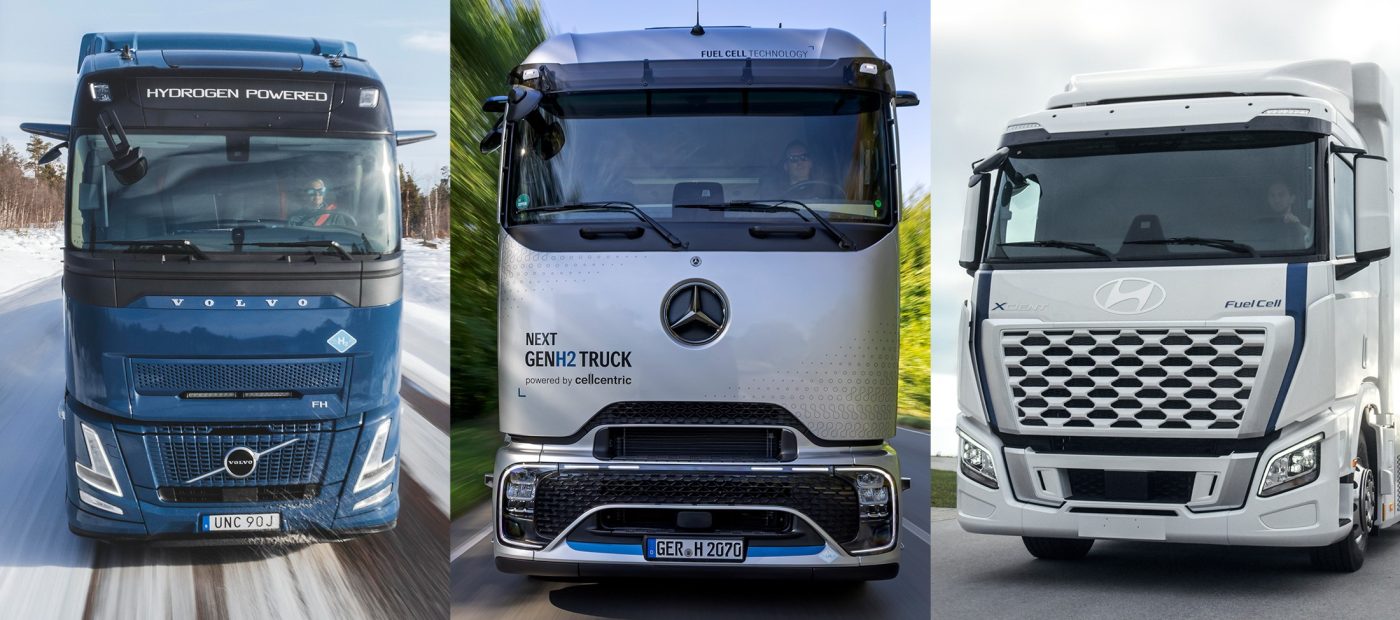
In April 2026, cellcentric announced its BZA375 fuel cell system for heavy-duty applications. The system is expected to deliver fuel consumption of less than 6kg of hydrogen per 100km for a fully loaded 40-tonne truck under real-world conditions, compared with an estimated 7.5kg/100km for current vehicle generations.
At an illustrative subsidised hydrogen price of €8/kg, reducing consumption from 7.5kg to 6kg per 100km would cut fuel costs by approximately 20%, equivalent to around €0.12 per kilometre.
For high-mileage long-haul operations, H2Accelerate says this type of improvement could make a meaningful difference to the business case for hydrogen trucks.
One of the key policy measures identified is the use of RED III credit mechanisms.
The Renewable Energy Directive III requires Member States to establish mechanisms allowing fuel suppliers to exchange credits associated with renewable energy supplied to the transport sector. Where renewable fuels of non-biological origin (RFNBO) hydrogen supplied to road transport qualifies, the resulting revenue can help reduce the price paid for hydrogen at the pump.
Under a typical mechanism, suppliers of eligible renewable fuels earn credits which can then be sold to obligated fuel suppliers required to meet renewable energy or greenhouse gas reduction targets.
H2Accelerate says this can create a significant revenue stream for hydrogen suppliers without relying entirely on direct public subsidies. However, the market-based approach also introduces price volatility, making long-term investment cases more difficult for hydrogen refuelling station operators and fleet customers.
The paper highlights Germany’s THG Quota as an example, noting that the trading price was around €80 per tonne of CO₂ in October 2024, compared with an average value of €320 per tonne of CO₂ in February 2026.
H2Accelerate therefore proposes a TCO Parity Certainty Mechanism to address the residual gap and reduce exposure to policy and market volatility. The concept will be developed further in the third paper in the organisation’s three-part policy series.
Road tolls represent another significant operating cost for high-mileage HGVs, making exemptions for zero-emission vehicles an important potential incentive.
Under the Eurovignette Directive, Member States applying road charges to heavy-duty vehicles are required to differentiate tolls according to emissions performance and move towards distance-based charging.
The directive also permits Member States to temporarily exempt zero-emission HDVs from road tolls, with the exemption period able to run until 30 June 2031.
H2Accelerate says toll exemptions can provide a predictable operating cost advantage for hydrogen trucks while having a relatively limited impact on public finances during the early deployment phase, when zero-emission HDVs account for only a small proportion of the overall fleet.
Unlike mechanisms dependent on fluctuating credit prices, toll exemptions are directly linked to vehicle use and can provide operators with greater visibility over running costs.
H2Accelerate also highlights the importance of coordinating investment in hydrogen vehicles and refuelling stations.
Since 2021, the European Union’s Connecting Europe Facility Alternative Fuels Infrastructure Facility (CEF AFIF) has provided capital support for refuelling and charging infrastructure. However, the paper says experience has demonstrated that infrastructure funding alone can be insufficient when there is no corresponding deployment of vehicles.
The Netherlands has attempted to address this through its annual SWiM programme, which has provided joint capital support for hydrogen refuelling stations and vehicles since 2024.
Across the first two rounds, around 600 hydrogen-powered vehicles and 13 new or expanded stations received funding from a budget of approximately €72 million.
Germany subsequently introduced a similar €220 million combined funding scheme in January 2026. The scheme was significantly oversubscribed, receiving bids worth more than €455 million targeting over 70 high-capacity stations and more than 800 heavy-duty hydrogen truck deployments.
H2Accelerate says combining vehicle and infrastructure funding can address two barriers simultaneously. Subsidies reduce the capital cost gap between early hydrogen trucks and diesel equivalents, while coordinated deployment increases the likelihood that new refuelling infrastructure will achieve sufficient utilisation.
The organisation is calling for future European funding rounds, including CEF AFIF, to adopt a similar combined approach.
The paper argues that the combination of RED III credit mechanisms, road toll exemptions and combined truck and station funding can create a credible pathway towards TCO parity in specific applications.
Germany is highlighted as a priority market because the three mechanisms are being brought together to support the commercial case for hydrogen trucking. H2Accelerate says that, in leading markets, TCO parity with diesel is possible today using mechanisms already available within European and national policy frameworks.
However, implementation remains uneven. Although the deadline for transposing RED III into national legislation passed in May 2025, H2Accelerate says many Member States have yet to establish effective credit mechanisms for RFNBO hydrogen in road transport.
Road toll exemptions and reductions are also being applied inconsistently, while combined funding programmes remain concentrated among a small number of early-moving countries.
The paper warns that this uneven approach risks slowing the development of a European hydrogen trucking market and creating a fragmented landscape.
H2Accelerate’s proposed approach is therefore based on coordinated policy rather than a single incentive. Its recommendations include wider implementation of RED III credit mechanisms, predictable road toll exemptions for zero-emission trucks, European funding that supports vehicles and stations together, and a TCO Parity Certainty Mechanism designed to reduce residual investment risk.
For fleet operators, the emerging policy landscape suggests that the commercial case for hydrogen will depend not only on the trucks themselves, but also on the cost and availability of hydrogen, refuelling infrastructure and the policy environment in which vehicles operate.