
Geely EX2 Max Review: it makes a strong fleet case
Watch the review — click here (opens YouTube in a new tab)
The world’s best-selling car of 2025, the Geely EX2 Max arrives in the UK — with a sub-£24k sticker reviewed by Ian Campbell.
First Impressions
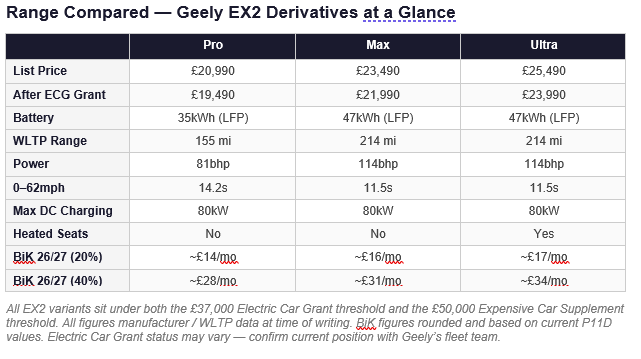
Geely is now three models deep into its UK offensive. The all-electric EX5, the plug-in hybrid Starray EM-i, and now the newest arrival that I spent a day with: the Geely EX2. And here’s the number that ought to make every Fleetpoint reader raise an eyebrow: this little hatchback was China’s best-selling car of 2025, shifting over 465,000 units and reportedly landing as the second-best-selling EV in the world after the Tesla Model Y. It arrives in UK showrooms this month at a starting price of £20,990.
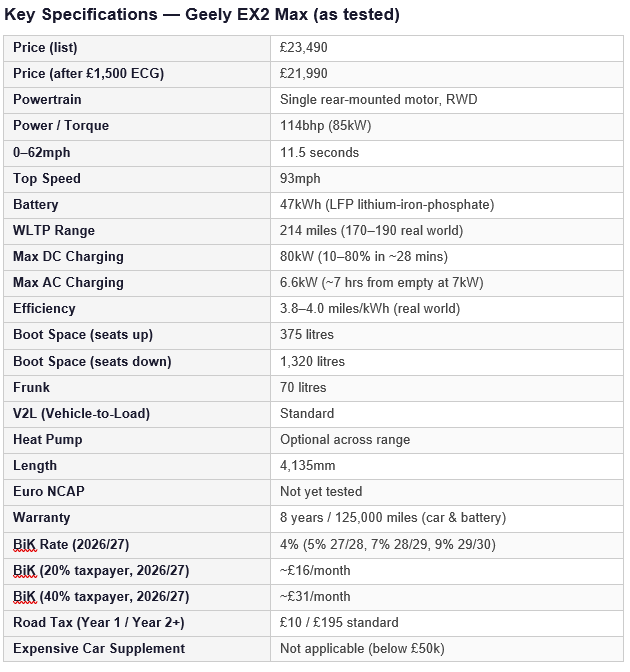
Cute, affordable and a pretty decent small electric hatchback; that was my top-line impression after a day with the mid-spec EX2 Max at £23,490. The 47kWh LFP battery is good for 214 miles WLTP, the 114bhp rear-mounted motor is enough for the sort of driving this car will actually do, and the equipment list is properly generous for the money. Standard kit includes synthetic leather upholstery, electric front seats, a 14.6-inch central touchscreen, wireless Apple CarPlay and Android Auto, keyless entry, adaptive cruise control, and vehicle-to-load capability. That’s a lot of car for a very small sum.
Here’s the fleet headline: at 4% Benefit-in-Kind for the 2026/27 tax year, a 20% taxpayer is looking at around £16 a month in BiK on this Max trim. Sixteen pounds. Thirty-one if you’re on the 40% band. Combined with the fact that every EX2 sits comfortably below the £37,000 Electric Car Grant threshold (meaning a £1,500 discount applies), it’s one of the cheapest routes into a brand-new company car currently available on the UK market. That is a serious sal-sac story.
Design and Interior
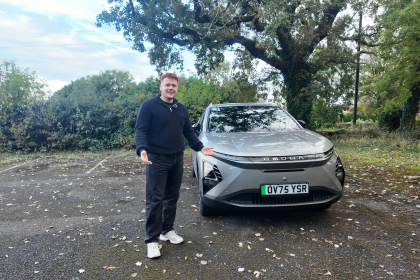
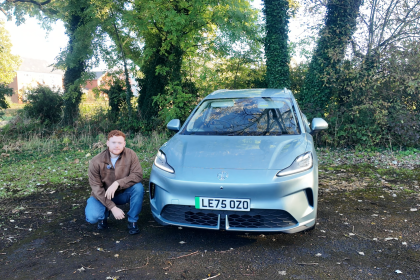
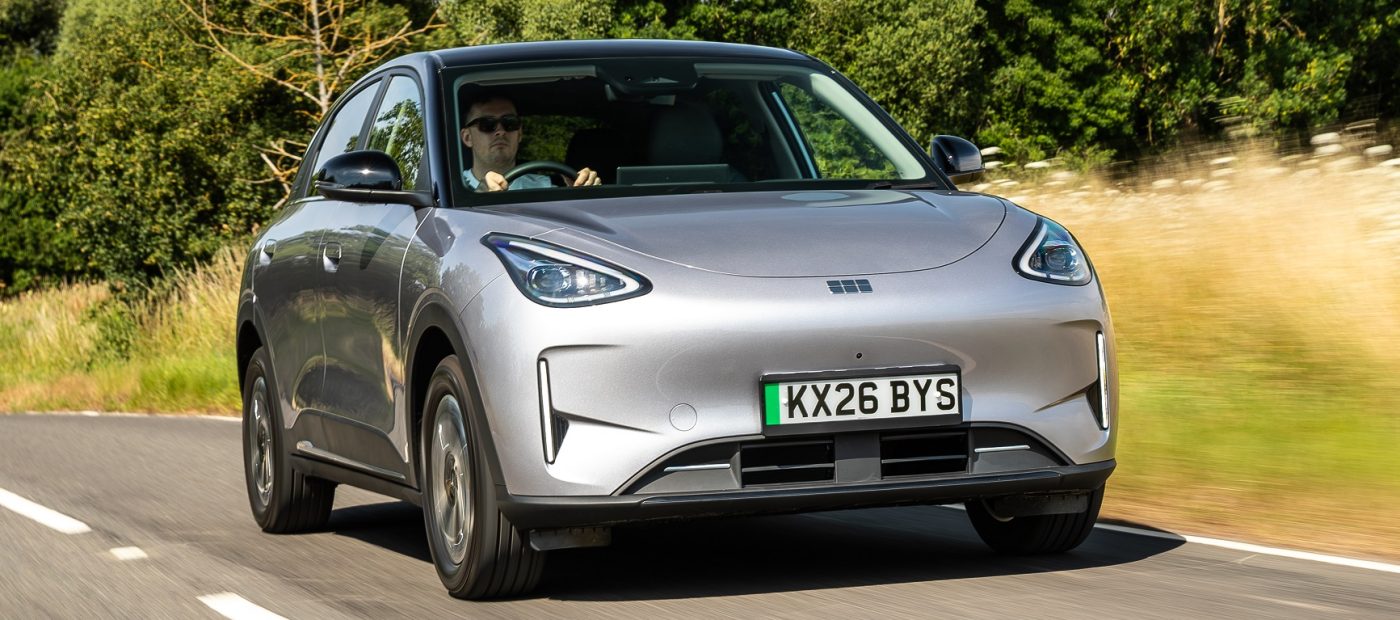
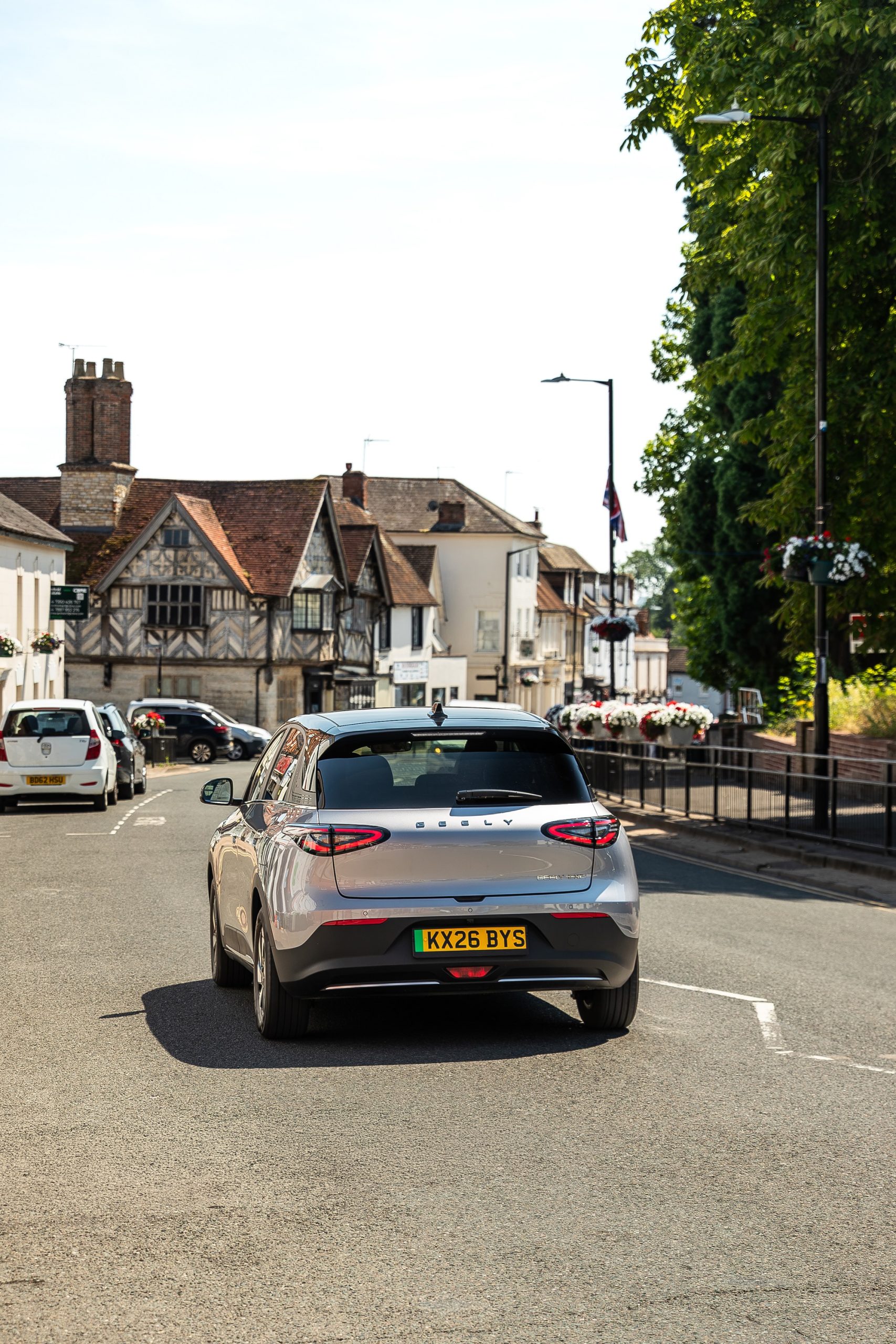
The EX2 has what I’d call a cheerful face. It’s not trying to out-cool the Renault 5 or the retro-styled Fiat Grande Panda, nothing does, but it has smooth, aerodynamic lines, semi-concealed door handles, feather-inspired LED headlights and a friendly stance that will play well in the school car park. Optional dual-tone paint and the sporty stripe pack (which was on my test car) noticeably lift the look. Without them it’s pleasant enough; with them it’s got proper small-car sporty appeal. The pale pink and pastel green paint options are unlike anything else in the small EV segment, and I mean that in a good way.
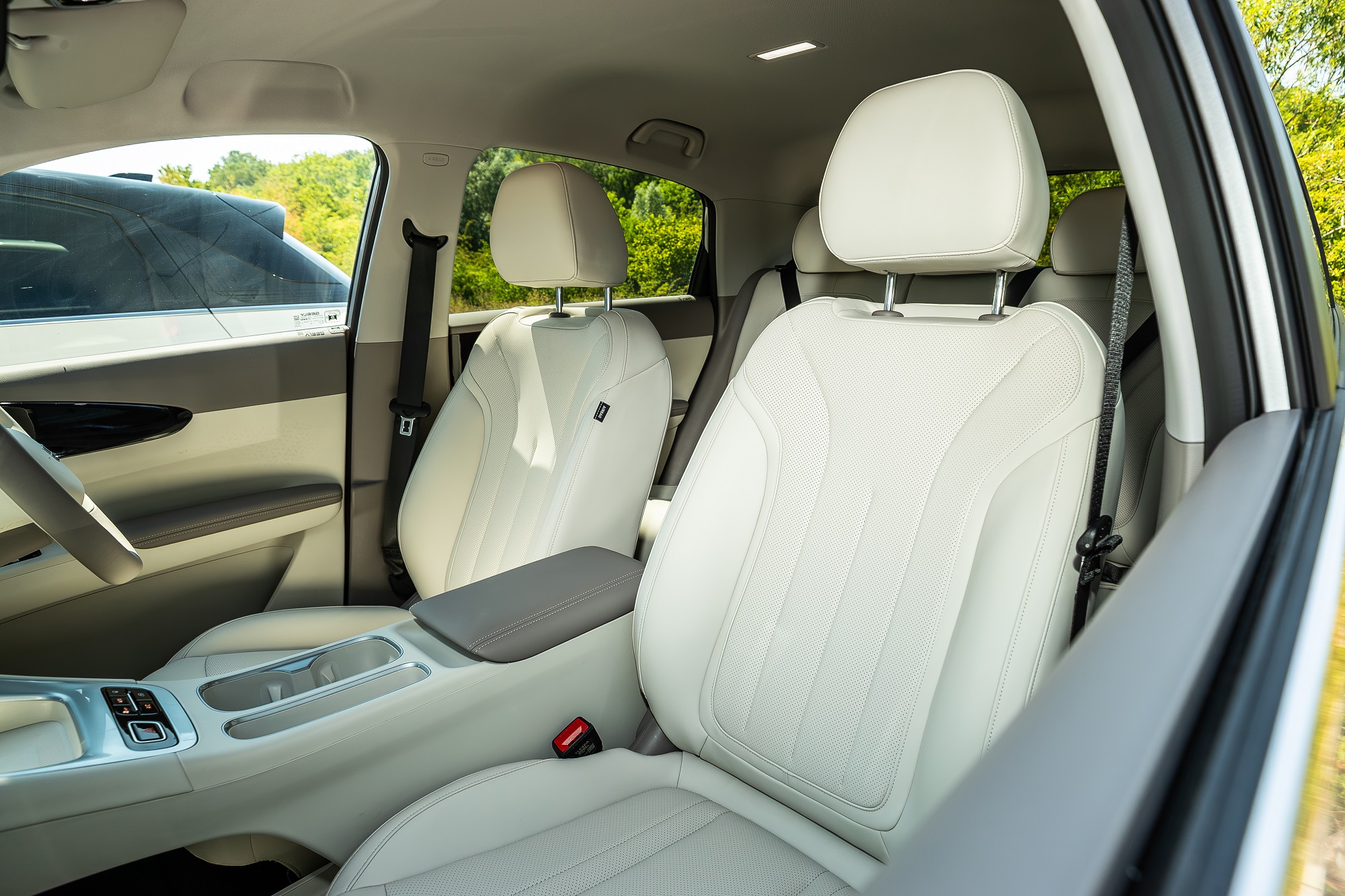
Inside, the surprise is space. The EX2 is 4.14 metres long — a fraction longer than a Renault 5 and the same length as a Renault 4 — but the interior feels notably bigger than either. The flat floor (a benefit of the dedicated EV platform) means rear passengers aren’t straddling a transmission tunnel, and legroom back there is properly good; a six-footer can sit comfortably behind another six-footer, which is genuinely rare at this price point. Two Isofix mounts on the outer rear seats, and while there’s no centre armrest, you can seat three across in a squeeze.
Materials are honestly good for the money. Nicely damped switches, decent plastics for the segment, and an overall sense of solid construction,it doesn’t feel like a budget car once you’re sitting in it.
One really lovely design detail worth calling out for drivers: the passenger-side glove box is a pull-out drawer rather than a drop-down flap. Sounds trivial. Isn’t. Getting hold of the contents — documents, insurance card, sunglasses, whatever — is genuinely easier because you can see what’s in there and grab what you need without having to fish around. Geely claims 36 storage spaces around the cabin, and while I didn’t sit and count them, there’s a 10-litre passenger-side drawer, a decent centre console cubby, an under-bonnet 70-litre frunk for the charging cables (leaving the 375-litre boot completely free for actual luggage), and even an optional 28-litre compartment beneath the rear seats. This is a car designed by people who thought about where you actually put stuff.
Infotainment and Controls
The 14.6-inch central touchscreen is the star of the interior show — huge, clearly presented, and it runs everything in the car. Wireless Apple CarPlay and Android Auto are standard and connected reliably every time I got in during my test. You can customise the home screen with shortcuts to make the most-used features one tap away, which I made good use of.
There’s an 8.8-inch digital instrument cluster in front of the driver — and this is where the EX2’s biggest problem lives. More on that shortly. On the plus side, the Ultra trim adds wireless phone charging and an upgraded six-speaker sound system, plus heated seats and steering wheel and cabin ambient lighting; on Max trim you get the essentials but not the frills.
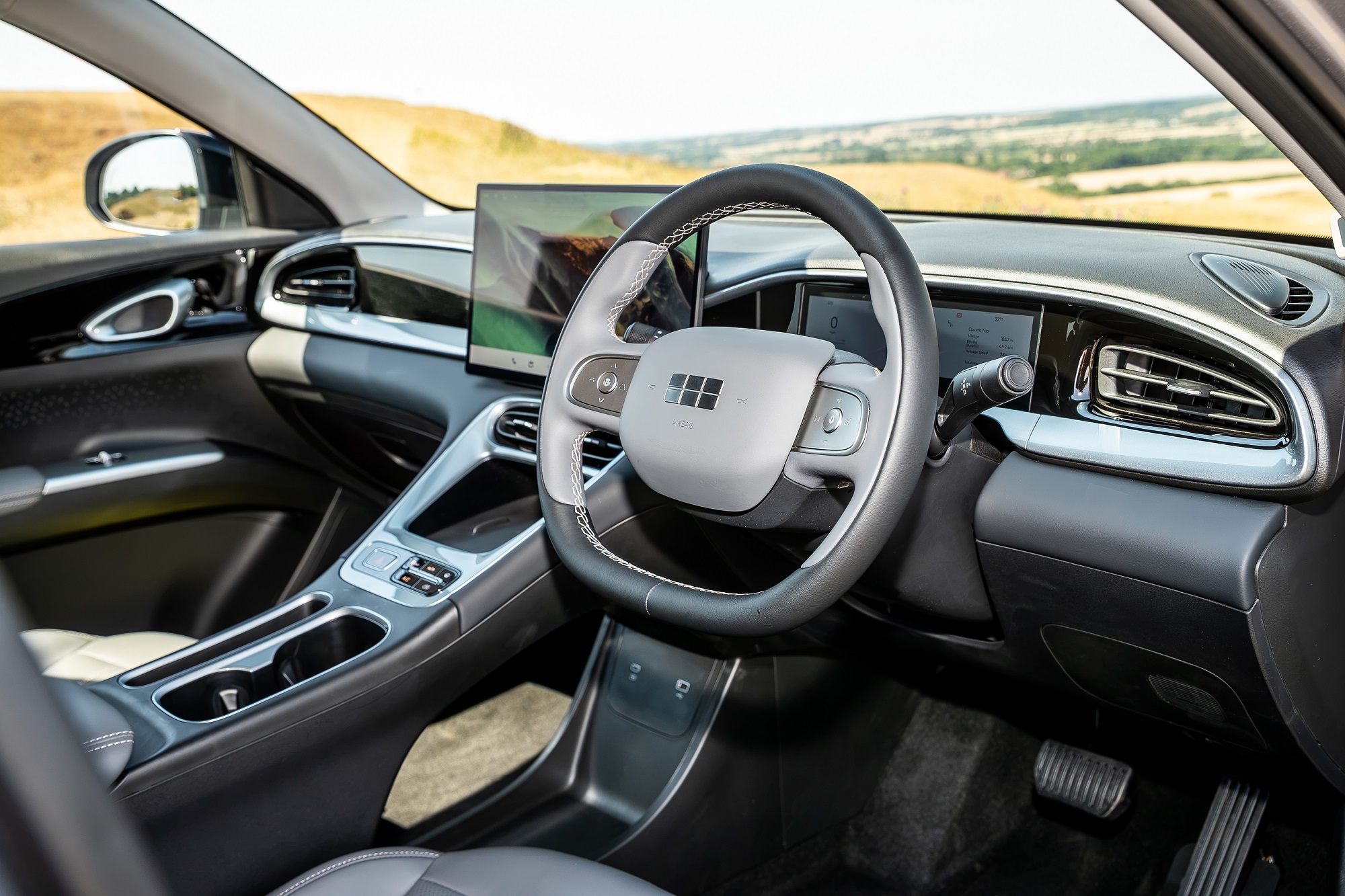
The honest truth is the touchscreen-for-everything approach isn’t my favourite. Climate temperature, drive mode selection, ADAS toggles, everything is buried in the central screen — there are essentially no physical buttons for anything beyond hazards and window switches. It’s workable once you’ve customised your shortcuts, but for a fleet driver who’s just picked up a pool car and needs to change the temperature while merging on to the M6, it’s more of a distraction than it needs to be. Geely have said over-the-air updates are coming and a heat pump is available as an option.
On the Road
The Max’s 85kW (114bhp) motor drives the rear wheels. It’s not fast — 0–62mph takes 11.5 seconds — and it’s not going to be a great grand tourer, but nobody is going to buy this car for that. What it is, is nippy enough around town, and genuinely well-suited to the sort of city driving that will be its bread and butter. The tight turning circle, quick steering at parking speeds, and standard reversing camera make navigating multi-storey car parks and tight urban streets an easy job. Pulling out into gaps in urban traffic isn’t drama-free but it’s never leaving you stranded either.
The entry-level Pro is worth flagging separately here — with only 60kW (81bhp) and a 14.2-second 0–62 time, it’s going to feel underpowered for anyone regularly joining faster-moving motorway traffic. If your drivers are doing anything more than urban commutes, spend the extra couple of grand on the Max at minimum. I’m glad Geely provided the mid-spec car for testing because it’s clearly where the sensible fleet money is.
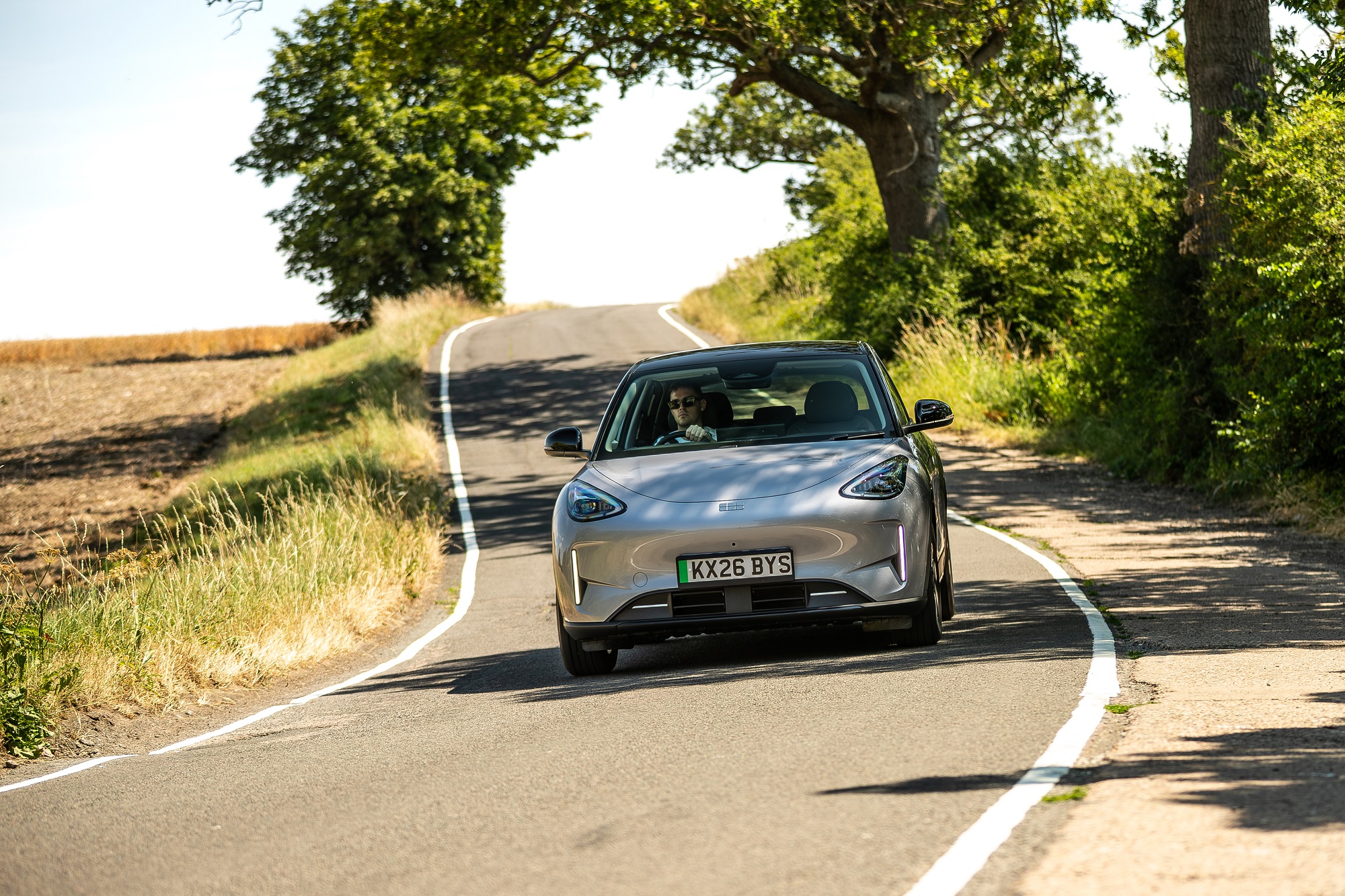
Ride comfort is genuinely a highlight. The tall, softly-tuned suspension irons out Britain’s crumbling road surfaces with surprising grace — better than the Renault 5’s slightly firmer setup. It doesn’t float about, but it does soak up the potholes with dignity. The steering is on the light side (typical of urban-focused EVs) and doesn’t give you a great deal of feedback at speed, but it’s easy and undemanding in the environments this car will actually spend its life in. The regenerative braking is smooth and has three levels including a one-pedal mode.
Efficiency, in my testing, was genuinely impressive. The EX2 felt frugal even when I wasn’t trying to zoom. The small footprint, the LFP battery chemistry, and the modest weight all conspire in the right direction. I saw around 4.0 miles per kWh in mixed driving, which would translate to a real-world range around 180 miles from the 47kWh battery. That’s a whole working week of typical commute mileage between charges.
Battery, Range and Charging
The Max and Ultra share the 47kWh LFP battery, which delivers 214 miles WLTP and around 170–190 real-world miles depending on conditions. That’s enough for the typical urban commuter, the school run driver, or the pool car doing local deliveries. It’s not enough for a rep who’s regularly on the M6 all week, but nobody in that role is going to be looking at this car anyway.
DC rapid charging peaks at 80kW, which is modest by 2026 standards — the MG4 pulls 140kW, an EV3 pulls 128kW. But because the EX2’s battery is small, a 10–80% charge is done in around 28 minutes on a suitable rapid charger, which is perfectly workable. At home on a 7kW wallbox you’re looking at around 7 hours for a full charge. The onboard AC charger is limited to 6.6kW, so you won’t get faster charging even on an 11kW three-phase supply.
V2L (Vehicle-to-Load) is standard on every EX2 trim, which for the money is a real bonus. If you’ve got a driver who occasionally needs to power a laptop, some site equipment, or a coffee machine at an event, it’s there.
The Niggle. And It’s a Big One.
Right. Here we go. The single biggest issue I had with the EX2, and the reason it doesn’t score higher, is the 8.8-inch digital driver display in front of the steering wheel. Specifically, the size of the writing on it.
It is small. Genuinely, remarkably small. I found it very difficult to read at a glance while driving. Even the speed limit graphic — which ought to be one of the most legible things on a dashboard because it’s a safety feature — I struggled to make out. The trip information? Good luck without reading glasses on. And before you ask: yes, I tried switching the background from black to white to see if it would help contrast-wise. It didn’t. The characters are simply too small for comfortable reading at driving speeds.
Maybe I’m just not the target buyer – my used eyeballs certainly aren’t the sharpest – but for a UK market where the average company car driver is well into middle age, this needs urgent attention. Fleet managers, this one goes on your test-drive checklist: put your least-visually-blessed driver in the seat for ten minutes and see if they can read the speed limit graphic at a glance. If they can’t, that’s a safety-relevant concern, not just a comfort niggle. Geely has said over-the-air updates are coming and I’d put a rework of this dashboard’s typography right at the top of the list. Fix it, and the EX2 gets its fourth star.
Safety and Warranty
The EX2 has not yet been Euro NCAP tested at time of writing (Aug26), that’s worth flagging honestly for fleet risk assessments. Seven airbags are standard across the range, along with the usual active safety suite: adaptive cruise control, lane-keep assist, blind-spot monitoring, rear cross-traffic alert, forward collision avoidance with pedestrian and cyclist detection, and a reversing camera. On paper it’s a full spec; without an independent crash rating we don’t yet have third-party verification of how well it performs.
The warranty is exactly the same headline-grabber as on the other Geely models I’ve tested this year: eight years or 125,000 miles of cover including the battery. That is one of the very strongest warranties in the industry; longer than Kia’s seven-year offering and considerably longer than any European rival at this price point. For a fleet operator running a typical four-year cycle, that’s absolute peace of mind on both the vehicle and the battery. Combined with Geely’s target of 100 UK dealers by the end of 2026, and the fact that the group already owns Volvo, Polestar and Lotus, this is a brand with the network scale and financial resources to genuinely support a fleet order. That matters.
The Fleet and Sal-Sac Case
This is where the EX2 does its most convincing work. Pure electric cars sit at 4% BiK for the 2026/27 tax year, rising to 5% in 2027/28, 7% in 2028/29 and 9% in 2029/30. For the EX2 Max at a P11D value of £23,490, that translates to:
- 20% taxpayer, 2026/27: around £16 per month in BiK (£188 per year) • 40% taxpayer, 2026/27: around £31 per month in BiK (£376 per year)
Those are genuinely small numbers. Compared to a similarly-priced petrol supermini in the 25–32% BiK bracket, you’re typically saving £120–£180 a month in tax alone. Over a four-year cycle that’s £5,000–£8,500 back in the driver’s pocket rather than HMRC’s.
Salary sacrifice is where this car makes real sense. With a P11D under £24k and a headline BiK of £16–£31 a month, broker-published sal-sac figures I’d expect to see for the EX2 Max will land somewhere around £220–£260 per month net for a 20% taxpayer through a typical scheme, all-in with insurance, servicing, tyres and often a home charger included. A 40% taxpayer would be closer to £180–£210. For an EV of this size, that’s one of the lowest sal-sac numbers on the UK market. If your organisation runs a scheme aimed at giving lower-paid staff realistic access to a decent brand-new car, the EX2 sits right at the top of the accessible-price tier.
Two more fleet-specific points to close on. Firstly, every EX2 sits below the £37,000 Electric Car Grant threshold, meaning it qualifies for the £1,500 Band 2 government grant, effectively bringing the OTR price of my test Max down to £21,990. Secondly, every EX2 sits well below the £50,000 Expensive Car Supplement threshold, so drivers dodge the £425 annual VED supplement that catches out pricier fleet EVs from year two through six. The 8-year/125,000-mile warranty completes the whole-life-cost picture, and it’s a compelling one.
The Competition
The EX2 arrives into one of the fastest-moving corners of the UK EV market. The Renault 5 is more stylish and slightly better-resolved to drive but costs more; the BYD Dolphin Surf has similar cheerful design DNA and competitive pricing; the Fiat Grande Panda undercuts on design flair; the Dacia Spring is even cheaper but a step down in every other respect; the MG4 Urban is close on price and has a heat pump as standard. What the EX2 uniquely offers is the biggest interior in the price bracket, the longest warranty package on the UK market at this price point, and the reassurance of being an already-proven product with over 465,000 real-world owners globally. For a fleet buyer running a sal-sac programme aimed at price-conscious staff, that combination is going to be hard to ignore.
The Verdict
The Geely EX2 Max is a decent little car at a genuinely great price. It looks cheerful, drives comfortably enough for urban and suburban work, has masses more room inside than its footprint suggests, gets a properly generous equipment list for the money, comes with an industry-leading eight-year warranty, and sits in a BiK and sal-sac position that’s at the very affordable end of the UK EV market. The pull-out glove box drawer is a lovely design detail. The 70-litre frunk is a legitimately useful piece of packaging. And Geely’s expanding UK dealer network gives you the infrastructure confidence that some newer entrants can’t match.
But the dashboard text size is a genuine problem. In a car aimed squarely at accessible, everyday use, a driver display that requires reading glasses to interpret the speed limit graphic is a real barrier. Combined with the modest 80kW peak DC charging speed, the ADAS calibration questions Geely still needs to resolve via over-the-air updates, and the fact that the entry Pro trim is genuinely underpowered for anything beyond urban work, the EX2 lands honestly at three stars from me. The dashboard alone brought it down a point — fix that and I’d happily push it up to four.
For fleet managers looking to open up salary sacrifice to lower-paid staff, or for organisations running urban pool cars where the mileage patterns fit within the 214-mile range, the EX2 Max deserves serious consideration — provided you can live with the dashboard until Geely gets the update out. Expect to see plenty of these on UK roads in the coming years. At this price point, and with the sales muscle Geely is building behind it, this is a story that’s only just beginning.