


HMRC Advisory Fuel Rates from 1 December 2026
HMRC has announced new advisory fuel rates (AFRs) that bring increases of up to 3p per mile from 1 December 2026. Petrol and diesel reimbursement rates rise, while LPG stays put. Electric rates also hold steady, at 7p per mile for home charging and 15p for public charging. Fleet managers must update expense systems, so here is what has changed and why.
Petrol and Diesel Advisory Fuel Rates Rise
HMRC updated the guidance on 18 November 2026. Petrol drivers see a rise of 2p per mile in every engine band. Diesel rates climb by 1p to 3p, depending on engine size. HMRC treats hybrid cars as either petrol or diesel.
The increases reflect higher fuel prices in HMRC’s calculations. The new petrol rates assume 174.1p per litre, up from 159.9p in September, while diesel moves from 179.2p to 199.2p. That is a rise of around 9% for petrol and 11% for diesel.
HMRC takes its prices from the Department for Energy Security and Net Zero (DESNZ). These figures run on a different timetable to forecourt prices. Fuel Finder reported averages of 162.3p for petrol and 193.4p for diesel on 19 November. Drivers may therefore notice a gap between the new rates and their pump costs. Employers can keep using the previous rates for up to one month after 1 December.
Advisory Fuel Rates from 1 December 2026: Full Table
The table below shows every rate per mile, with the previous quarter’s figure for comparison.
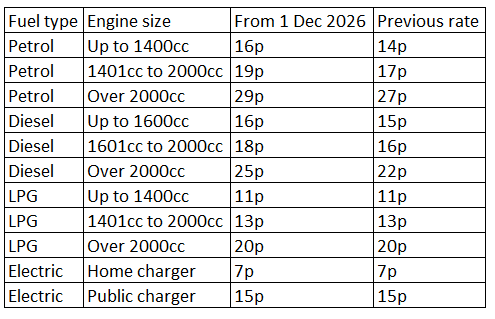
Source: GOV.UK, Advisory fuel rates, updated 18 November 2026.
Why Does HMRC Have Two Advisory Electric Rates?
The Advisory Electric Rate (AER) has two tiers because home and public charging cost very different amounts. HMRC introduced the split from 1 September 2025. Before then, one rate applied to every electric company car, wherever the driver plugged in. The BVRLA and the Association of Fleet Professionals (AFP) had campaigned for the change. Drivers without a home charger were often left out of pocket.
The numbers explain the gap. HMRC assumes electric company cars manage 3.59 miles per kilowatt-hour. Home electricity at 25.94p per kilowatt-hour works out at 7.22p per mile. Public charging at 54.00p per kilowatt-hour works out at 15.02p per mile. HMRC then rounds those figures to 7p and 15p. Public charging costs more than twice as much per mile.
Each tier draws on different data. The home rate starts with an annual DESNZ price, which the Office for National Statistics (ONS) electricity index adjusts each quarter. The public rate uses the Zapmap Price Index for chargers below 50 kilowatts. Efficiency figures come from the Department for Transport and reflect company car sales.
What the Two Rates Mean for Fleets
The public rate targets a specific group. Lorna McAtear of the AFP, who also heads fleet at National Grid, said HMRC never designed it as “a rate for all public charging.” The government aimed it at drivers who cannot charge at home, such as those who rely on kerbside chargers overnight. AFP chair Paul Hollick called the original split “very good news for fleets.”
Confusion has followed, though. For journeys that mix both charging types, HMRC says the apportionment must be “fair and reasonable”. Employers can also pay more than the AER if they can prove the actual cost per mile is higher. That matters for ultra-rapid charging, because the 15p rate only covers slower chargers. One industry representative called the earlier 14p rate “arguably low”. Industry groups have asked for a third tier.
Analysis: What to Do Before 1 January
The December review shows how quickly petrol and diesel rates move. They follow fuel prices every quarter, whereas the electric rates change far less. A 2p rise adds £200 to a petrol driver’s reimbursement over 10,000 business miles. A 3p rise on larger diesel cars adds £300.
Update payroll and expense systems before the one-month grace period ends. Check that your mileage rates do not exceed the AFRs without evidence. Any excess becomes taxable profit and earnings for Class 1 National Insurance. Electric drivers should keep clear records of home and public charging costs, which supports a fair apportionment. Fleetpoint will track each quarterly review as it lands.