
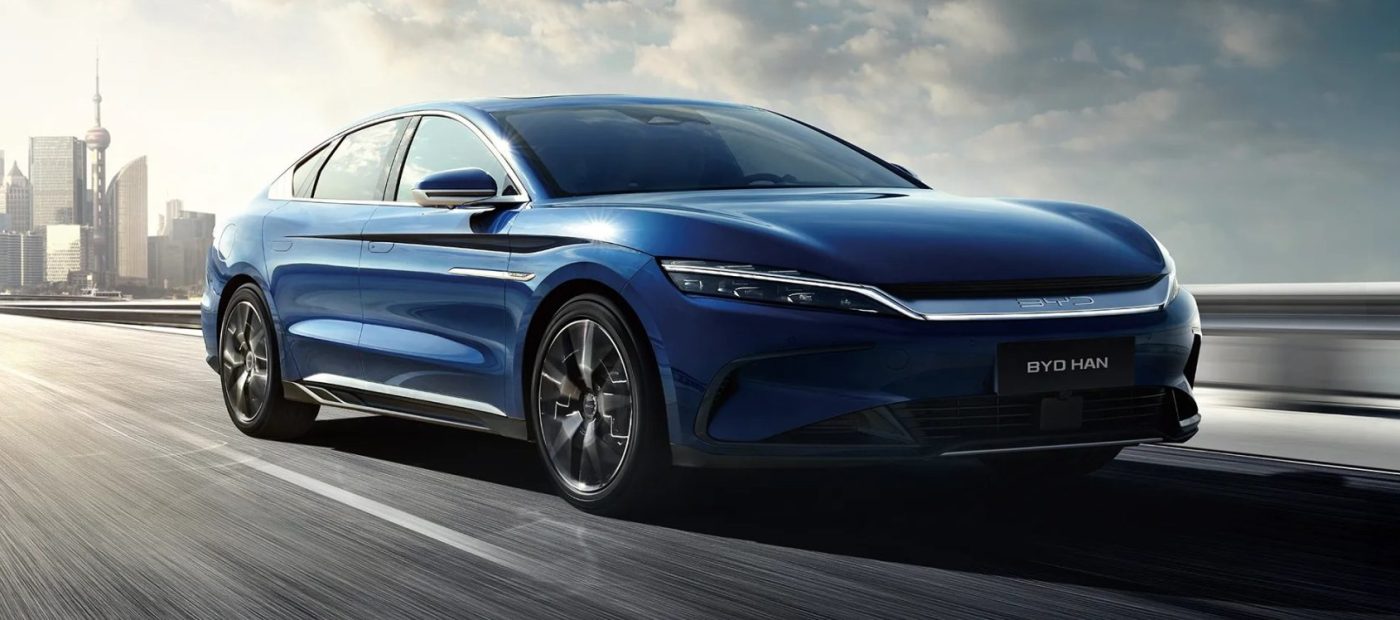
BYD Da Han brings 1,008km range and nine-minute charging
BYD is taking aim at the premium electric executive car market with the new Da Han, a flagship electric saloon combining a claimed range of more than 1,000km with 1,500kW FLASH Charging, rear-wheel steering and sophisticated air suspension.
Although early references have sometimes described the Da Han as an SUV, it is actually a large executive saloon. The SUV equivalent in BYD’s flagship Dynasty line-up is the Da Tang. At 5,256mm long, 1,999mm wide and with a 3,130mm wheelbase, the Da Han is closer in concept to a Mercedes-Benz S-Class than a conventional family SUV, and is 66mm longer than the German luxury saloon.
The Da Han represents an important step in BYD’s attempt to move further into the premium market. It is the first D-segment flagship saloon in the Dynasty range and sits above the existing Han, with BYD combining long-distance capability with technology normally associated with considerably more expensive luxury cars.
More than 1,000km of electric range
The headline specification is undoubtedly the battery and range. The rear-wheel-drive Da Han uses a 102.326kWh second-generation Blade Battery and a single electric motor producing 370kW, equivalent to around 496bhp. Under China’s CLTC testing regime, BYD quotes a maximum range of 1,008km, or approximately 626 miles.
It is important for UK buyers not to interpret that 1,008km figure as a likely 626-mile WLTP range. CLTC testing generally produces considerably higher figures than WLTP, so the Chinese result should be treated as a headline indicator rather than a direct comparison with European-market EVs.
Even so, the underlying proposition is impressive. The Da Han combines a relatively large battery with an exceptionally aerodynamic body, with a reported drag coefficient of just 0.197. The result should make the car particularly well suited to long-distance executive travel, where motorway efficiency and the ability to cover substantial distances between charging stops are important.
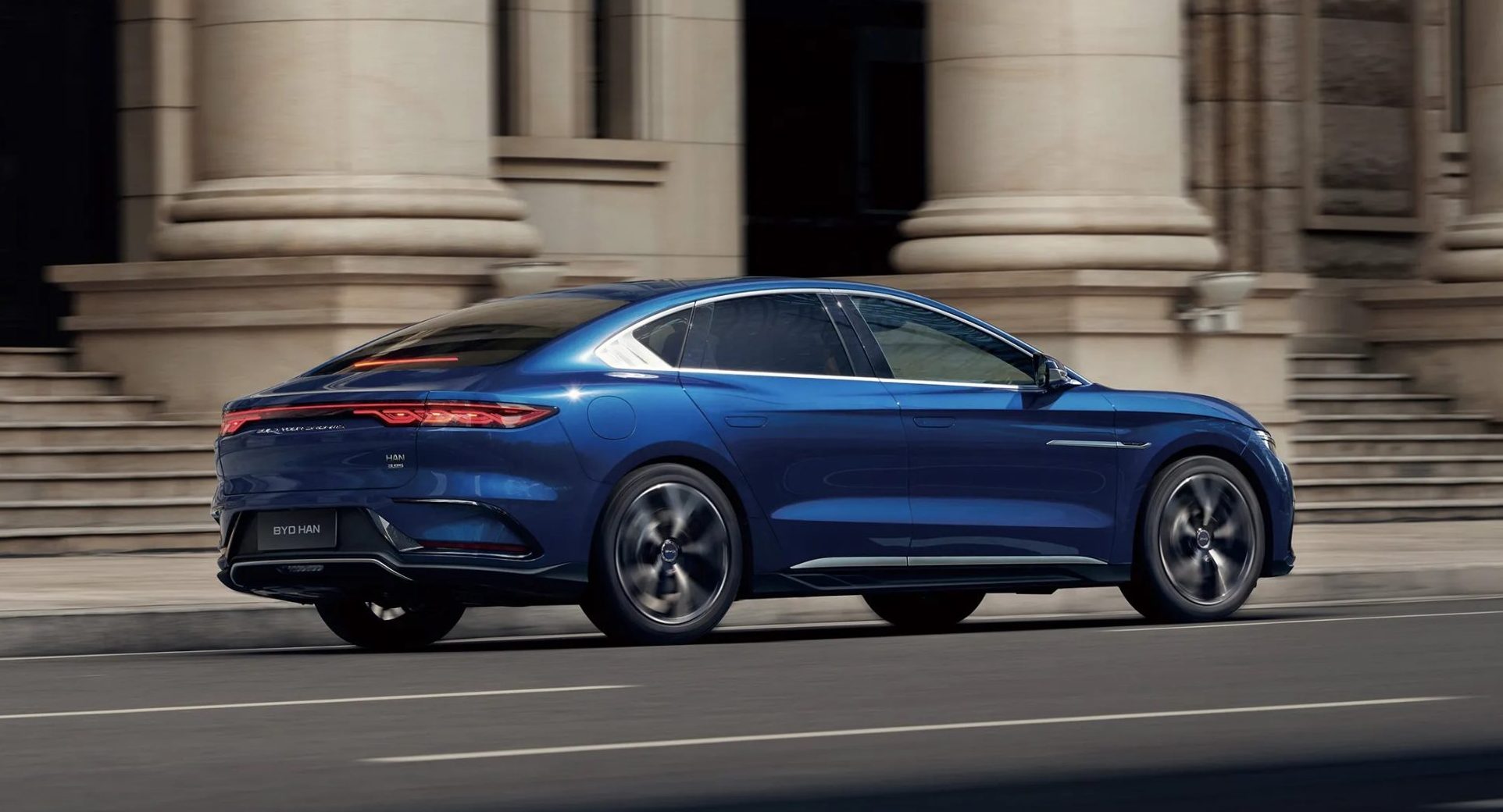
The range figure falls to 880km CLTC for the all-wheel-drive flagship. However, that version adds a 200kW front motor to the 370kW rear motor, producing a combined 570kW, or around 764bhp. The AWD Da Han can accelerate from 0-100km/h in 3.3 seconds and has a claimed top speed of 270km/h.
FLASH Charging changes the equation
Range is only part of the story. The Da Han is also compatible with BYD’s new FLASH Charging technology, which could be even more significant for the future of electric executive cars.
BYD says its FLASH Charging system can deliver up to 1,500kW through a single connector when combined with its second-generation Blade Battery. The company’s headline charging proposition is “Ready in 5, Full in 9, Cold Add 3”: a 10-70% charge in five minutes, 10-97% in nine minutes and, even at -30°C, 20-97% in 12 minutes.
That means the Da Han could potentially add several hundred miles of driving range during a charging stop lasting little more than the time normally required for a coffee break.
BYD’s UK FLASH Charging demonstration with the DENZA Z9 GT provides a useful indication of what this means in practice. The company says the Z9 GT, with a 372-mile WLTP range, can gain 223 miles of range from a five-minute charge and 323 miles from a nine-minute charge.
However, there is an important qualification. The nine-minute figure does not mean every Da Han will charge in nine minutes from any public rapid charger. FLASH Charging requires compatible BYD hardware and a vehicle capable of accepting the very high charging rate. The system achieves its 1,500kW peak by incorporating substantial battery storage within the charging station, allowing stored electricity to be discharged rapidly into the vehicle without requiring an equivalent 1.5MW continuous grid connection.
That infrastructure requirement is therefore central to the Da Han’s real-world charging advantage.
Why does the Da Han have rear-wheel steering?
One of the more intriguing features is rear-wheel steering. On a car measuring more than 5.2 metres long, manoeuvrability could otherwise be a significant weakness, particularly in multi-storey car parks, urban streets and tight loading areas.
The Da Han’s rear wheels can steer in addition to the front wheels, reducing the car’s minimum turning radius to just 4.95 metres. That is remarkably tight for a vehicle of this size.
At lower speeds, the rear wheels steer in the opposite direction to the front wheels, effectively shortening the car’s turning circle and making it easier to manoeuvre. At higher speeds, rear-wheel steering can improve stability and responsiveness by helping the car change direction more naturally.
This is particularly appropriate for the Da Han because BYD is trying to combine limousine-style passenger space with something approaching the agility of a considerably smaller vehicle.
Rear-wheel steering is supported by BYD’s DiSus-A dual-chamber air suspension, which can adjust ride height by up to 100mm and is designed to provide both comfort and improved body control.
How does it compare with rivals?
The Da Han enters an increasingly competitive electric executive market. In Europe, its most obvious established rivals include the BMW i5, Mercedes-Benz EQE and Audi A6 e-tron, while the Tesla Model S remains a significant long-range technology-focused competitor. The BMW i5 and Mercedes EQE are already recognised as key rivals to the Audi A6 e-tron in the executive EV sector.
The Audi A6 e-tron is particularly relevant because of its emphasis on efficiency and long-distance driving. Its 100kWh battery can accept up to 270kW and charge from 10-80% in around 21 minutes on an appropriately powerful charger.
That makes the Da Han’s claimed nine-minute 10-97% FLASH Charging performance potentially transformational if the necessary charging infrastructure becomes widely available.
There are also increasingly serious Chinese competitors, including the NIO ET7, Xiaomi SU7 Max and Zeekr 001. These models demonstrate how rapidly Chinese manufacturers are closing the technology gap with established European premium brands, particularly in battery technology, software and charging performance.
A potential new benchmark
The Da Han is significant because it challenges one of the long-standing compromises of electric vehicles: buyers have traditionally had to choose between range, performance, charging speed and price.
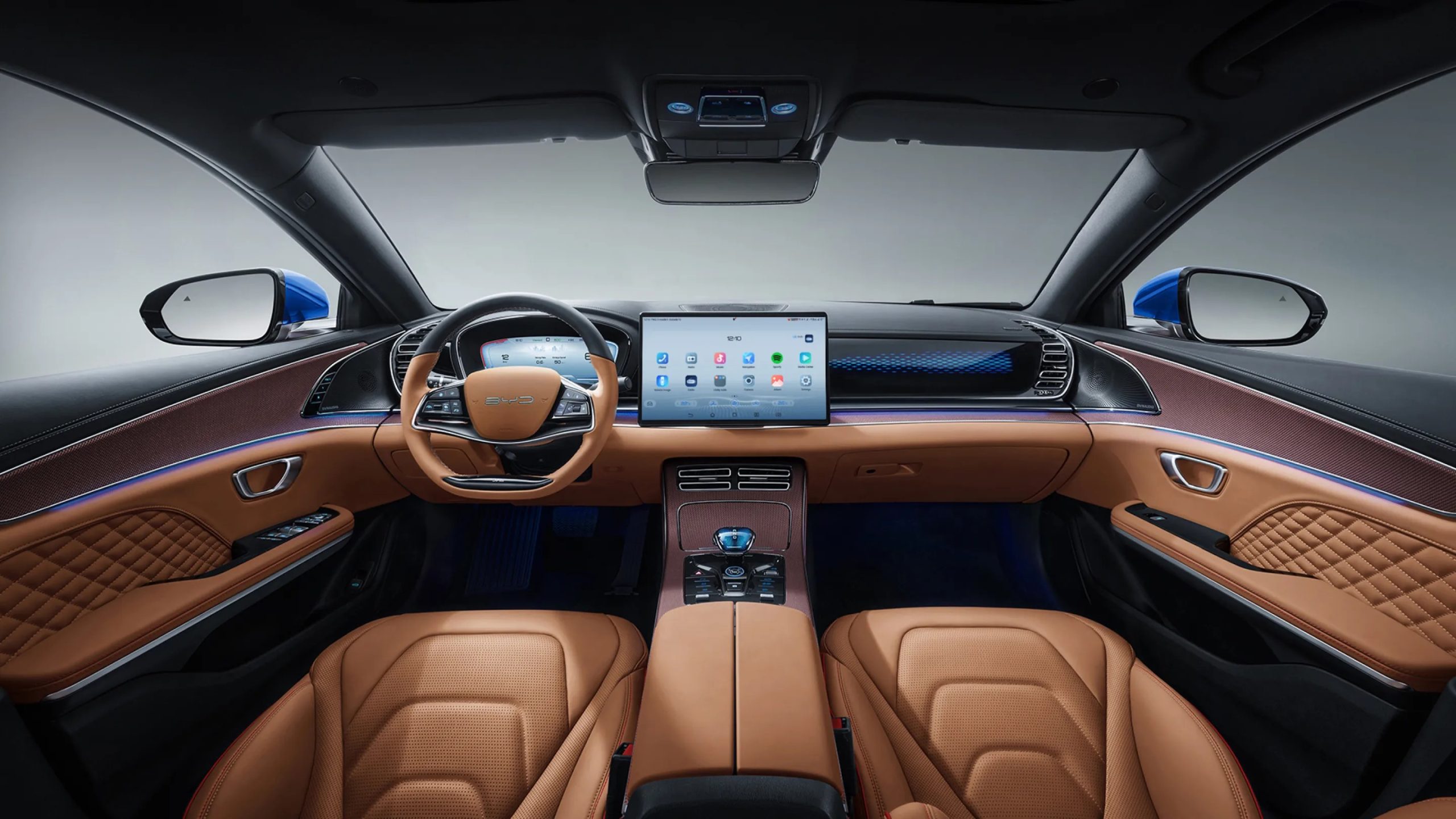
BYD is attempting to deliver all four. The 1,008km CLTC range, 370kW rear motor, 570kW AWD option, rear-wheel steering, dual-chamber air suspension and advanced driver assistance technology give the Da Han the specification of a much more expensive executive flagship.
Chinese pre-sales started at 249,900 yuan, rising to 299,900 yuan for the AWD flagship, although UK pricing has not been announced. Nor has BYD confirmed a UK or wider European launch for the Da Han.
That caveat matters. For British fleet and company-car buyers, the Da Han is currently more an indication of where BYD’s technology is heading than an immediate alternative to the BMW i5, Mercedes EQE or Audi A6 e-tron.
Nevertheless, the technology deserves attention. If BYD can bring the Da Han, or its underlying battery and charging technology, to Europe at a competitive price, it could put considerable pressure on established executive EV manufacturers.
The biggest breakthrough may ultimately prove to be FLASH Charging rather than the 1,000km range itself. A car that can travel hundreds of miles between stops is useful; one that can replenish most of its battery in around nine minutes fundamentally changes how drivers think about electric-car charging.