
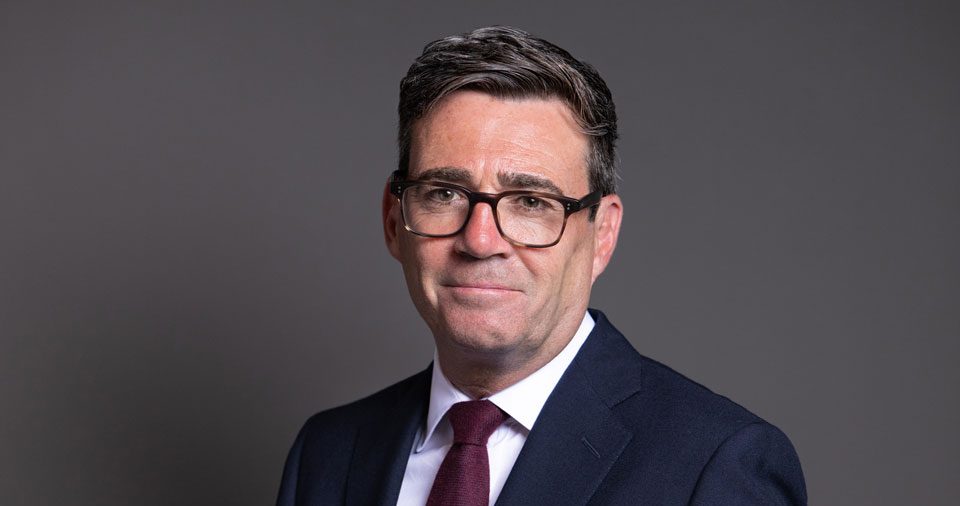
Andy Burnham officially became the UK’s Prime Minister on 20 July 2026 following his election as Labour leader, promising to deliver a “circuit breaker for Britain” through a new political and economic model. While his first speech focused on the cost of living, devolution, housing and tackling homelessness, the transport, logistics and freight sectors will be watching closely to see how those broader ambitions translate into policy.
For fleet operators, hauliers and logistics businesses, there were no major transport policy announcements on Burnham’s first day in office. However, his record as Mayor of Greater Manchester, together with comments made during the Labour leadership contest, provides some strong indications of the direction his government could take.
Throughout his time in Greater Manchester, Burnham championed greater local control over public transport, bringing buses back under public franchising, integrating ticketing and promoting more affordable fares. He has also consistently argued that economic growth depends on improved transport connectivity outside London and has repeatedly called for greater investment in rail and regional infrastructure.
In his inaugural speech outside Downing Street, Burnham pledged to “take power out of here and carry it into every postcode in the land”, while promising to “re-industrialise Britain” through public procurement and stronger support for British industry. He also confirmed that a comprehensive 10-year national plan would be published later this year, suggesting that many of the government’s detailed transport and industrial policies are still to come.
What could this mean for transport and logistics?
Although Andy Burnham stopped short of announcing specific measures affecting freight, road transport or commercial vehicle operators, several themes emerging from his political career could have significant implications.
Devolution is expected to remain central to government policy. Burnham has long argued that regional leaders should have greater powers over transport planning, funding and infrastructure investment. That could lead to more integrated local transport networks, increased investment in city-region infrastructure and potentially new opportunities for freight planning at a regional level.
Infrastructure investment also appears likely to remain high on the agenda. Burnham has previously argued that better rail, road and public transport links are essential to improving productivity and reducing regional economic inequalities. Reports following his appointment suggest his government may explore greater flexibility within fiscal rules to fund long-term infrastructure projects.
Affordable public transport is another likely priority. During the Labour leadership campaign, Andy Burnham highlighted cheaper transport as part of wider measures to ease the cost of living, building on his experience delivering lower bus fares in Greater Manchester.
For the logistics sector, however, the immediate priority remains the absence of a comprehensive National Freight Strategy.
RHA calls for National Freight Strategy
Responding to Burnham’s appointment, the Road Haulage Association welcomed the new Prime Minister while urging him to recognise the importance of the freight sector to economic growth.
Richard Smith, RHA Managing Director, said: “I would like to congratulate Andy Burnham on becoming Prime Minister today (Monday 20 July).
“He inherits a huge in-tray, from the cost of living to international pressures; he will have a raft of plans to tackle these in the months and years ahead and we look forward to seeing that vision and how he will go about delivering it. Our asks and priorities remain unchanged by a new PM taking office and we will continue to be a trusted partner to the Government and Whitehall officials.
“He will recognise that the road transport and logistics sector – as a key economic enabler – plays a vital role in driving growth.
“Our industry is critical national infrastructure that quite literally keeps the country moving. And that’s why we urge the PM to deliver solutions which empower the haulage, coach and van sectors to help stimulate economic growth, and support businesses to invest and thrive.
“We remind the PM that 85% of all goods in the UK are transported by road freight at some point. So, a much needed and clear National Freight Strategy would be a key enabler to unlock economic potential both regionally and nationally.
“We’re ready to work with his team, cross-party and cross-industry on devising and delivering this – and indeed on other government priorities that would spark the growth and prosperity we all want to see.
“We wish the Prime Minister every success.”
The RHA’s message reflects long-standing industry concerns around driver shortages, infrastructure investment, decarbonisation, planning reform and ensuring freight is embedded within wider transport policy.
Industry awaits further detail
While Burnham’s broader economic vision appears supportive of investment, regional growth and industrial renewal, there remains little concrete detail on issues such as zero-emission commercial vehicles, fuel duty, road investment, planning reform, freight decarbonisation or taxation affecting fleet operators.
His promise to publish a detailed 10-year strategy later this year is therefore likely to become the first major test of how his government’s economic ambitions translate into practical support for the transport and logistics sector.
For now, fleet operators and logistics businesses are likely to welcome Burnham’s emphasis on economic growth and infrastructure while waiting to see whether his long-standing commitment to regional transport reform is matched by a comprehensive strategy for the road freight industry that keeps 85% of the UK’s goods moving every day.