
Samsara User Group: what’s new in the platform
Samsara used its latest UK User Group to show fleet managers where the platform is heading: AI agents that can phone drivers, a connector that lets tools like ChatGPT and Claude pull fleet data directly, a stitched overhead view from four cameras, and a single place for every incident.
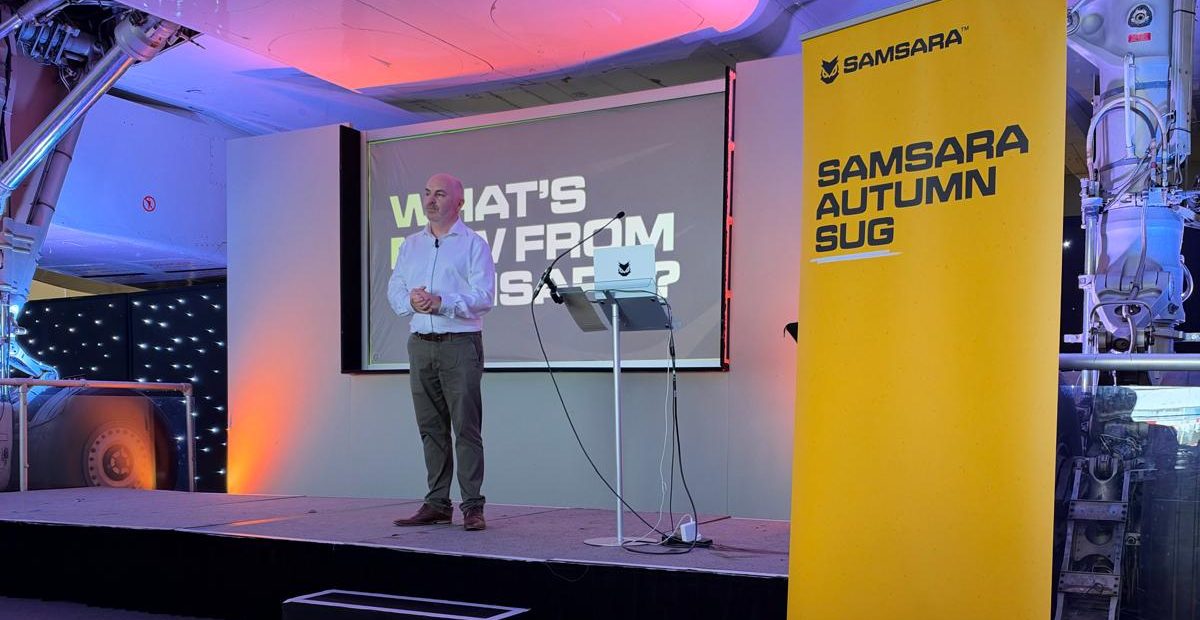
Jonathan Ramsey, Senior Manager, Customer & Solutions Marketing EMEA, walked through the new pieces with solutions engineer Anna Clark. The consistent message was that teams are stretched, the data is already sitting in the platform, and the next job is getting it to do more of the actual work.
“Everyone’s teams are stretched on repetitive tasks,” Ramsey said. “We know many of you have been working with AI and trying it out in different ways. This is bringing that agent capability natively into the Samsara platform and starting to help you really scale.”
Agents that talk to drivers
The agents feature, which went live the day before, is the clearest example. Where the existing Samsara Assistant answers questions typed into the dashboard, agents go out and act. They can call drivers, and the conversation is two-way.

“You get an agent to proactively call all your drivers, or a segment of your drivers, about a particular topic or issue that has come up while they are out on the road,” Ramsey said. “And it’s interactive. It’s not just delivering a message. They can have that two-way conversation with the agent.”
He described how it might fit into a shift. At the start the agent assigns the vehicle by voice and runs through road conditions, messages from the office, and anything specific to that truck. On the road the driver long-presses the blue button on the dash cam to ask something; the AI answers or passes it back to the manager, and can also flag site speed limits, low clearances, and which entrance to use. At the end of the week it rings round with a short wrap-up: where the driver did well, what’s improved, and the one habit—say a seatbelt lapse—to watch next week.
“Enabling and training up 100 managers is fantastic,” Ramsey said. “Maintaining that momentum at scale is now enabled by using the agents.”
Your fleet data, inside ChatGPT and Claude
Alongside that sits a Samsara MCP connector so the AI tools a business already uses—Claude, ChatGPT, Copilot—can query Samsara data without going through an API key. Clark, whose role is working with customers evaluating new products, said the previous route was always an API key. With the connector, questions about the fleet can be asked inside those tools and answered there. Samsara has been testing it internally and is deliberately light on prescribed use cases. The line from the company was straightforward: try it, then tell them what works and what’s missing.
The Assistant itself has also been extended. It can now generate PDF and CSV reports on request rather than only answering short questions about safety scores or fuel spend. For customers on Street Sense, which draws on dash-cam footage across the Samsara base to show road conditions, the Assistant can now answer questions about blockages and conditions directly.
A bird’s eye view from four cameras
The 360-degree camera set-up is now generally available, including a new bird’s-eye view. Footage from the four cameras around the vehicle is stitched into a single overhead image, like a helicopter hovering above the cab, and the view turns red when the vehicle moves toward a pedestrian. Ramsey noted that drivers no longer have to mentally combine several camera feeds; they get one picture that highlights the risk. Clark, who has used the same style of system on a hire car, said it can be retrofitted by fitting and calibrating the four cameras, and is aimed at fleets doing tight manoeuvres, cornering, and work in crowded spaces such as docks.
Incident Centre: one place for every alert
On the operations side, the number of AI detections—harsh driving, distraction, theft, loss, fuel theft—has kept rising, and until now each lived in its own part of the dashboard. The new Incident Centre pulls them into one queue. Ramsey framed it as fixing three practical problems: alerts scattered across screens, investigations that split between Samsara and other systems, and no consistent record of what has been done, which is how cases drag on.
Each incident arrives as a ticket with the evidence already attached. An “asset left behind” example: a van with an AT11 tag on a piece of equipment stops for a job and drives off without it. Within a couple of minutes the vehicle gateway notices the tag is out of range and raises a ticket showing which drivers are nearby, who last had the asset, snapshots from the gateway at the moment of separation, and dash-cam footage from any vehicle that has passed the spot since. A route replay shows where the two parted. The incident can then be tracked to resolution, with a live link that can be shared so others are notified when the asset is found. None of the underlying data is new; the change is that no one has to pull it together from separate tabs. For fleets losing tools, radar units or trailers, that is the difference between recovering something the same afternoon and writing it off. Fuel theft, which can reach as much as 10 per cent of fuel spend in some operations, is covered in the same view.
Fuel: every pound in one picture
Fuel remains the biggest cost pressure for most fleets, and Ramsey broke the leakage into three places: inefficient burn from idling, buying at the wrong forecourt, and theft through siphoning or card fraud. The Fuel Command Centre, now generally available, is meant to show all three in one place, highlight where to look first, and close the gaps automatically. Paired with Samsara’s commercial navigation it can steer drivers to preferred suppliers once the tank drops below a set level.
The Fuel and Energy hub has been rebuilt around actions rather than raw figures. Instead of pages of cruise control, anticipation and speeding numbers, the opening screen shows spend and potential savings by category, then recommends specific changes—for example cutting an idling alert from ten minutes to five. Idling detection excludes PTO use and respects temperature thresholds so drivers are not left to freeze or cook, and the in-cab alert can tell the driver to switch off. Clark said fuel-card integration is where the fraud checks sit: once transactions flow in, the system checks whether the vehicle and driver were actually at the pump, whether a 100-litre fill fits a tank with 50 litres of space, and whether petrol has been put on the receipt of a diesel vehicle. For fleets still checking transactions by hand, she noted, that alone could save time.
360 camera for forklifts and plant
The 360 camera, launched globally in June, also extends coverage to forklifts and other equipment that never had a Samsara device. Ramsey cited 97,000 injuries involving industrial trucks a year, with 70 per cent of forklift accidents deemed preventable. Mounted on the overhead bar it records continuously in every direction, so a reviewer can drag the view around after the event. One demo showed an aircraft being pushed back; another was on a construction site.
Its value shows up in incidents a conventional dual-facing camera cannot explain. In a warehouse where boxes keep falling from the top of the racking, a forward- and driver-facing unit can confirm the operator was paying attention but cannot show what was happening above or behind the mast. With the 360 camera the full recording can be scrolled around after the event: the load creeping toward the edge of the pallet, the clearance between the racking and the forks, the pedestrian stepping into the aisle. That turns a blame-the-driver conversation into a fix-the-process one, with evidence that can go to the warehouse team and the insurer.
A tracking label that is literally a sticker
The final reveal moved beyond the fleet. The Samsara tracking label looks like a sticker and is one, but inside sits a battery, a Bluetooth radio and an antenna that pings off Samsara gateways the same way the firm’s asset tags do. It is printable and disposable, lasts 45 days once activated, and goes in the bin at the destination. The use case is the parcel-sized consignment that is worth far more than its box suggests and has a habit of going quiet in transit—a box of ECUs or diagnostic tablets on its way to a dealer workshop, a carton of pharmaceuticals, a replacement part a customer’s vehicle is waiting for, a set of keys and documents for a sold car. None of these justifies a reusable asset tag, but all of them hurt when they disappear. Stick a label to the carton and it can be watched from loading bay to doorstep, pinging off every Samsara-equipped vehicle and gateway it passes. If it sits at a cross-dock for three days, or turns up in a yard it has no business being in, the operator knows before the customer rings. Because the label is disposable there is no return journey for the tracker. Paired with the new agents, a late consignment can trigger an automatic update to the customer without anyone in the office lifting a phone.
Smaller changes worth knowing
A few quieter updates rounded off the session. Biometric login with Face ID, Touch ID or Windows Hello now works across the dashboard and Fleet app, with a single registered passkey doubling as a phishing-resistant second factor and fewer lockouts when text codes fail. Role-bound limits let full admins define which roles a custom role is allowed to hand out, for audit and compliance. And the Samsara Community, open to customers only and reachable from the dashboard, is now live in Europe for crowdsourcing settings and answers between user groups.
The Fleetpoint view
Taken together, the changes are mostly about making the data the platform already holds easier to act on. The Incident Centre and the redesigned fuel hub both turn information that was already somewhere in the dashboard into something a manager can use: which alert matters most, where the fuel money is going, what to change first. The agents go a step further and do some of the acting. For UK operators the nearer-term gains are the unglamorous ones—switching on idling alerts, integrating fuel cards so the fraud checks run automatically, and routing every alert through the Incident Centre. The agents and the MCP connector are the ones still being shaped by what customers actually try.
The invitation from the stage was open. “We’ve been testing it internally and coming up with all sorts of creative use cases,” the MCP team said in the launch video, “but mostly we’re interested to see where the customers go. Tell us what works. Tell us what’s missing.” Ramsey’s closing note was simpler: come and talk to the Samsara team over lunch.
Fleetpoint attended the Samsara User Group on 15 October 2026. Quotes are from the session presented by Jonathan Ramsey, Senior Manager, Customer & Solutions Marketing EMEA, and Anna Clark, Solutions Engineer, Samsara.