
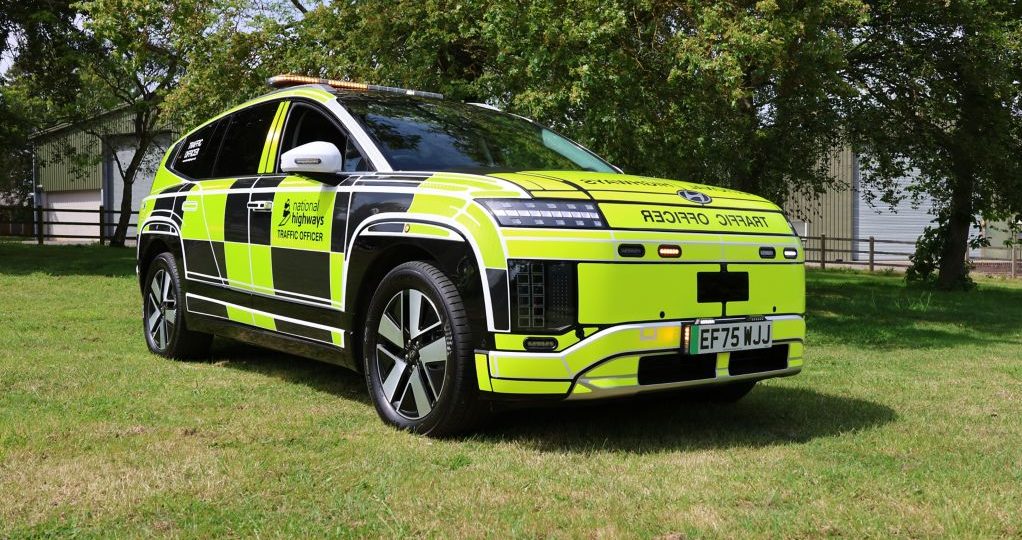
National Highways trials four Hyundai IONIQ 9 electric SUVs
National Highways has begun trials of four all-electric Hyundai IONIQ 9 SUVs as it assesses whether the large seven-seat EV can meet the demands of frontline Traffic Officer operations on England’s motorways and major A-roads.
The trial is part of National Highways’ continuing work to move its operational fleet towards zero-emission vehicles. The organisation has previously stated an ambition for 100% of its Traffic Officer vehicles to be electric by 2030, although the specialist requirements of the role mean that suitable vehicles must demonstrate more than simply zero-emission capability.
The four IONIQ 9s supplied by Hyundai Motor UK have been converted from standard passenger SUVs into dedicated Traffic Officer vehicles. National Highways will use the vehicles in frontline operations to assess their range, charging performance, practicality and ability to carry the equipment required when responding to incidents.
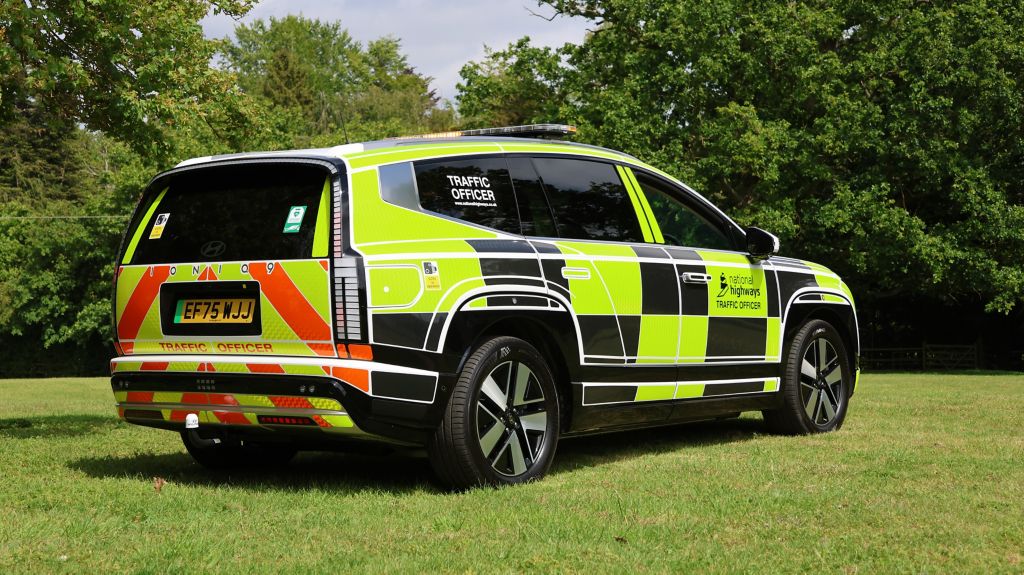
Hyundai IONIQ 9 put through operational testing
For National Highways, one of the key questions is whether an electric vehicle can provide the combination of range, load capacity and rapid charging required for a demanding operational role.
The IONIQ 9 uses a 110.3kWh battery and has a WLTP range of up to 385 miles, depending on specification. Its 800V electrical architecture is designed to support ultra-rapid charging, helping to reduce downtime when vehicles need to return to operational use.
That combination will be particularly important for Traffic Officers, who can spend long periods on the road and need their vehicles to remain available to respond to incidents. National Highways says its Traffic Officer fleet travels an average of 1.5 million miles each year, with each vehicle carrying more than 650kg of equipment.
The IONIQ 9’s flexible interior is therefore another important consideration. With the third row of seats folded, the SUV provides up to 908 litres of load space, giving officers room for operational equipment while retaining the advantages of a large passenger vehicle.
National Highways will assess how that capacity works in practice once the vehicles are fitted with the additional equipment needed for frontline duties. It will also examine whether the conversion and equipment load have a meaningful impact on the vehicle’s real-world electric range and charging requirements.
Specialist Traffic Officer conversion
The four vehicles have been converted by Richell Vehicle Conversions (RVC), which has transformed the standard IONIQ 9 into a vehicle capable of performing the specialist functions expected of a National Highways Traffic Officer vehicle.
Each SUV has been finished in National Highways livery with high-visibility decals, emergency lighting and the equipment required when officers attend incidents and assist road users.
A dedicated 240Ah lithium auxiliary battery system has also been installed. The separate battery is electrically isolated from the IONIQ 9’s main vehicle battery and is used to power the emergency warning equipment, reducing the need to draw operational power from the vehicle’s traction battery.
The warning system incorporates a lightbar, a 100W bullhorn and an array of amber and red warning LEDs. Additional lighting has been fitted to the wing mirrors, rear screen and tailgate.
RVC has also installed a flip-up Standby Traffic Commander matrix board, allowing incident and traffic information to be displayed to approaching road users.
The conversion goes beyond the emergency warning equipment. RVC has engineered a bespoke load-carrying system to accommodate the radio, Inseego telematics and CCTV equipment required by Traffic Officers.
This integration will be a significant part of the trial because National Highways needs to understand not just how an electric SUV performs as a vehicle, but how effectively it can accommodate the specialist equipment and electrical systems required for operational work.
Range and charging under scrutiny
The headline 385-mile WLTP range provides a useful benchmark, but National Highways will be particularly interested in the vehicle’s real-world performance once it is carrying its additional equipment and operating in frontline conditions.
The trial will therefore examine the practical relationship between range, duty cycles and charging. Ultra-rapid charging is an important part of the proposition, because reducing charging downtime can be as significant for fleet operations as increasing the vehicle’s maximum range.
National Highways has already been investing in charging infrastructure to support the transition. Its decarbonisation programme includes the installation of chargers at Traffic Officer outstations across England, with the organisation previously reporting 334 chargers at outstations and further work to understand the grid connections required for ultra-rapid charging.
The organisation has also previously used electric vehicle pilots to understand how different models perform in operational conditions. National Highways’ former National Fleet Manager Martin Edgecox said the purpose of its EV pilots was to learn about vehicle capabilities before changing the fleet, with feedback intended to inform future purchasing decisions.
The IONIQ 9 trial therefore provides another opportunity to gather operational data before any wider fleet decision is made.
Further IONIQ 9 purchases possible
The four vehicles are being trialled on England’s motorways and major A-roads, where Traffic Officers attend breakdowns, incidents and obstructions, manage traffic and support emergency services.
National Highways says the IONIQ 9s will be assessed for operational suitability, equipment integration and charging performance, as well as their ability to support the organisation’s frontline work while producing zero tailpipe emissions.
The results could influence future procurement. National Highways is considering further purchases of the IONIQ 9 during 2026, subject to the outcome of the trial.
The trial comes as National Highways works towards making its Traffic Officer fleet fully electric by 2030. The organisation says its vehicles need to be reliable, versatile and capable of dealing with the rigours of safety-critical work, making operational testing an important part of its electrification strategy.
Ashley Andrew, President of Hyundai & Genesis UK, said: “This trial demonstrates IONIQ 9’s capability in demanding real-world roles, combining zero-emission performance, practicality and rapid charging to support National Highways’ vital work.”
For fleet operators, the trial will provide a useful real-world test of whether a large electric SUV can combine the range, payload capacity, charging speed and specialist equipment integration required for intensive frontline operations. The findings should also help demonstrate how electric vehicles can be adapted for roles that extend well beyond conventional passenger and company-car use.