
Elektrotrucker begins first global electric truck journey in eActros 600
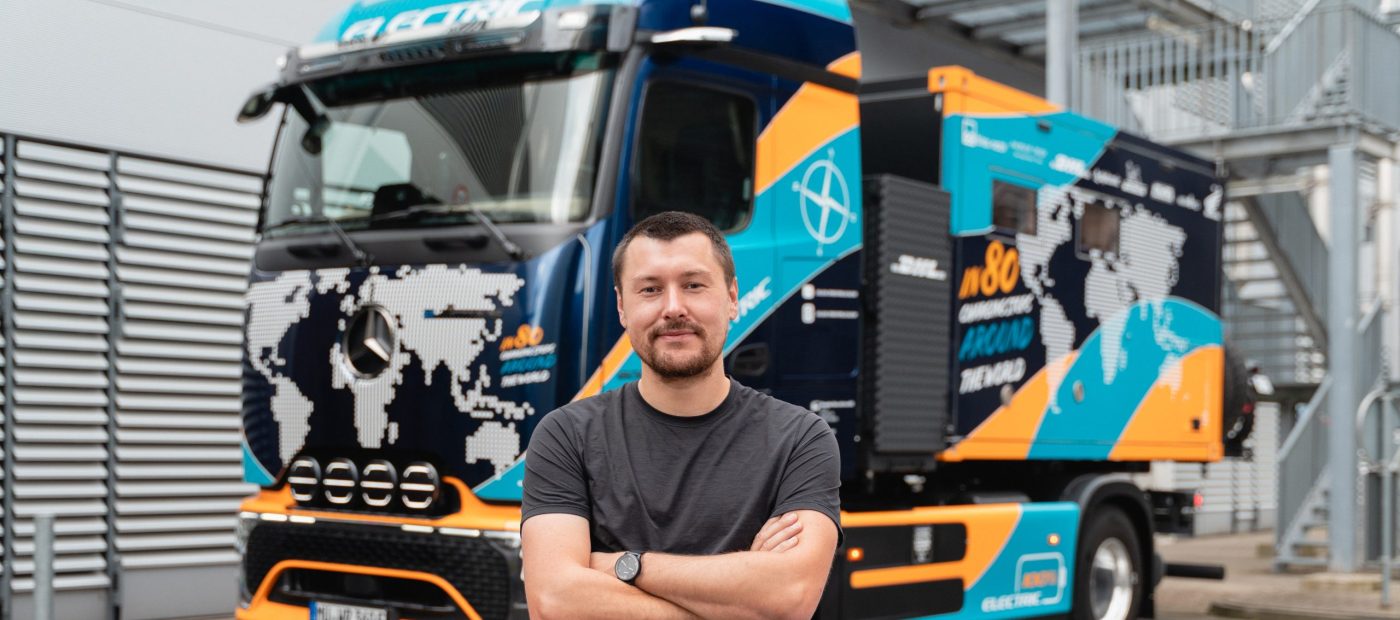
Tobias Wagner, better known as the ‘Elektrotrucker’, has set off on an ambitious round-the-world expedition that could make him the first person to circumnavigate the globe in a battery-electric long-haul truck.
Driving a Mercedes-Benz eActros 600, Wagner began his journey from IAA Transportation in Hanover on 20 September, embarking on a planned year-long expedition covering around 45,000 kilometres through approximately 30 countries.
The German truck driver and content creator aims to complete the journey with no more than 80 charging stops, putting both the capabilities of modern battery-electric trucks and the availability of charging infrastructure across multiple continents to a demanding real-world test.
Wagner has considerable experience of electric heavy transport behind him. He has driven battery-electric trucks from several manufacturers on national and international routes and has already covered around 200,000 kilometres electrically.
“I have been driving battery-electric trucks in international long-haul transport for several years and know what is already possible today,” said Wagner.
“With this round-the-world tour, I want to find out how far we really are.”
From European haulage to global expedition
The expedition is intended to be more than a record attempt. Wagner has described it as a practical test of how far battery-electric heavy goods vehicles have progressed, particularly when they move beyond the relatively developed charging infrastructure available in parts of Europe.
His planned route will take the eActros 600 through Europe before continuing into Central and East Asia. From there, the truck is expected to travel through South-East Asia to Singapore, followed by stages in Australia, North America and Latin America.
The route includes countries such as the Czech Republic, Austria, Slovakia, Hungary, Serbia, Bulgaria and Turkey before the expedition moves further east. Later stages are planned through Azerbaijan, Turkmenistan, Uzbekistan, Kyrgyzstan, Kazakhstan and China.
That variety will expose the truck to very different climates, road conditions, terrain and charging environments. It also means that Wagner cannot rely solely on the type of high-powered public charging network increasingly available to electric trucks in Europe.
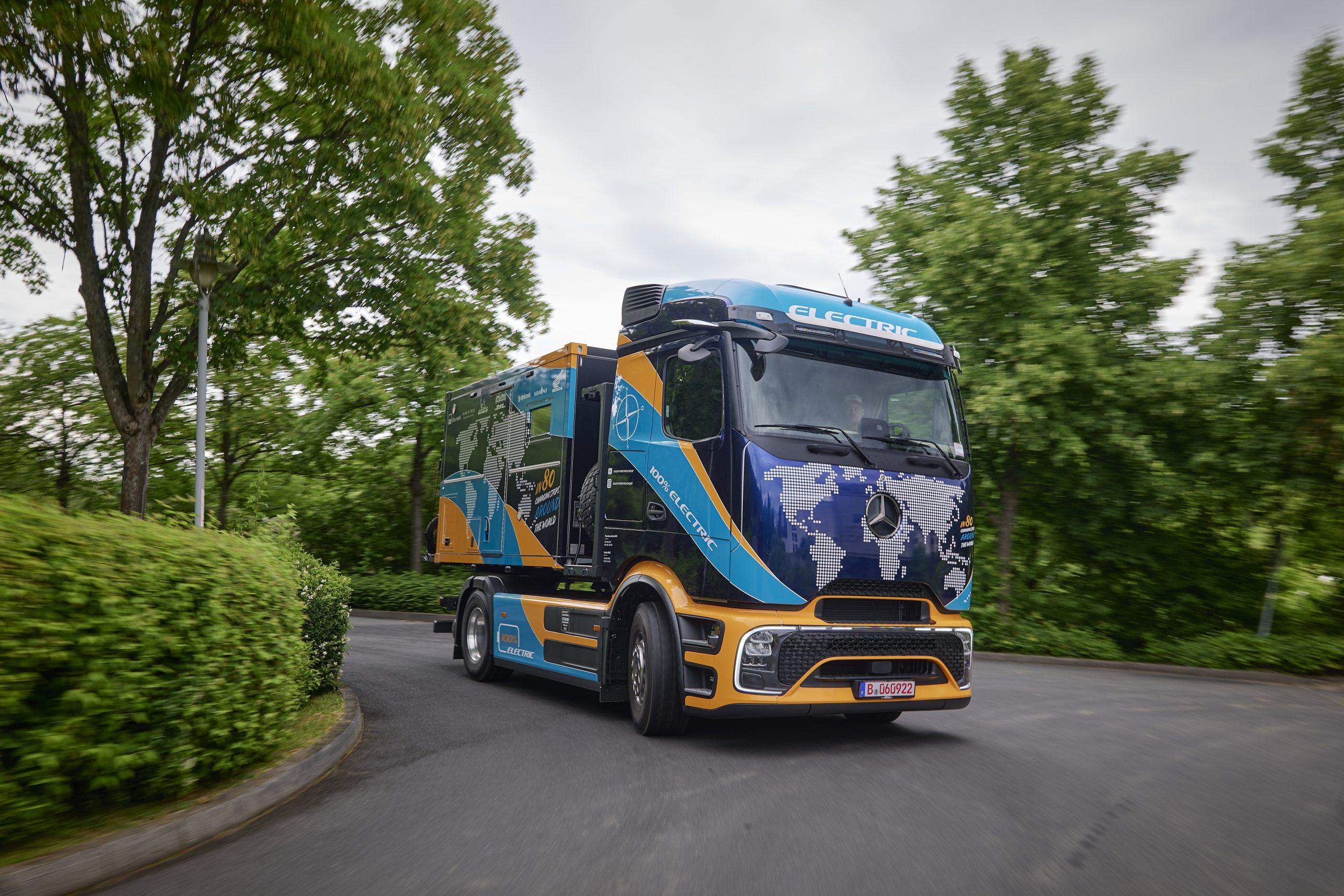
The expedition eActros 600 has therefore been adapted to provide additional flexibility. The production-based 4×2 truck has been fitted with single tyres, additional lighting and spare-wheel carriers, including a mobile charging system. A specially developed Bliss Mobil motorhome body provides accommodation and a mobile base for the expedition.
A production electric HGV at the centre
Despite its expedition modifications, the vehicle remains based on the production Mercedes-Benz eActros 600 rather than being a purpose-built experimental truck.
The eActros 600 was developed specifically for long-distance transport and uses three 207kWh lithium-iron-phosphate (LFP) battery packs, giving it an installed battery capacity of 621kWh.
Mercedes-Benz Trucks quotes a range of around 500 kilometres without intermediate charging when the truck is operating at 40 tonnes in long-haul conditions. The expedition vehicle should normally achieve a longer range because its operating weight is lower than that of a fully loaded articulated combination.
The truck can also make use of the Combined Charging System (CCS), with charging of up to 400kW. However, recognising that suitable truck charging infrastructure will not be available everywhere on the route, Wagner’s vehicle also carries an Alpitronic DC charger capable of drawing power from AC supplies at up to 43kW.
That additional capability could prove important as the expedition moves through regions where dedicated high-power electric HGV charging is still limited.
Testing the reality of electric long-haul transport
For fleet operators, perhaps the most significant aspect of Wagner’s journey will be what it reveals about the practical limitations of electric trucks outside controlled demonstration programmes.
The eActros 600 is already operating commercially in more than 15 European countries. Mercedes-Benz Trucks has also subjected the model to extensive testing, including the 15,000-kilometre European Testing Tour in 2024, which covered 22 countries, and a further 6,500-kilometre winter testing tour through northern Europe in 2025.
The global expedition presents a substantially different challenge. A European electric HGV can generally operate within a developing network of truck-compatible charging locations and established electricity infrastructure. Wagner will instead have to plan around a mixture of charging technologies and infrastructure availability while crossing some of the world’s most remote regions.
Mercedes-Benz Trucks Germany chief executive Christian Wilz said the expedition would demonstrate both the progress already made and the remaining infrastructure challenges.
“Battery-electric long-haul transport is already everyday practice in many regions of Europe today,” said Wilz. “Our customers demonstrate in daily operation that electric long-distance logistics works – provided the infrastructure is available.”
He added that Wagner’s journey would show that battery-electric long-haul transport can work worldwide while also highlighting where the necessary conditions still need to be created for wider adoption.
80 charging stops for 45,000 kilometres
The headline target of completing approximately 45,000 kilometres with no more than 80 charging stops is central to the expedition.
It represents an average of roughly 560 kilometres between charging stops across the entire planned route, although actual distances between charges will vary considerably according to terrain, weather, payload, road conditions and the availability of charging infrastructure.
Wagner has already accumulated extensive experience with electric trucks in international transport. Since 2024 he has worked as a professional driver for Nanno Janssen Spedition in Germany, a company that is progressively electrifying its fleet and has installed its own charging infrastructure.
Since summer 2025, Wagner has also driven an eActros 600, giving him direct experience of the vehicle before undertaking the global expedition.
“After countless tours through 22 countries I know: the electric truck in long-haul transport works without any problems,” Wagner said.
“To convince even the last sceptics, I am following in the footsteps of Jules Verne – however, I am not travelling in 80 days, but around the world in 80 charging stations!”
A test for the wider HGV industry
The Elektrotrucker expedition comes as truck manufacturers, operators and governments continue to investigate how battery-electric technology can be scaled into heavier and longer-distance applications.
For UK and European fleet operators, the journey could provide useful real-world evidence of the relationship between vehicle range, charging availability and route planning. It will also demonstrate how significantly infrastructure becomes part of the operating model once diesel refuelling is replaced by electricity.
Wagner intends to document the journey and share his experiences with his more than 160,000 followers, providing a running account of the truck’s performance and the practical challenges encountered along the route.
Rather than simply asking whether an electric HGV can travel around the world, the expedition is designed to explore a more important question for the transport industry: where are the practical limits of battery-electric long-haul transport today?
If Wagner succeeds, the journey will provide another high-profile demonstration of what a production-based electric HGV can achieve. Just as importantly, the charging stops, infrastructure gaps and operational challenges encountered along the way could provide valuable evidence of what needs to change before battery-electric long-haul transport can become practical on a truly global scale.