
InstaVolt calls on Government to act on EV charging signage promises
InstaVolt, the UK’s leading ultra-rapid EV charging network, is calling on the government to make good on its commitment to improve signage for electric vehicle charging sites, after a planning application designed to draw attention to the issue was rejected by the local planning authority.
The application, submitted in November 2025, proposed a non-functional advertising wind turbine at InstaVolt’s flagship Winchester Superhub. Its purpose was to highlight the ongoing failure to provide adequate roadside signage directing drivers to public charging infrastructure, which the company regards as a significant barrier slowing the wider adoption of electric vehicles.
A Flagship Site Without Adequate Signage
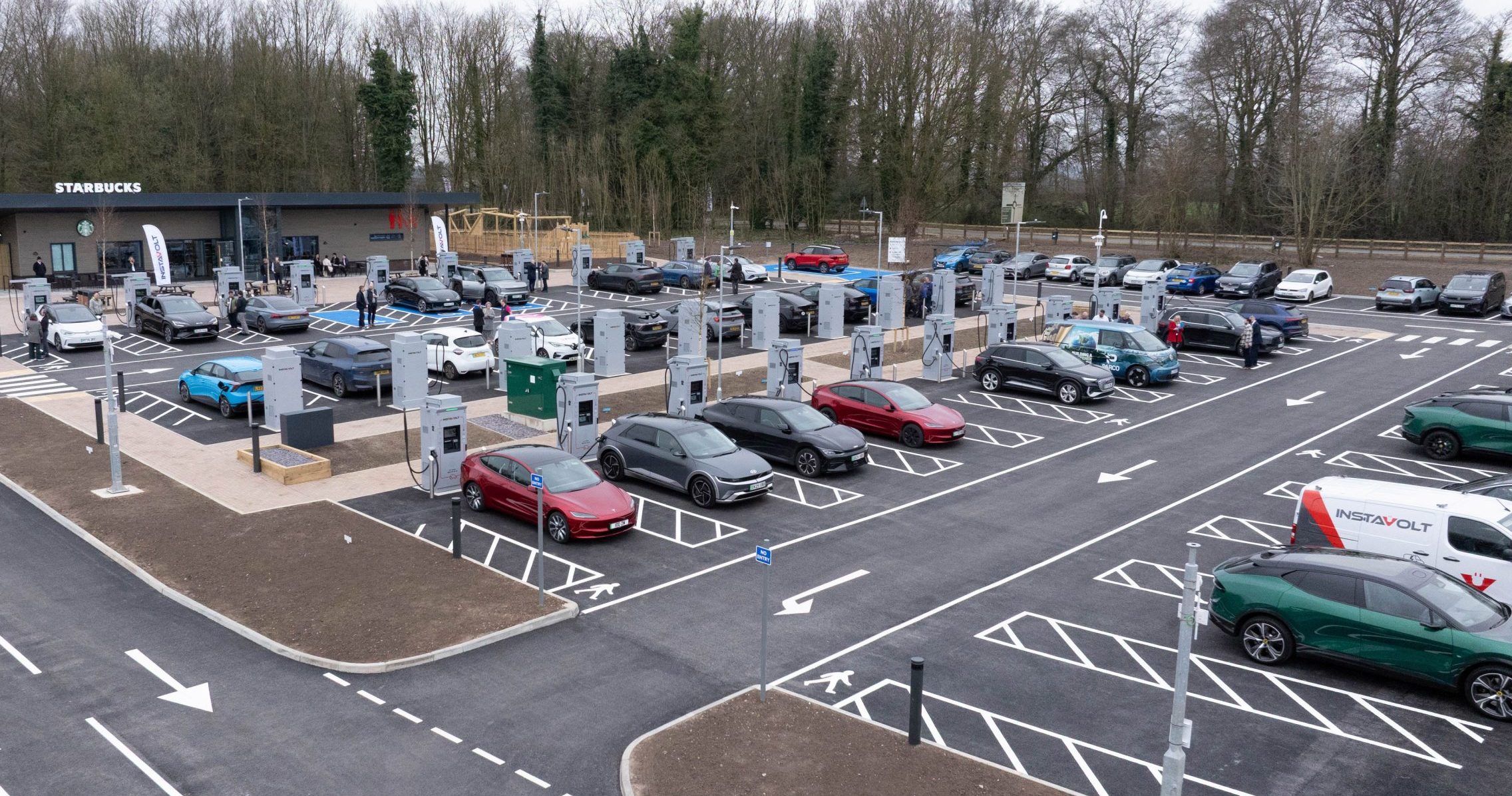
The Winchester Superhub, situated just off the A34 near the M3, is the UK’s largest single-operator ultra-rapid charging hub. It features 44 ultra-rapid chargers, an 870-panel solar array and on-site battery storage. Despite its scale and national significance, the site lacks the clear signage drivers need to find it. InstaVolt says this is far from an isolated case, and reflects a broader gap between the government’s stated ambitions for EV infrastructure and what is actually being delivered at the roadside.
The government has publicly committed to improving signage for EV charging as part of its wider strategy to support the transition to electric vehicles and meet its target of ending the sale of new petrol and diesel cars by 2030. InstaVolt believes this progress has stalled, and that the resulting uncertainty is itself slowing the EV transition, as drivers concerned about the availability of charging infrastructure remain unaware that world-class facilities already exist near them.
A Gap Between Ambition and Delivery
According to InstaVolt, the disconnect is not one of ambition but of delivery. National policy is set by central government, yet decisions on signage for individual sites rest with local highway authorities and councils, which often work to differing priorities and timescales. Without clearer coordination between Whitehall and local government, the company argues, commitments made at a national level will continue to stall before they translate into action on the ground. This is why InstaVolt is calling on government at both national and local level to act.
Delvin Lane, Chief Executive Officer of InstaVolt, said: “We’re delivering on our commitments to build critical EV infrastructure using private investment, and we need government to deliver on its promises as well. We’ve faced an ongoing battle with signage, and we know more can be done.
“We’re doing everything we can to make charging simple and convenient for drivers, but too often people still struggle to find charging locations easily. That creates unnecessary friction for drivers and risks slowing wider EV adoption.
“The government has been clear that improving signage for EV charging is a priority. A year on, we are still waiting for that to translate into action. Drivers deserve better, and the wider EV transition depends on it. We will keep making that case until something changes.”
A Network-Wide Issue
InstaVolt operates more than 3,000 chargers across 900 sites nationwide, all powered by 100% renewable energy and available on a pay-as-you-go basis with no subscription required. The company says it has faced repeated challenges securing adequate signage at sites across its network, with the issue particularly acute at larger out-of-town hubs, where drivers approaching from major roads often have limited advance notice of the facility ahead.
InstaVolt is now calling on the government to set out a clear timetable for implementing improved EV charging signage standards, and to work closely with local highway authorities to ensure that major public charging sites are properly signposted on the strategic road network. The company argues that without such coordinated action, drivers will continue to face unnecessary uncertainty in locating charging facilities, undermining confidence in the UK’s charging network at precisely the moment the government needs public support to accelerate the shift away from petrol and diesel vehicles.