


UK new car registrations rose 11.7% in July
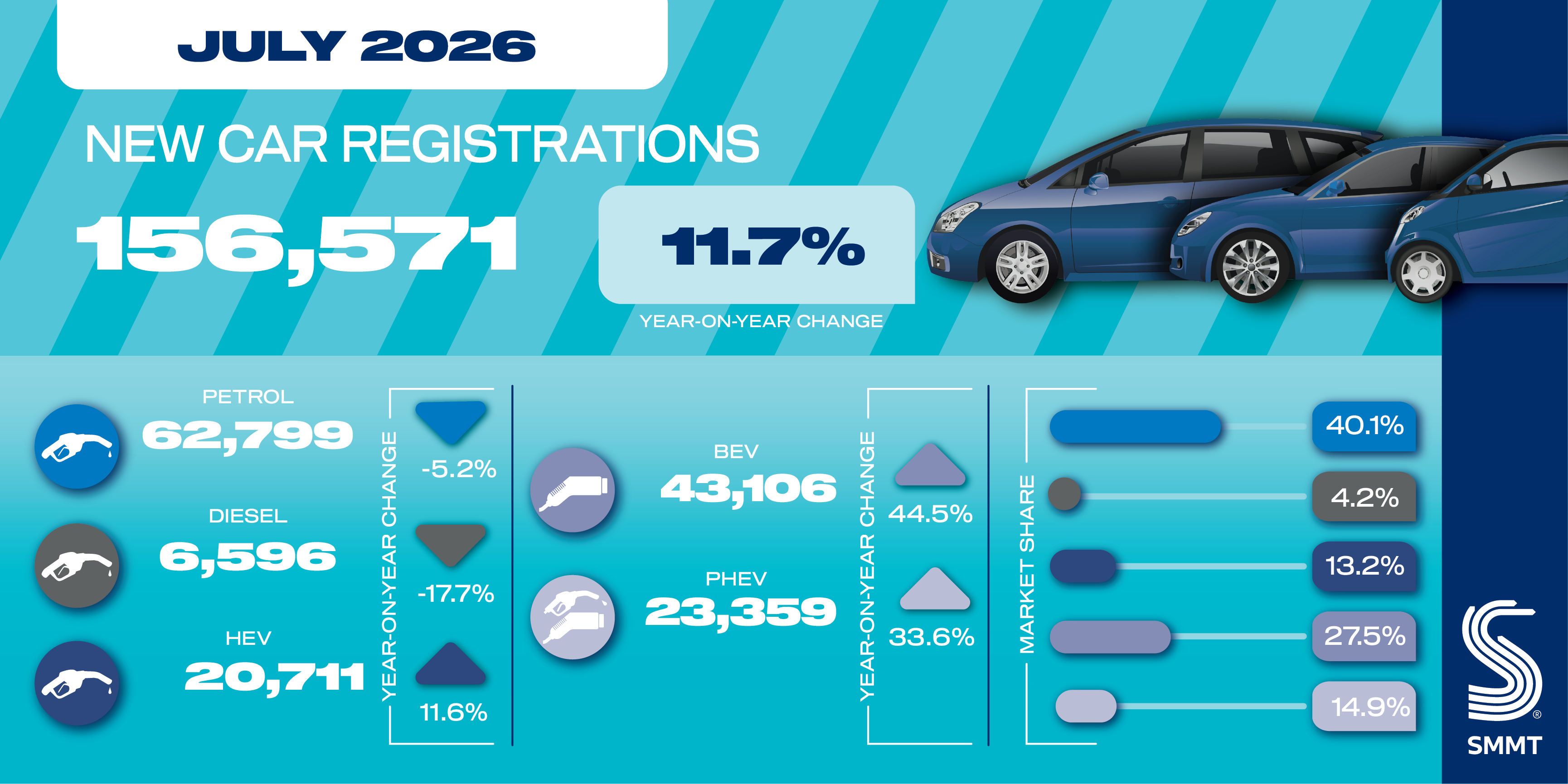
Britain’s new car market recorded its eighth consecutive month of growth in July, with car registrations rising by 11.7% to 156,571 units, according to the latest figures from the Society of Motor Manufacturers and Traders (SMMT).
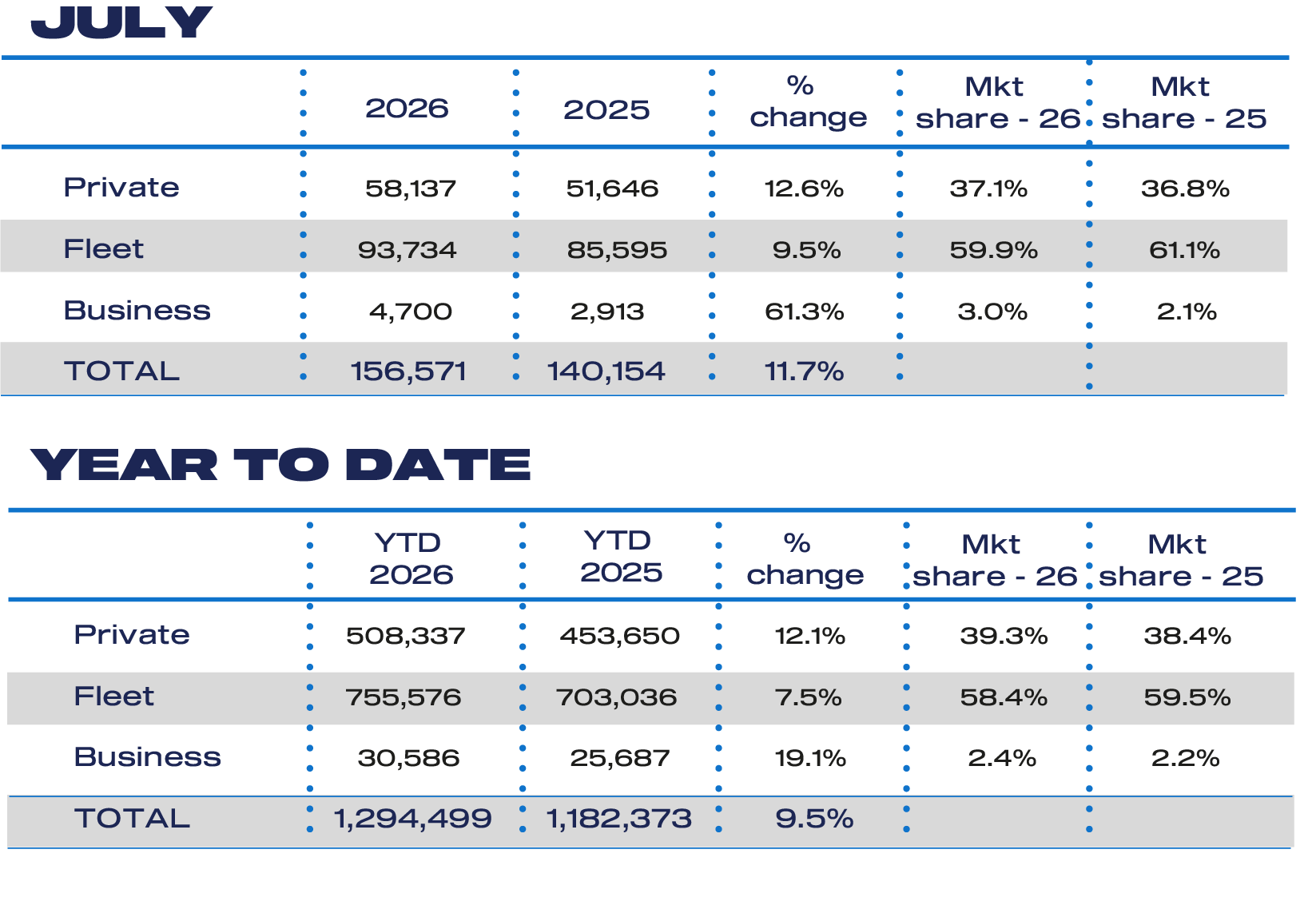
Although the increase comes against a relatively weak July 2025, it signals continued recovery towards pre-pandemic market levels. Growth was recorded across every buyer segment, with private registrations increasing by 12.6%, fleet demand rising 9.5% and accounting for almost 60% of the market, while business registrations surged by 61.3%.
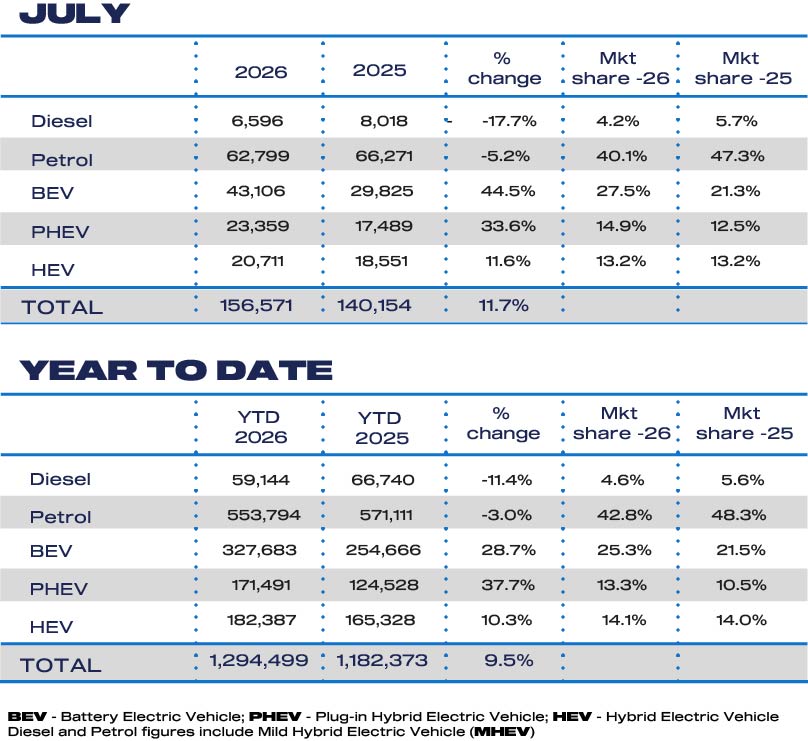
The strongest performance came from electrified vehicles. Battery electric vehicles (BEVs) achieved a record July, with registrations climbing 44.5% year-on-year to secure a 27.5% market share. Plug-in hybrid (PHEV) registrations increased by 33.6% to take a 14.9% share, while hybrid electric vehicles (HEVs) grew 11.6%, accounting for 13.2% of new registrations.
 The record BEV performance was helped by comparison with a weaker July 2025, when many buyers delayed purchases until confirmation of full model eligibility under the Government’s Electric Car Grant (ECG).
Despite the strong growth, the industry remains concerned that electric vehicle demand is still falling short of the UK’s Zero Emission Vehicle (ZEV) Mandate targets. The SMMT now forecasts BEVs will account for 27.4% of the expected 2.18 million new car registrations in 2026, an improvement on its previous forecast of 26.8% but well below the 33% market share required under the mandate. Looking ahead to 2027, BEVs are expected to reach 32.1% of registrations, still behind the 38% target.
Manufacturers continue to support sales through substantial incentives, discounts and marketing campaigns, alongside government grants. However, the SMMT warns these measures are becoming increasingly costly, placing pressure on profitability, investment decisions and employment across the automotive sector.
Mike Hawes, SMMT Chief Executive, said: “July’s record EV performance is a great achievement, reflecting industry’s huge investment in zero emission mobility. But that progress cannot be sustained if manufacturers continue haemorrhaging billions in EV discounts, distorting demand to avoid even steeper penalties. The sector’s commitment to decarbonisation is not in doubt but its ability to remain viable – and attract investment for an EV future – is under intense pressure.
“A sustainable transition will not happen merely by compelling supply when underlying demand is not keeping pace despite year-on-year growth. We need urgent reform of the regulation, else Britain risks undermining its competitiveness and the jobs and livelihoods that depend on this industry.”
Russell Olive, UK Director at vaylens, highlighted the continued importance of the fleet sector.
“Britain’s new-car market still leans heavily on fleet demand. Fleets accounted for six in ten registrations in July as the overall market grew 11.7%. The 44.5% jump in battery-electric registrations looks dramatic, but it was boosted by a weak July last year. Even after a record July, BEVs accounted for 27.5% of car registrations, leaving a considerable gap to the 33% mandate target.
“Reaching that requires far greater certainty over the everyday cost of running an EV, particularly for businesses weighing up the cost of electrifying a fleet.
“Whether an employee has access to a driveway can have a major bearing on those costs. From October, the VAT gap between home and public charging will widen. This will leave businesses who rely on the public network facing higher headline prices and greater complexity around reimbursement and VAT recovery. The confirmed pay-per-mile tax will add another cost for businesses running electric cars, particularly those covering high mileages.
“Organisations with underused workplace or depot chargers could open them to neighbouring fleets at agreed rates. This would provide a more predictable alternative to the public network while helping site owners get more value from infrastructure they have already paid for.”
Jon Lawes, Managing Director at Novuna Vehicle Solutions, said: “July’s increase in EV registrations reflects the growing momentum behind electric vehicles. Competition is intensifying, drivers have more choice than ever, and new entrants are making EVs more accessible, yet the market is still being supported heavily by fleet demand and manufacturer investment rather than broad-based consumer confidence. At the same time, uncertainty around the future of the ZEV mandate risks creating hesitation across the market when manufacturers, fleets and drivers need certainty most.
“The next stage of the transition will be won or lost on running costs. The Government’s move to cut VAT on household electricity is a positive signal for drivers who can charge at home, but it also risks widening the divide with those who rely on public charging and still face a much higher cost to plug in.
“The industry doesn’t need another reset. It needs certainty. A stable and realistic ZEV framework, combined with action to make EV ownership more affordable, will be critical if electric vehicle adoption is to become truly self-sustaining. Without that, registration growth could continue to depend on heavy discounting rather than genuine consumer demand.”
Paul Hyne, Transport Commercial Director at Lloyds Banking Group, said fleet operators continue to lead the transition to electric mobility while the used EV market is becoming increasingly attractive.
“July’s figures point to a market that has continued to build through the summer, with battery electric vehicles now accounting for around a quarter of new cars sold. The pattern of demand remains familiar, with fleets doing much of the heavy lifting on volume and private buyers steadily following as more affordable models reach the market and running-cost fundamentals showing significant value in going electric.
“The shift in the affordability picture is striking. Used EVs are broadly at parity with, if not cheaper than, their petrol equivalents on price and the second-hand market grew by around a third in the first quarter alone. As more ex-fleet vehicles filter through over the rest of the year, that growing pool of well-priced used stock is what will bring more drivers into electric vehicle ownership.
“The other shift worth noting is on confidence for longer journeys. The UK’s rapid and ultra-rapid charging network has matured significantly over the last twelve months, with much better coverage on the routes that matter most – motorways, A-roads and major service areas. For families heading away this summer, the question of whether an EV can handle a long trip has been largely answered by the network itself, and that everyday experience is worth more than any amount of communication. Sustaining this momentum through the second half of 2026 will depend on continued investment in charging, policy stability from the new government and ensuring the value case stays clear for both households and fleets.”
Jamie Hamilton, automotive partner and head of electric vehicles at Deloitte, added: “A strong increase in new car registrations this month will be extremely positive news for manufacturers. The figures reflect strong consumer confidence in the automotive market, despite ongoing economic pressures.
“The massive year-on-year uptick in sales of fully electric and hybrid vehicles is a sign of the times. With Deloitte research showing that 76% of UK consumers expect higher fuel prices in the near future, we anticipate a continued shift towards electric vehicles as buyers look for more cost-effective alternatives. However, sustained growth in EV adoption will depend on addressing key challenges, including the availability of charging infrastructure and clarity around government policy on zero-emission targets.”
The latest figures underline the strength of the UK’s electric vehicle transition, but they also highlight the growing challenge facing manufacturers. While demand for EVs continues to rise, the gap between market performance and ZEV Mandate targets remains significant, reinforcing industry calls for regulatory reform and continued investment in charging infrastructure and consumer incentives.