
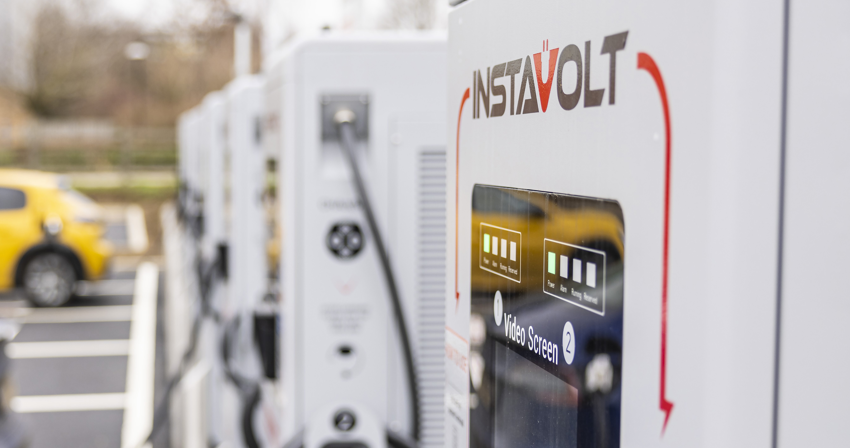
InstaVolt has announced the launch of five new battery storage system (BESS) sites as part of a major nationwide investment programme designed to strengthen the UK’s electric vehicle charging infrastructure and reduce pressure on the national grid.
The new sites, each representing an investment of around £500,000, increase InstaVolt’s total number of battery-equipped ultra-rapid charging locations to eight. The company plans to roll out at least 20 additional BESS sites before the end of 2026, with further locations already confirmed in Wisbech, Knutsford, Cheltenham, Blyth, Stockton-on-Tees, Penrith, York and Thirsk during the next financial year.
The expansion comes as EV charging operators face rising network demand charges and ongoing delays to grid connections, both of which are slowing the rollout of rapid charging infrastructure across the UK.
Delvin Lane, CEO of InstaVolt, said: “Battery storage is one of the most powerful tools we have for accelerating the switch to electric. It lets us deploy faster, manage our costs more effectively, and pass genuine savings on to drivers. Our batteries charge overnight when energy is cheaper and cleaner, and we draw on that stored power during the more expensive daytime hours. That saving goes to the consumer. When you factor in standing charges, VAT, and the full weight of infrastructure costs, passing savings on to drivers is not the easy option. It is the right one, and it is what we are committed to doing.”
By integrating battery storage on-site, InstaVolt can store cheaper off-peak electricity overnight and use that energy during busy daytime charging periods. The approach reduces exposure to peak demand tariffs while increasing the amount of power available to drivers, particularly at motorway and rural charging locations where grid capacity is often limited.
The five newly opened BESS sites are located at Hadfer Ltd at Bwch Moch Cafe, National Co-op at 311 Lower Addiscombe Road, Burney Group at Harwich 2, BNP Paribas at Northampton Williams Way and Three Trees Farm Shop and Cafe. They join existing battery-backed charging locations at Winchester and Corley North and South.
According to InstaVolt, early performance data from the Corley motorway service sites demonstrates the benefits of battery integration. Adding 230 kVA of battery capacity increased total available power to 500 kVA at each location across seven and eight chargers respectively. Since the upgrades, energy delivered per charging session has risen by 33% at Corley South and 22% at Corley North, suggesting drivers are able to charge more efficiently when higher power levels are available.
Dr Andy Palmer, CEO and Founder of Palmer Energy Technologies, said: “The grid connection problem is real and it isn’t going away quickly. What InstaVolt has understood is that you don’t have to wait for it to be solved centrally before you invest. Store cheap overnight power in batteries, draw it down during peak hours, pass the saving to the driver. That’s not complicated, it’s just disciplined infrastructure thinking. The Corley data tells you everything you need to know: a 33% increase in energy delivered per session because drivers can actually charge at the speed the hardware is capable of. That’s what good engineering looks like in practice.”
InstaVolt’s flagship Winchester Superhub is also being positioned as a model for future EV charging infrastructure. The site combines battery storage with on-site solar generation, allowing the company to purchase electricity during cheaper off-peak periods while delivering consistent charging prices for motorists throughout the day.
In March alone, the Winchester site generated 42,000 kWh of solar energy, contributing zero-cost electricity to the network. InstaVolt said 91% of energy sold at the site was delivered during peak daytime hours, despite 89% of electricity purchased from the grid being acquired overnight and stored in batteries.
The company is using the increased solar generation to support a reduced charging rate of 70p per kWh throughout the summer, with plans to expand the model across more locations as battery and renewable energy capacity increases.
InstaVolt said its strategy focuses on engineering around existing infrastructure constraints rather than waiting for policy changes or grid upgrades. While the company continues to call for faster grid connection processes and greater recognition of EV charging as critical national infrastructure, it says investment in battery-backed charging hubs remains a priority as electric vehicle adoption continues to accelerate.