
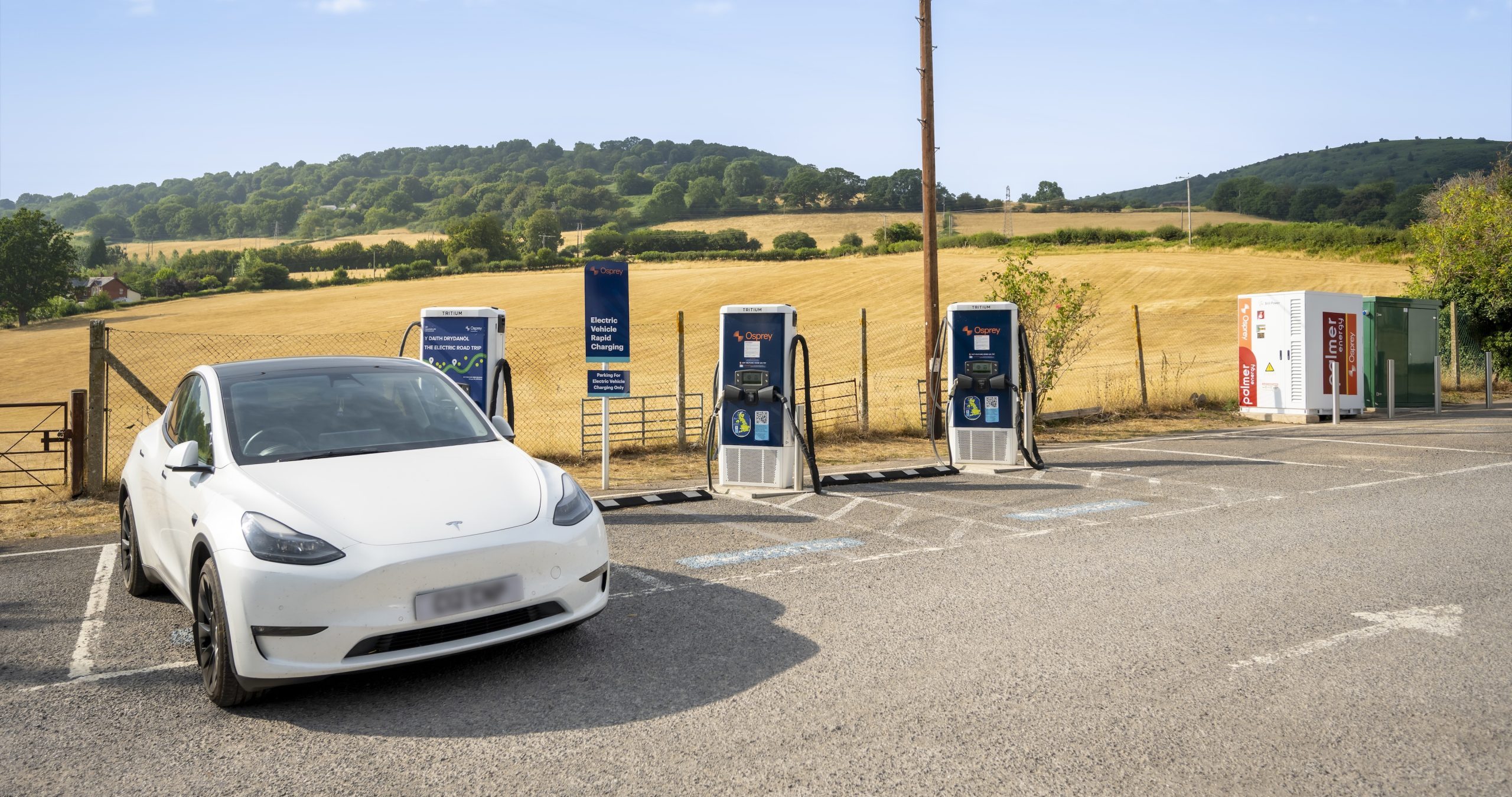
Osprey Charging Network has installed its first Battery Energy Storage System (BESS) at its Lamb & Flag rapid charging station on the A40 in Abergavenny, marking an important step in the company’s strategy to improve the efficiency and resilience of its nationwide EV charging network.
The site, which features three 75kW rapid charge points, is the first across Osprey’s estate to integrate battery storage with its charging infrastructure. The project will allow the charge point operator to assess how battery technology performs on a low-voltage grid connection at a busy charging location, with the findings helping to shape future BESS deployments across its network.
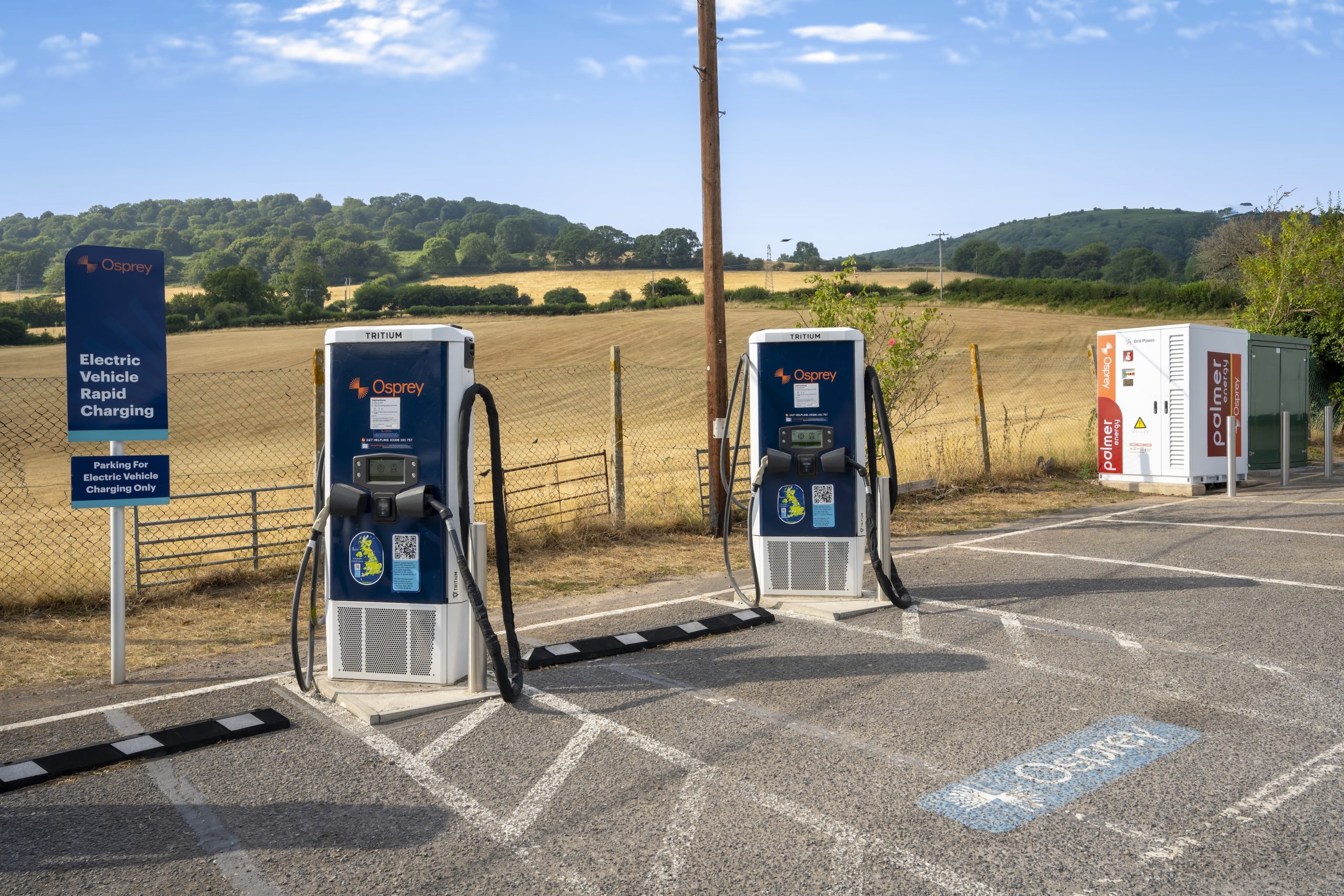
Osprey Charging Network – 17/07/2026 – Lamb & Flag, Abergavenny, NP7 7EW – Photo: Richard Blaxall / Photerior
Osprey will use its proprietary Osprey Iris software platform to monitor and analyse the battery’s performance alongside site operations. The platform will collect detailed data on energy flows, battery usage and operating costs, enabling the company to identify the locations where battery storage can deliver the greatest operational and commercial benefits.
The installation was delivered in partnership with Palmer Energy Technology, combining Osprey’s experience operating one of the UK’s largest public rapid charging networks with Palmer’s expertise in battery energy storage systems.
Marcus Lewis, Head of Development at Osprey Charging Network, said: “We know there are significant benefits to integrating battery storage with rapid EV charging, allowing us to fine tune our grid connections whilst delivering the ultra-rapid charging and market-leading Osprey experience customers expect.
“However, we want to be targeted in our deployment of BESS on the Osprey estate. This isn’t a PR stunt. Our trial sites will equip us with crucial analysis and guide the roll out to come.”
Battery Storage Addresses Rising Energy Costs
Battery Energy Storage Systems are becoming increasingly attractive for EV charging operators as they help offset the rising costs associated with maintaining large electricity grid connections. Since changes to electricity network charging arrangements were introduced in 2021 and 2022, the standing and capacity charges faced by operators of high-powered charging hubs have increased dramatically.
Industry body ChargeUK reported in 2025 that fixed network charges across public EV chargers of all power ratings had increased by an average of 462%, placing additional financial pressure on charge point operators expanding the UK’s public charging infrastructure.
By incorporating battery storage, charging providers can reduce the size of the grid connection required while continuing to deliver high-power charging during periods of peak demand.
Peter Freedman, Chief Commercial Officer at Palmer Energy Technology, said: “We’re delighted to have worked with Osprey to install their first BESS at the Lamb & Flag in Abergavenny, and support them with valuable operating data and insight to inform the installation of further battery solutions across the UK. By utilising our intelligent battery management system (BMS) and energy management system (EMS) we are able to optimise the performance of the BESS in real-time, alongside maximising usable capacity and improving system efficiency for Osprey.”
Supporting the Future of Public EV Charging
Integrating battery storage alongside EV charge points delivers several important operational advantages. Batteries can supplement power drawn from the electricity grid, reducing the need for larger and more expensive grid connections while maintaining charging speeds during busy periods.
They also enable charging sites to store electricity when renewable generation is high or energy prices are lower, reducing reliance on local distribution networks during peak demand. This can improve both operating efficiency and sustainability.
Perhaps most significantly, battery storage offers a practical solution for expanding charging infrastructure in locations where grid capacity is constrained. This is particularly important for rural areas, where demand for public EV charging continues to grow but network upgrades can be costly and time-consuming.
As the UK’s EV charging network continues to expand, projects such as Osprey’s Abergavenny trial are expected to play an increasingly important role in demonstrating how battery storage can help deliver reliable, cost-effective and scalable rapid charging infrastructure.