
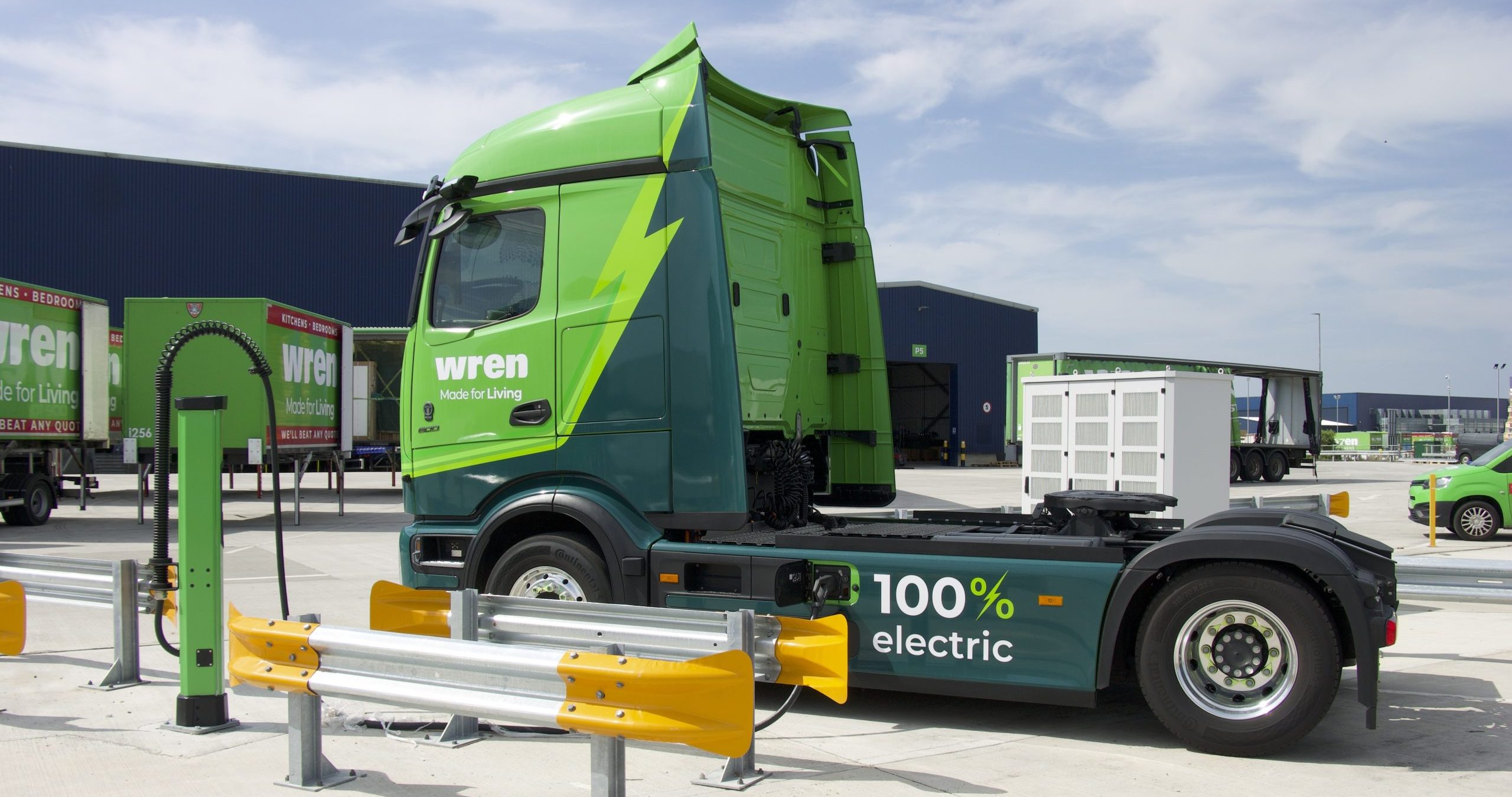
Mer Fleet Services, the specialist fleet electrification business, has completed a bespoke EV charging installation for Wren Kitchens and Bedrooms’ eHGVs at its Barton upon Humber depot in North Lincolnshire. The project supports Wren’s wider programme of initiatives aimed at achieving Net Zero by 2030, marking a significant step in the retailer’s logistics decarbonisation efforts.
The new infrastructure underpins the arrival of ten Mercedes-Benz eActros 600 eHGVs, each capable of covering up to 500km on a single charge. Their deployment across Wren’s most demanding inbound logistics routes is expected to reduce Scope 1 carbon emissions by more than 90% across its supply chain operations.
Lee Holmes, Transport and Logistics Director at Wren Kitchens, said: “The arrival of our first Mercedes-Benz eActros 600 trucks is a landmark moment in our sustainability journey. These are among the most advanced and safest heavy goods vehicles on the road today and by deploying them on our raw material routes we are removing fossil fuels from the very heart of our supply chain. Partnering with Mer was a natural fit given their expertise and they’ve played a key role in helping us deliver the infrastructure needed to support the arrival of the new eHGVs.”
A Distributed Charging Architecture
At the heart of Wren’s new infrastructure is a triple Kempower Power Unit, which powers six individual satellite chargers. The system relies on a distributed power architecture that dynamically shares available power between vehicles, optimising Wren’s ability to recharge its eHGVs between shifts whilst also enabling rapid top-up sessions during operations. This flexibility is particularly important for a depot running demanding logistics schedules, where downtime for charging needs to be kept to an absolute minimum.
Central to Mer’s approach was prioritising operational efficiency for Wren, rather than positioning infrastructure wherever installation proved most straightforward. Mer’s final design placed the chargers at the most practical point within the depot for the fleet itself, with the satellite chargers specifically aligned to the HGVs’ charge port position in the bay. This allows vehicles to charge with a trailer still attached, removing a significant point of friction from daily operations.
Engineering Around the Customer’s Operation

Dan Robinson
Dan Robinson, Strategic Sales Manager at Mer Fleet Services, said: “This installation reflects how Mer approaches every fleet project. We make the infrastructure work around the customer’s operation, not the other way around. In total we laid nearly 2km of cabling to get the chargers in exactly the right place for Wren’s eHGVs, which made the project more complex, but ultimately delivered exactly what Wren needed. This is what a long-term partnership looks like in practice. It has been a pleasure to work with the Wren team on this project.”
The scale of cabling involved underlines the complexity of the project, with Mer choosing a more demanding installation route in order to deliver a layout that genuinely suited Wren’s day-to-day operations rather than simply meeting the minimum technical requirement.
A Bespoke Finish
Beyond the technical specification, the chargers have been finished with a bespoke wrap in Wren Kitchens’ signature green, featuring the brand’s distinctive bird motif. The finishing touch ensures the new infrastructure reflects Wren’s identity throughout the depot, turning a piece of operational equipment into a visible extension of the brand.
The Barton upon Humber installation represents a significant milestone in Wren’s electrification journey and demonstrates the kind of tailored, operationally-led approach increasingly expected by fleet operators transitioning to electric HGVs. As more retailers and logistics businesses look to decarbonise their supply chains ahead of 2030 targets, projects of this scale and complexity are likely to become an increasingly common feature of the UK’s fleet electrification landscape.