
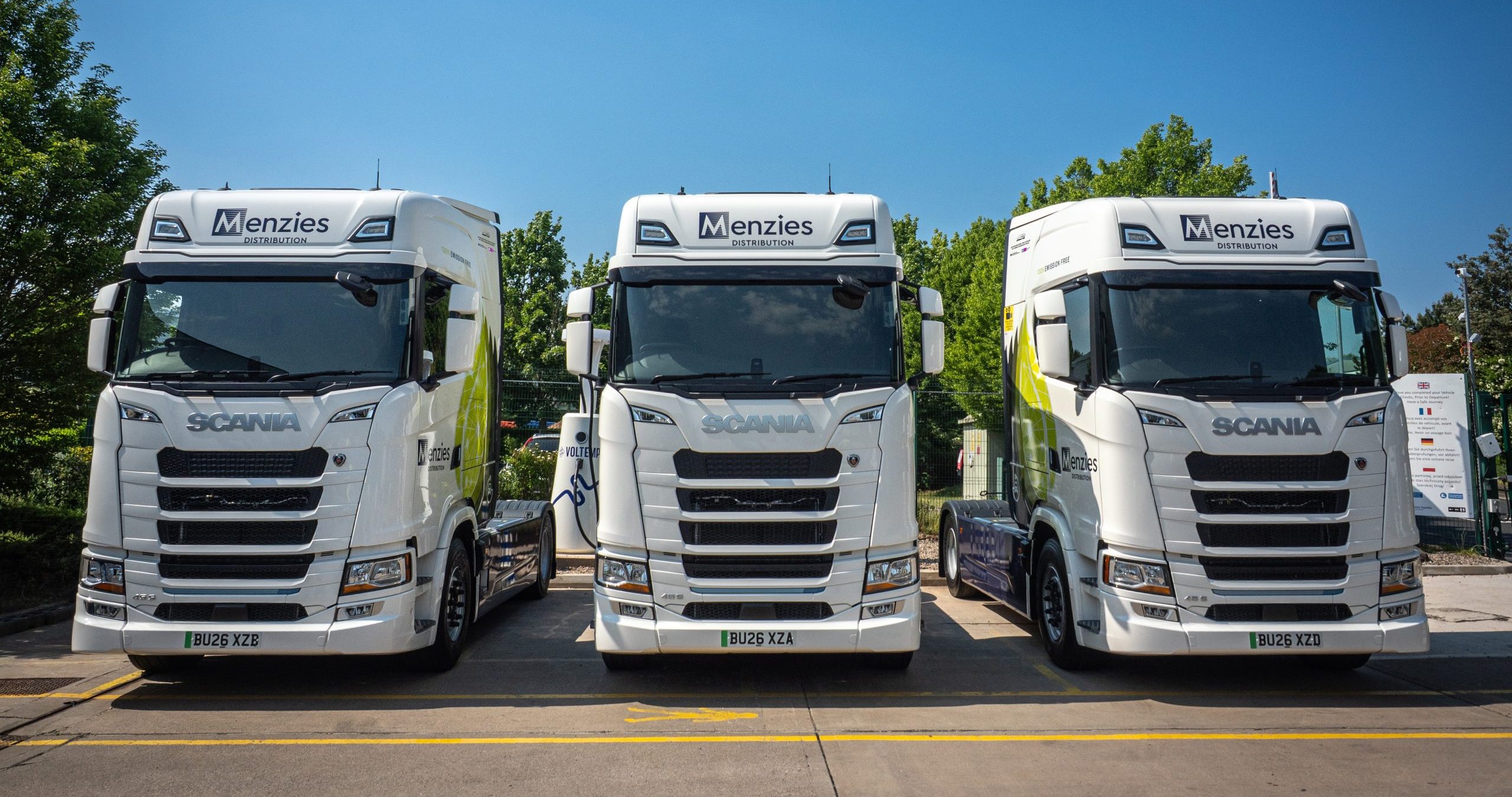
Menzies Distribution Solutions (MDS) has marked a major milestone in its fleet decarbonisation strategy by introducing its first battery-electric heavy goods vehicles (HGVs) into live commercial operation. The company has deployed three 42-tonne Scania electric tractor units through the eFREIGHT 2030 programme, forming the first phase of a wider rollout supported by the UK Government’s Zero Emission HGV and Infrastructure Demonstrator (ZEHID) programme.
The new vehicles are the first of 10 battery-electric HGVs that MDS will introduce as part of the government-backed initiative, which is designed to accelerate the adoption of zero-emission freight transport while generating valuable operational data for the UK logistics sector.
Although MDS has previously trialled electric vehicles and already operates trucks powered by alternative fuels such as Bio-CNG and HVO, these Scania tractor units are the first fully electric HGVs to become a permanent part of the company’s fleet.
Adam Purshall, Fleet, Program and Systems Director at MDS, said: “This is the next significant step in our decarbonisation strategy. We have been exploring alternative fuels such as Bio-CNG and HVO for some time, but these are the first battery-electric vehicles to join our fleet and represent our first major move towards electrification.
“We have been actively involved in eFREIGHT 2030 since joining the consortium around two years ago and seeing our first vehicles enter live operation is an important milestone. It enables us to build on the work already undertaken through the project by gathering real-world operational data and driver feedback that will help shape our future fleet decisions.”
Electric Scania HGVs Begin Double-Shift Operations
The three Scania 4×2 45S high-roof battery-electric tractor units combine the manufacturer’s S-series sleeper cab with a 450kW electric drivetrain and are based at MDS’s multi-user distribution centre in Wakefield.
Initially supporting retail and FMCG customers, the electric trucks will transport predominantly lightweight loads, including packaging, on local and regional delivery routes. To maximise utilisation, the vehicles will operate across both day and night shifts, covering approximately 250 miles per shift before returning to base for recharging.
To support the rollout, MDS has invested in on-site charging infrastructure capable of delivering 1MW megawatt charging, allowing each vehicle to recharge twice within every 24-hour operating cycle.
As project lead for eFREIGHT 2030 and charging infrastructure partner, Voltempo has worked closely with MDS throughout the planning and installation process.
Purshall said: “Voltempo has helped us navigate a complex process, bringing specialist expertise around the technical requirements, grid connection and engagement with the Distribution Network Operator. Its team has been knowledgeable, responsive and collaborative throughout.”
He added: “The new trucks will initially support local and regional deliveries from Wakefield, but over time we plan to move them between operations, assess a range of use cases and understand how far we can push the technology in live operations.”
Multi-Manufacturer Trial Will Shape Future Fleet Decisions
The Scania vehicles represent just part of MDS’s wider electric HGV programme. Through eFREIGHT 2030, the company will deploy a total of 10 battery-electric trucks supplied by Scania, DAF and Renault Trucks.
By operating vehicles from multiple manufacturers, MDS aims to compare vehicle performance, efficiency, reliability and support services across different operating environments.
Purshall explained: “Our decision to take vehicles from three manufacturers was very deliberate. We want to understand how they perform across different routes and duty cycles and generate the operational evidence needed to make informed decisions about future orders and the role battery-electric trucks can play within our fleet.”
He also highlighted the importance of government support in bringing the project forward.
“The funding has allowed us to make decisions that we might not otherwise have made at this stage,” he said.
Operational data collected through the vehicles’ telematics systems will monitor mileage, energy consumption and duty cycles before being shared with eFREIGHT 2030 and ZEHID technical evaluator WSP. The anonymised information will contribute to a wider evidence base assessing the performance of battery-electric HGVs across UK freight operations.
Scania Supports Successful Electric HGV Rollout
Scania worked alongside MDS throughout the project, helping specify vehicles suited to the operator’s routes, shift patterns and operational requirements while also providing driver training and aftersales support.
Nick Clarke, Direct Sales Manager at Scania UK, commented: “It has been a pleasure collaborating with the team at MDS throughout this project, and we’re proud to support them as they continue to adopt sustainable transport solutions from Scania.
“There has been an immense amount of work taking place behind the scenes to make partnerships like this successful for everyone involved, and I’m excited to see how these new vehicles perform as they become an integral part of the wider MDS fleet.”
Following comprehensive driver familiarisation and vehicle handovers, MDS allocated a dedicated team of drivers to operate the electric trucks.
Purshall said: “The drivers have been really positive, engaged and keen to understand the technology. They want to be part of the transition and share that experience with their colleagues.”
Building the Business Case for Electric Freight
MDS intends to use the operational experience gained through eFREIGHT 2030 to guide future investment in zero-emission freight transport and identify where battery-electric HGVs can deliver commercial value across its network.
Purshall said: “Success for us means generating enough evidence to make the right business decisions and support further investment in battery-electric vehicles.
“This project is an important part of building a credible fleet decarbonisation roadmap. As the technology and infrastructure develop, the data we gather will help us understand exactly where electric trucks can work for our business.”
Simon Smith, CEO of Voltempo, added: “MDS’s first battery-electric HGV deployment is an important milestone for the business and for eFREIGHT 2030. Operating these trucks intensively across day-to-day transport operations will generate valuable evidence about where electric HGVs can work most effectively.
“By testing vehicles from three manufacturers, MDS will also provide important comparative insights that can support future fleet investment and help accelerate the wider transition to zero-emission road freight.”
Dr Isabella Panovic, Programme Manager at Innovate UK, said: “Menzies Distribution Solutions has been a valued and proactive partner within the eFREIGHT 2030 consortium, helping to drive forward the transition to zero-emission road freight. The deployment of its first battery-electric HGVs into live commercial operation marks an important milestone, not only for the business’s decarbonisation journey, but for the wider ZEHID programme.
“As these vehicles begin operating in real-world logistics environments, they will generate vital operational insights that help build the evidence base needed to accelerate the adoption of zero-emission HGVs across the UK. Together with Menzies’ three ZEHID-supported depot sites coming online this year, this deployment highlights the scale of ambition and collaboration required to deliver a cleaner, more sustainable freight sector.”
Led by Voltempo, the eFREIGHT 2030 consortium is one of three projects funded through the Department for Transport’s Zero Emission HGV and Infrastructure Demonstrator programme, delivered in partnership with Innovate UK. Across the programme, 88 battery-electric HGVs will be introduced alongside charging infrastructure at 36 sites, including 25 megawatt-scale charging hubs, helping build the evidence needed to support the UK’s transition to zero-emission road freight.