
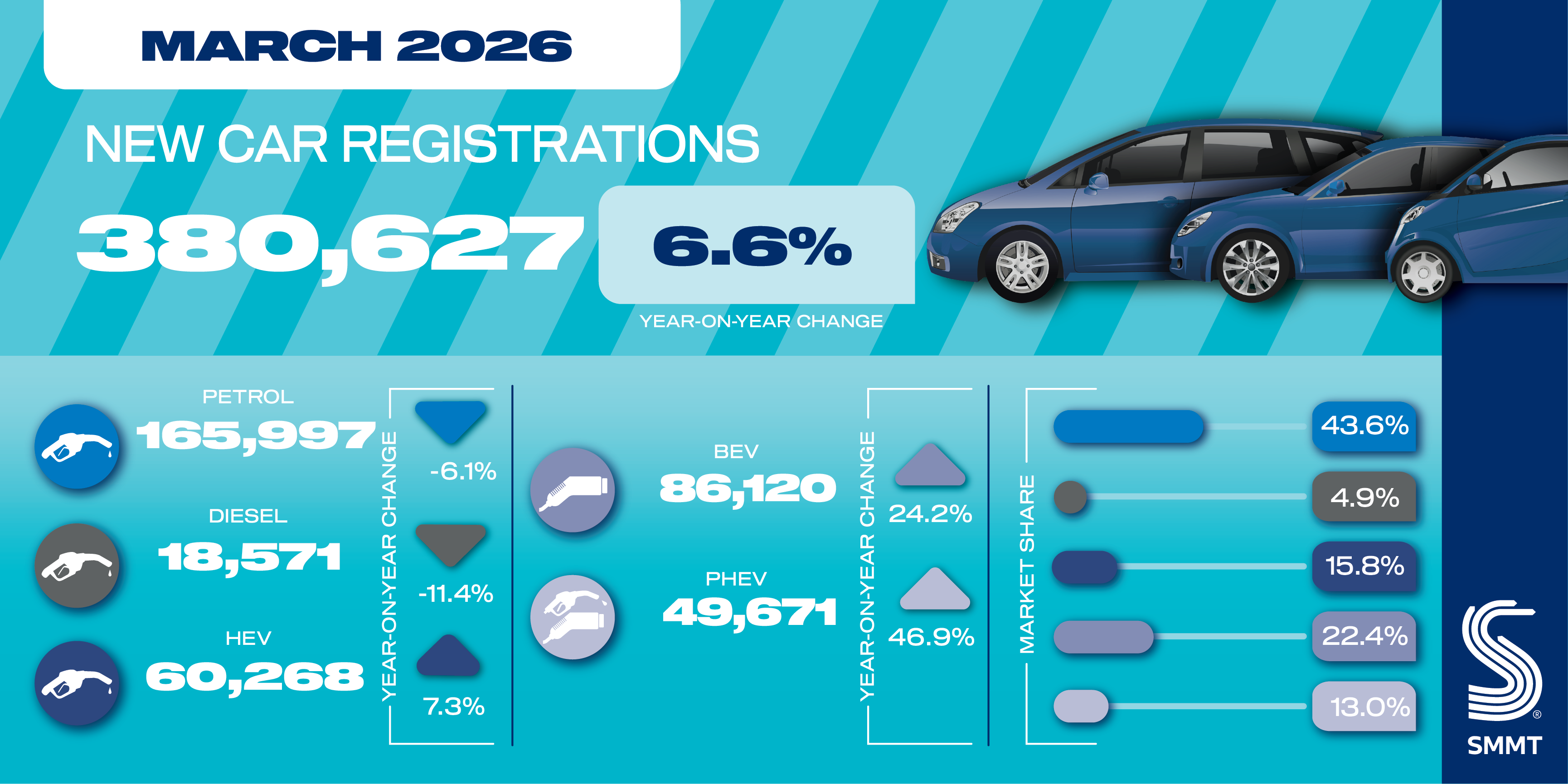
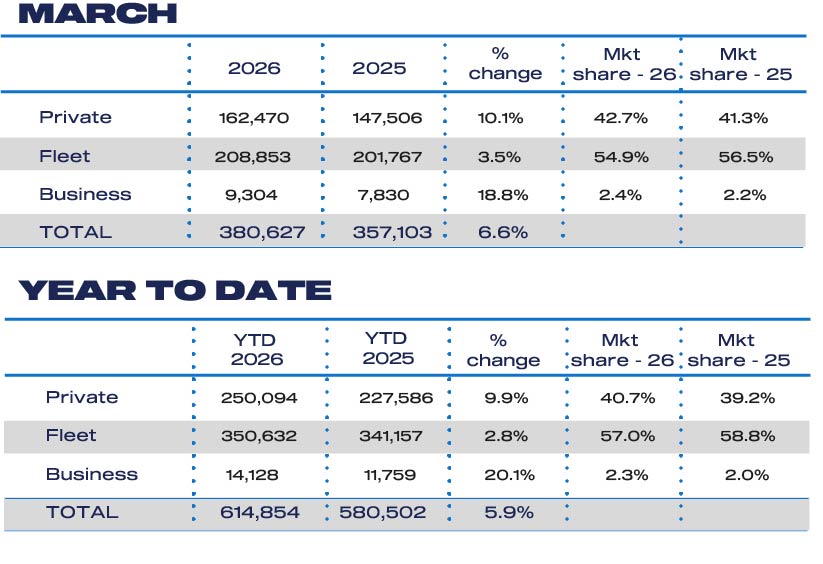
The UK new car market recorded a 6.6% increase in March, with 380,627 vehicles registered, according to the latest data from the Society of Motor Manufacturers and Traders (SMMT). The figures mark the strongest March performance—and the best overall monthly total—since 2019.
Private Demand Drives Market Growth
Growth was largely fuelled by private buyers, with retail registrations rising by 10.1% to 162,470 units. Fleet registrations also saw an uplift, increasing 3.5% to 208,853 units, while the smaller business segment recorded the highest percentage growth, up 18.8% to 9,304 units.
This broad-based growth highlights improving confidence across multiple buyer groups, reinforcing March’s status as a crucial month for the UK automotive sector.
 Record Month for Electric and Hybrid Vehicles
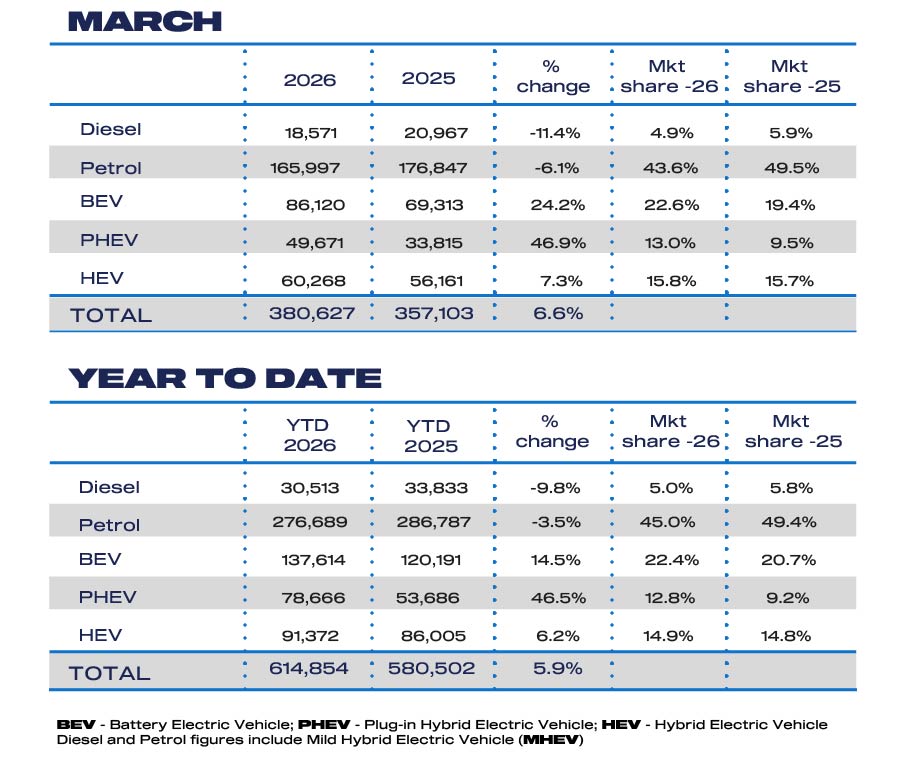
March also delivered a record-breaking performance for electrified vehicles, which accounted for 196,059 registrations overall. This milestone reflects continued manufacturer investment in low-emission technologies and the ongoing shift towards road transport decarbonisation.
Plug-in hybrid electric vehicles (PHEVs) saw the strongest growth, rising 46.9% to secure a 13.0% market share. Hybrid electric vehicles (HEVs) also performed well, increasing 7.3% to represent 15.8% of the market.
Battery electric vehicles (BEVs) reached a new high, climbing 24.2% to 86,120 registrations. However, despite this record volume, BEVs accounted for just 22.6% of the market in March and 22.4% year-to-date—significantly below the 33% target set under the UK’s Zero Emission Vehicle Mandate for 2026.
 Rising Costs and Market Pressures
While EV adoption continues to grow, the market is facing increasing economic pressures that were not anticipated when current regulatory targets were established. Battery costs at the start of 2026 were more than 30% higher than expected, while industrial energy prices remain around 80% above 2021 levels. Public charging costs have also surged, now more than 140% higher than five years ago.
Geopolitical uncertainty, including the ongoing Iran crisis, adds further complexity. While such events could increase interest in electric vehicles, they also risk driving up energy and supply chain costs, potentially weakening consumer confidence and increasing the overall cost of living.
Industry Calls for Policy Review
Despite government support measures, including the introduction of the Electric Car Grant, manufacturers continue to face significant financial pressure to meet regulatory requirements. Billions have been invested in EV development, with more than 160 models now available to UK consumers. However, in order to stimulate demand, many manufacturers are relying heavily on discounting—raising concerns about long-term sustainability.
 As a result, industry leaders are calling for an urgent review of the UK’s transition strategy. Other major global markets are already adjusting their timelines and policies to reflect evolving economic and geopolitical conditions. Without similar action, there are concerns the UK could become less competitive, potentially impacting investment, consumer choice and the overall pace of decarbonisation.
Mike Hawes, Chief Executive of the SMMT, said, “The strongest new car market since 2019, with the highest ever volume of EV registrations, is a boost to the industry and the economy. However, the headlines belie the costs incurred and the challenges involved. Much of March’s performance will be from orders placed before the start of the Iran conflict, which threatens to raise the cost of living, undermining consumer confidence. Against this backdrop, and with the EV market falling further away from mandated levels despite record levels of incentives, an urgent review of the transition is required to secure a sustainable market, economic growth and the UK’s net zero ambitions.”
Leaders from across the EV industry react to the record March registration figures:
Delvin Lane, CEO, InstaVolt: “March registration data shows petrol market share at 24.8%, down from 29.7% a year ago. BEV is at 22.7%. The gap is now just over two percentage points. That gap was ten points twelve months ago.
“This is not sentiment. It is not momentum. It is a structural shift showing up in the numbers, month after month. Petrol is losing share. Electric is taking it. The direction is not in question.
“What that requires is infrastructure that keeps pace. Drivers making that switch need to know the network is ready for them. That is the job. That is what the data is asking of us.”
Tanya Sinclair, CEO, Electric Vehicles UK: “Growth at this scale was the ambition for over a decade. It is arriving now. The response from parts of the industry has been to keep airing concerns.
“That is a choice and it has consequences. Drivers considering an electric vehicle do not need to hear that the sector is uncertain about its own future.
“Every public hesitation is a reason handed to someone to wait.
“The focus belongs on the people making the switch. Making it easier, making it reliable, making it worth it. That is how confidence is built. Not in boardrooms, but in the experience of drivers who chose electric and found it worked exactly as promised.”
John Lewis, CEO, char.gy: “March’s EV registration data is a real boost for everyone who backed the ZEV mandate. A record-breaking 22.7% year-on-year rise proves that ambitious policy works when government and industry stay the course together.
“Rising oil prices are a reminder of why this transition matters. Every electric vehicle on the road is a step towards energy security, cleaner air, and lower running costs for British drivers.
“char.gy remains fully committed to building the UK’s charging infrastructure, delivering skilled green jobs, and ensuring that every driver, in every community, has access to reliable public charging.”
James Court, Public Policy Director, Octopus Electric Vehicles: “The market is growing and we’re seeing a new wave of new drivers reacting to the petrol price crisis. Drivers are moving and the mandate is working.
“What they need now is a consistent message from industry and government. The brands gaining share are the ones getting on with it. That is the only message that matters right now.”
Outlook for the UK Automotive Market
March’s strong performance demonstrates both the resilience of the UK automotive sector and the growing role of electrification. However, the gap between policy targets and market realities remains a significant challenge.
As cost pressures persist and global uncertainty continues, the industry’s ability to balance growth, affordability and sustainability will be critical in determining the pace of the UK’s transition to zero-emission mobility.