

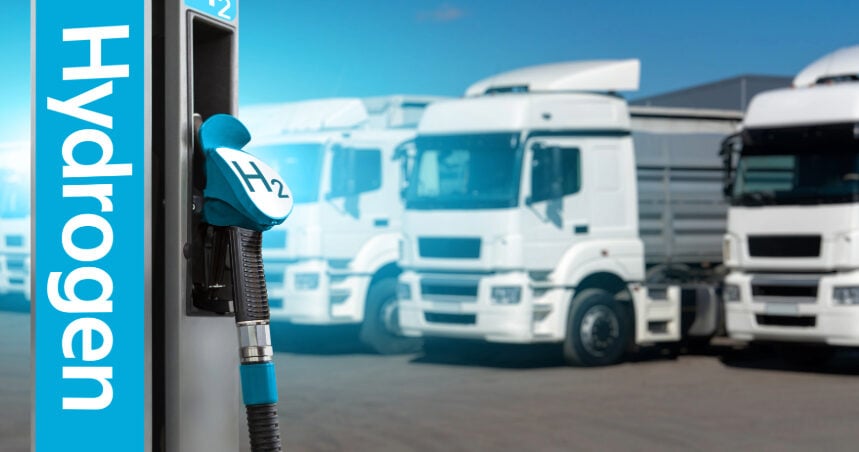
As Germany commits €220 million to expand its hydrogen trucking network, including up to 40 new hydrogen refuelling stations and around 400 hydrogen-powered HGVs, the UK risks falling behind in this critical area of transport decarbonisation.
The core issue is not technology or demand, but a lack of policy clarity and regulatory certainty.
Kristine Malok, solicitor, and Martyn Thorpe, consultant, part of the Commercial Services team at law firm, Shakespeare Martineau, share their thoughts on why the UK is struggling to make hydrogen HGV technology more commonplace.
Battery technology has dominated the conversation around clean transport, but for long-haul and heavy-duty freight, hydrogen is increasingly being viewed as a practical alternative. Batteries for large HGVs can be extremely heavy, require lengthy charging times and may not suit demanding routes or off-grid operations. Hydrogen, by contrast, offers faster refuelling and greater operational flexibility, particularly in industries where vehicles operate continuously or in remote environments. Yet despite the opportunity, the UK hydrogen fleet market remains stalled by uncertainty.
While regulations governing hydrogen storage and handling are already clearly established, the rules surrounding its use in transport fleets remain fragmented. For fleet operators considering significant investment in hydrogen-powered HGVs, that uncertainty creates hesitation. Industry experts say the problem is not necessarily a lack of appetite from operators – as many businesses already recognise the advantages that hydrogen can offer over diesel or battery-electric alternatives in specific settings – but the challenge is that operators are being asked to commit substantial capital without a clear long-term policy framework.
At present, the UK appears to be watching the market develop rather than proactively shaping it, leaving fleet operators trying to assess commercial viability without clear guidelines on future regulations or infrastructure to support the rollout of hydrogen. By comparison, Germany’s proactive approach demonstrates the success of establishing a forward-looking policy. By investing directly in infrastructure and creating certainty around deployment, it is accelerating both vehicle adoption and private investment. Naturally, German fleet operators are more prepared to invest, compared with their UK counterparts.
That uncertainty quickly translates into a commercial gap, with some fleet operators arguing that private investment would follow if government policy gave operators confidence in the growing role of hydrogen. Many would be prepared to absorb early-stage costs if there was confirmation that hydrogen infrastructure will expand and regulations will support long-term adoption.
One major obstacle is the regulatory treatment of hydrogen refuelling infrastructure, such as pumps and facilities, which is subject to complex planning, safety and permitting requirements that slow deployment and increase cost. Unlike EV charging, which benefits from a rapidly expanding national network, hydrogen infrastructure remains sparse and fragmented and, in many cases, hydrogen must still be transported directly to vehicles. Hydrogen is understandably subject to strict safety controls due to its classification as a highly flammable gas, yet the current framework could still evolve alongside technological advancements to allow it to be stored and transported safely.
There are also concerns around future hydrogen pricing as, without established infrastructure and large-scale supply, hydrogen remains expensive compared with diesel and battery-electric alternatives. Operators considering hydrogen fleets must therefore assess not only vehicle investment costs, but also whether long-term fuel supply will be commercially viable.
This is where contractual planning becomes crucial. Fleet operators that enter the hydrogen market will have to carefully structure agreements to allocate risk appropriately across the supply chain, including arrangements with hydrogen supplier vehicle manufacturers, operators and insurers. Supply agreements will need to address both price stability and the security of supply. This is particularly vital at the beginning stages of infrastructure development. Contracts also need sufficient flexibility to adapt to future regulatory change, especially given that the government will continue to develop its hydrogen strategy, with the UK’s last major policy framework being the UK Hydrogen Strategy 2021, and the Energy Act 2023. Insurance and liability provisions will also become increasingly important and questions around responsibility for storage, maintenance and operational safety must also be clearly defined within contracts.
Existing energy markets may offer a useful template, particularly the natural gas sector which provides established models for transportation, supply and risk allocation. These traditional energy suppliers may also play a larger role in operating refuelling stations and supplying fleets as adoption increases.
In the meantime, there are practical steps operators can take now. Businesses considering hydrogen adoption should begin assessing which parts of their fleet are best suited to its use, particularly routes or environments where battery-powered vehicles are less practical. Operators should also review future infrastructure availability, engage early with suppliers and build flexibility into procurement and supply contracts, covering such issues as price indexation, minimum supply obligations and remedies for interruption.
Most importantly, the sector needs policy clarity. Hydrogen is unlikely to replace every transport technology, but for heavy-duty freight it has the potential to become a critical part of the UK’s decarbonisation strategy. Without coordinated policy and investment, the UK risks ceding leadership in hydrogen freight to European markets that are already moving at pace. The technology is ready, operators are interested, and the legal frameworks can be built — what’s missing is the certainty to unlock investment.