
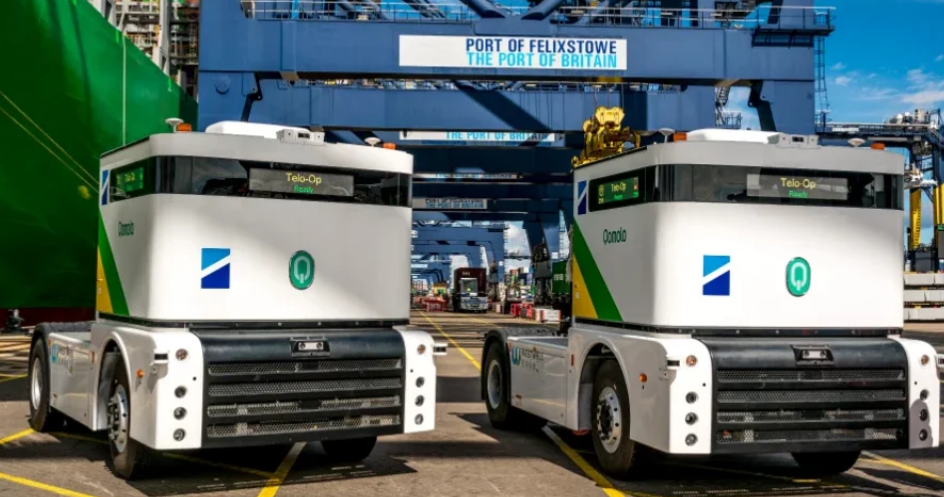
The Port of Felixstowe has strengthened its position as Europe’s leading adopter of autonomous container handling technology after placing a third order for self-driving, autonomous trucks with Westwell, taking its fleet to 100 vehicles.
The latest investment builds on the successful deployment of autonomous trucks in live mixed-traffic container terminal operations at the UK’s largest container port. The expansion underlines Felixstowe’s long-term commitment to automation, digitalisation and decarbonisation while improving operational efficiency across its terminals.
Clemence Cheng, Executive Director of Hutchison Ports and Chief Executive Officer of the Port of Felixstowe, said: “This further investment marks another important step in the Port of Felixstowe’s journey towards smarter, safer and more sustainable port operations.
“Expanding our autonomous truck fleet to 100 vehicles demonstrates our confidence in the technology and in the benefits it is already bringing to our customers, colleagues and operations. Felixstowe has led the way in deploying autonomous trucks safely at scale in a live port environment, and this latest order reinforces our commitment to innovation, operational resilience and our target of achieving Net-Zero for Scope 1 and 2 emissions by 2035.”
Kenny Tan, Founder and Chairman of Westwell, said: “This latest order marks another important milestone in our partnership and reflects the confidence Felixstowe has placed in Westwell’s technology, products and operational support.
“With 100 autonomous trucks in operation, the Port of Felixstowe is Europe’s leading port for the deployment of autonomous vehicles at scale in live terminal operations.”
Unlike autonomous lorries designed for public roads, Westwell’s battery-electric autonomous terminal trucks operate entirely within the controlled environment of the port. Their role is to transport containers efficiently between the quayside, container stacks and other operational areas without a driver on board.
The vehicles are designed to work safely alongside conventionally driven terminal equipment in a mixed-traffic environment, making Felixstowe the first port in Europe to deploy autonomous trucks at scale in live terminal operations. Their advanced perception system combines 128-line LiDAR with multiple high-definition cameras to create a detailed real-time view of the surrounding environment, allowing the vehicles to detect obstacles, navigate safely and respond to changing conditions across one of Europe’s busiest container terminals.
The new order also includes a second automated battery swapping station. Rather than waiting for batteries to recharge, the trucks automatically exchange depleted battery packs for fully charged units in around five to six minutes. This significantly increases fleet availability while reducing operational downtime.
A key enabler of the autonomous fleet is the Port of Felixstowe’s private 5G network, one of the largest industrial private 5G deployments in the UK.
The dedicated network provides secure, high-speed and ultra-reliable communications between the autonomous trucks, traffic management systems and wider terminal infrastructure. This constant low-latency connectivity allows vehicles to exchange real-time operational data, receive routing instructions and coordinate movements with cranes, conventional vehicles and other equipment across the port.
Because the network is private rather than relying on public mobile infrastructure, it offers the resilience, security and reliability needed for mission-critical industrial automation. The combination of autonomous vehicles, AI-driven control systems and private 5G connectivity enables the port to optimise traffic flow, improve safety and increase container handling efficiency while supporting its wider digital transformation programme.
The fully electric fleet also contributes to the port’s sustainability ambitions. Felixstowe has sourced electricity certified from renewable sources since April 2023, and the expanded autonomous fleet supports its goal of achieving Net-Zero Scope 1 and 2 emissions by 2035.
The wider ports industry is increasingly viewing autonomous vehicles as a practical application of artificial intelligence within controlled logistics environments. While self-driving trucks on public roads continue to face regulatory and technical hurdles, ports provide a predictable operating environment where automation can deliver measurable gains in productivity, safety and emissions reduction. Felixstowe’s expansion to 100 autonomous trucks therefore represents not only a milestone for the port itself but also a significant benchmark for smart port development across Europe.