
HM Revenue & Customs has published its latest advisory fuel rates (AFRs), with the new figures taking effect from 1 June 2026. The quarterly update is important for employers, fleet operators and company car drivers because it determines how much can be reimbursed tax-free for business mileage in company vehicles.
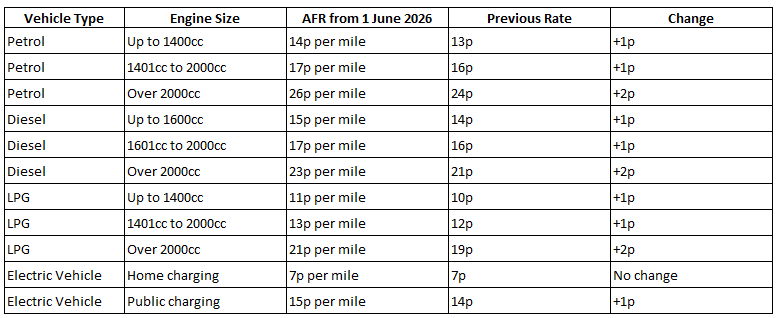
HMRC’s updated advisory fuel rates from 1 June 2026:
The latest changes reflect rising fuel and energy costs across the UK and continue HMRC’s evolving approach to electric vehicle reimbursement. Most notably, fully electric cars will continue to operate under a dual-rate system, with separate reimbursement rates depending on whether the vehicle is charged at home or via the public charging network.
From 1 June 2026, petrol company cars will see advisory rates increase across all engine sizes. Drivers of petrol vehicles up to 1400cc can claim 14p per mile, while cars between 1401cc and 2000cc rise to 17p per mile. Vehicles with engines over 2000cc increase to 26p per mile. Diesel rates also rise, with vehicles up to 1600cc moving to 15p per mile, engines between 1601cc and 2000cc increasing to 17p per mile, and vehicles above 2000cc climbing to 23p per mile.
LPG-powered company cars are also affected by the latest revision. Rates increase to 11p per mile for vehicles up to 1400cc, 13p per mile for engines between 1401cc and 2000cc, and 21p per mile for larger vehicles over 2000cc. Hybrid vehicles continue to use the equivalent petrol or diesel AFR depending on their engine type, rather than a standalone hybrid rate.
Electric vehicles remain one of the biggest talking points in the AFR system. HMRC confirmed that the advisory electric rate structure introduced in 2025 will continue, meaning there are still two separate reimbursement rates for EV drivers. From 1 June 2026, employees charging at home can claim 7p per mile, while those relying on public charging can claim 15p per mile.
The split-rate approach was originally introduced because public charging costs have risen significantly faster than domestic electricity prices. HMRC’s advisory electric rate now recognises the substantial difference between home charging and rapid public charging, particularly for fleet drivers covering long distances away from base. Industry commentators have broadly welcomed the move, arguing that a single EV reimbursement figure no longer reflected real-world charging costs.
Fleet and payroll specialists say the June 2026 update demonstrates how reimbursement policy is gradually adapting to the UK’s transition towards electrification. Driversnote noted earlier this year that the public charging rate had already risen to 15p per mile due to increasing network charging costs, while home charging remained comparatively stable.
Industry experts also point out that the AFRs are advisory rather than mandatory. Employers can pay different rates if they can demonstrate the actual fuel or electricity cost per mile is higher or lower than HMRC’s published figures. However, businesses paying above the advisory rate without evidence risk creating a taxable benefit for employees.
For employers operating mixed fleets, the latest AFR update may increase reimbursement costs during the second half of 2026, particularly for larger petrol and diesel vehicles. At the same time, the continued distinction between home and public EV charging is likely to reinforce the cost advantages of workplace and domestic charging infrastructure.
HMRC reviews advisory fuel rates every quarter, with updates typically issued on 1 March, 1 June, 1 September and 1 December. Businesses can continue using the previous rates for up to one month after the new figures come into effect.